SpaceX Flies Its 700th Falcon Rocket From the Space Coast
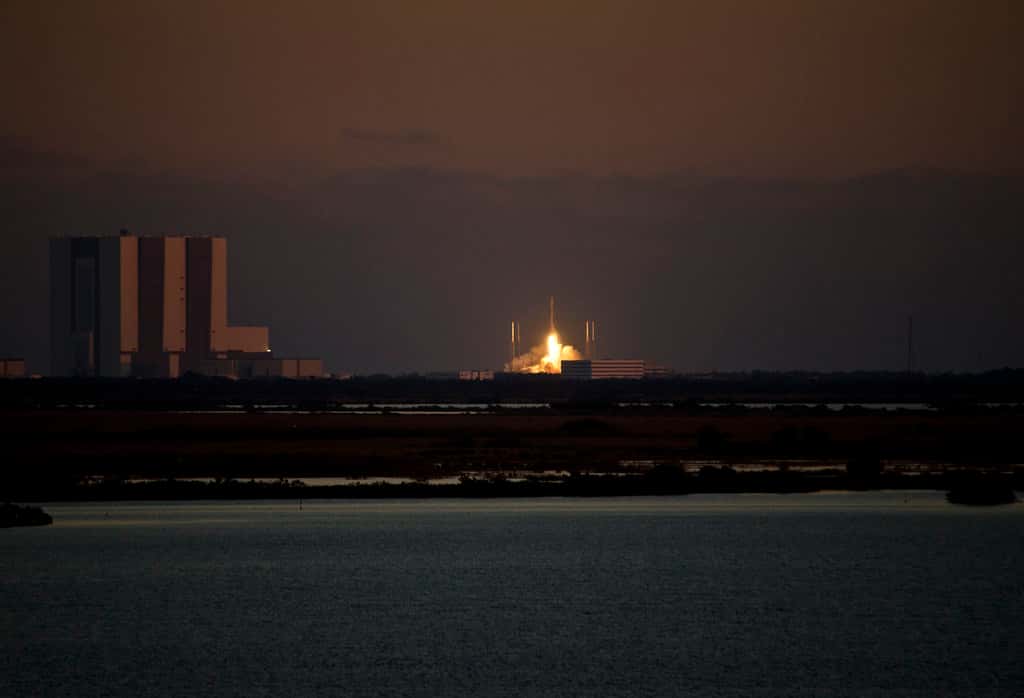
SpaceX launched the 700th Falcon rocket in the vehicle family's history on September 13, carrying the final satellites in the O3b mPOWER constellation to orbit from Florida's Space Coast. The milestone lands in a month that has already seen the company fly a classified payload for the U.S. Space Force on September 9 and its 80th Starlink mission of the year on September 5.
Seven hundred flights is a number worth sitting with. The Falcon 9 first flew in 2010. Reaching 700 launches across the Falcon family in roughly 16 years puts the vehicle in a category that previously belonged only to long-running national launch programs, and the overwhelming majority of those flights have departed from Brevard County.
The cadence has reshaped Florida's Space Coast more thoroughly than any single program since the shuttle era. Launches that were once regional events scheduled months apart now happen at a pace where residents check a schedule rather than plan around one.
What flew on the milestone mission
The September 13 flight carried the concluding satellites of the O3b mPOWER constellation, a medium-Earth-orbit communications system operated by SES. The constellation provides high-throughput connectivity to maritime, aviation, government, and enterprise customers, and medium Earth orbit gives it different latency and coverage characteristics than either geostationary satellites or low-Earth-orbit constellations.
Completing a constellation is a meaningful commercial moment rather than just another launch. It means the operator moves from deployment spending to revenue service across the full system, and it closes out a multi-launch contract that has run for several years.
For SpaceX, the mission is one entry in a manifest that mixes its own Starlink deployments with commercial customer payloads, national security missions, and NASA work. That mix is the economic engine of the business, and the reusability of Falcon boosters is what makes the cadence financially viable.
What 700 launches means for Brevard County
Florida's Space Coast, centered on Cape Canaveral Space Force Station and Kennedy Space Center in Brevard County, went through a difficult decade after the shuttle program ended in 2011. Direct employment fell sharply and the regional economy absorbed a real shock.
The recovery has been driven by commercial launch, and its character is different from the shuttle era. Launch operations themselves are less labor-intensive than shuttle processing was. The growth has come instead from volume, from vehicle manufacturing and refurbishment, from payload processing, and from the supplier and services ecosystem that has clustered around the cape.
Tourism has become a measurable component. Launch viewing draws visitors to Titusville, Cocoa Beach, and Port Canaveral, and a launch schedule dense enough that a visitor can plan a trip with reasonable confidence of seeing one changes the calculation for the local hospitality industry in a way that occasional launches never did.
Real estate has followed. Brevard County has seen sustained in-migration tied to aerospace employment, with the workforce spanning engineering, skilled trades, and operations. That has put pressure on housing supply in a county that was not building for it.
The competitive field at the cape
SpaceX is the dominant operator but not the only one. United Launch Alliance operates from Cape Canaveral with its Vulcan vehicle, Blue Origin has built substantial infrastructure in the area for its New Glenn program, and several smaller operators hold or seek launch licenses.
That competition matters for Florida because it distributes the economic base across multiple employers. A Space Coast economy dependent on a single launch provider carries the same concentration risk the region learned about when the shuttle stopped flying.
Range capacity is the emerging constraint. The Eastern Range, operated by Space Force, has to deconflict launches, manage airspace and maritime closures, and maintain safety systems, and the current cadence pushes against infrastructure designed for a slower era. Range modernization has been a sustained investment priority.
The Crew-13 delay in the background
The month's other significant Space Coast story runs in the opposite direction. NASA and SpaceX have delayed the Crew-13 mission to the International Space Station after detecting an oxidizer leak in the Dragon spacecraft's propulsion system during standard prelaunch processing.
The propellant involved is nitrogen tetroxide, the oxidizer used in Dragon's Draco thruster system. The mission had been targeted for September 12. NASA officials indicated the repair could take two to four weeks, which points toward a late September or early October launch window.
The contrast between a 700th Falcon launch and a held crew mission is a fair illustration of how the program actually works. Cargo and satellite cadence has become routine. Crew flights are held for anything anomalous, because the tolerance for risk on a mission carrying four people is categorically different.
What it means for Floridians
For Brevard County residents, launch cadence is now part of daily life, with sonic booms from returning boosters and road closures around launch windows as recurring facts. The county publishes launch schedules and residents plan around them.
For the broader Florida economy, the aerospace sector represents one of the state's more successful diversification efforts away from tourism, agriculture, and real estate. Space Florida, the state's aerospace development authority, has worked to attract manufacturing and research operations rather than launch operations alone, on the theory that manufacturing jobs are stickier.
For residents outside the Space Coast, the effect is mostly indirect: a high-wage employment sector adding to the state's tax base, and a visible Florida industry that competes internationally. Launches are also visible from a remarkable distance, and evening launches are routinely seen across Central Florida and as far as the Gulf coast.
How reusability changed the economics
Reaching 700 flights in roughly 16 years is a function of one engineering decision more than any other: recovering and reflying the first stage. Before that capability existed, every launch consumed an entire vehicle, and the cost of building a new booster for each flight set a hard floor under both price and cadence.
Recovery changed both. A booster that returns to a landing zone or a droneship can be inspected, refurbished, and flown again, with individual boosters accumulating many flights. The manufacturing rate stops being the constraint on the launch rate, which is what allows a manifest dense enough to produce multiple flights per week.
The consequences for Florida are physical as well as economic. Boosters returning to landing zones at Cape Canaveral produce sonic booms audible across Brevard County and sometimes well beyond it, which is now a routine feature of life on the Space Coast rather than a novelty. Refurbishment work happens locally, which puts skilled technical employment in the region rather than at a distant factory.
What the cadence does to the range
The Eastern Range, operated by Space Force from Patrick Space Force Base and Cape Canaveral Space Force Station, provides the tracking, safety, and airspace coordination that every launch from Florida depends on. It was built for an era of launches measured in dozens per year, not in the numbers the current manifest produces.
Each launch requires clearing airspace and maritime traffic within hazard zones, positioning safety systems, and coordinating with the Federal Aviation Administration. At low cadence that work happens between missions. At high cadence it becomes continuous, and range modernization has been a sustained federal investment priority for exactly that reason.
Autonomous flight safety systems, which allow a vehicle to terminate its own flight if it departs its corridor rather than relying on a ground-based command, have been central to the improvement. They reduce the personnel and infrastructure required per launch and shorten the turnaround between missions on the same pad.
The commercial payload market
Behind the launch count sits a satellite industry that has changed as much as the rockets. Communications constellations in low and medium Earth orbit now account for a large share of mass to orbit, and the business models behind them differ substantially from the geostationary satellite industry they are displacing.
A traditional communications satellite was a single large spacecraft costing hundreds of millions of dollars, designed to operate for 15 years from a fixed position. A constellation replaces that with many smaller satellites in lower orbits, accepting shorter individual lifespans in exchange for lower latency and the ability to upgrade the fleet incrementally.
That shift is what generates launch demand. Constellations require deployment flights to build out and replenishment flights to maintain, which converts launch from an occasional capital event into a recurring operational expense. Florida is where most of that work happens, and the satellite manufacturing and payload processing that accompanies it has been a target of state economic development effort.
What Floridians actually experience
For residents outside Brevard County, the most common encounter with the launch cadence is visual. Evening launches from the Space Coast are routinely visible from Orlando, from the Gulf coast, and on clear nights from as far as South Florida, producing a plume lit by sunlight at altitude that is frequently mistaken for something else entirely.
Booster landings back at the cape produce sonic booms that carry well inland and that generate a predictable round of calls to local law enforcement from residents who did not know a launch was scheduled. County emergency management offices publish launch schedules partly for that reason.
For anyone wanting to watch in person, viewing sites along the Indian River in Titusville, the Kennedy Space Center Visitor Complex, and beaches in Cocoa Beach and Cape Canaveral offer different vantage points. Launch times move frequently, and checking within a few hours of a scheduled attempt is the only reliable approach.
What's next
The immediate item on the Space Coast calendar is Crew-13's new launch date, which NASA has said it will announce once joint teams complete testing, data review, and any necessary rework on the Dragon spacecraft. The four-person crew includes NASA commander Jessica Watkins and pilot Luke Delaney, along with mission specialists from the Canadian Space Agency and Roscosmos.
Beyond that, SpaceX's Starlink deployment and commercial manifest continue at pace, and the competitive vehicles from United Launch Alliance and Blue Origin have their own schedules. Florida's launch count for the year is on track to exceed prior records.
Residents who want to watch can find launch schedules through Space Force range announcements and local Brevard County sources. Launch times shift frequently based on weather and technical holds, and the schedules are updated continuously.
Spotted an issue with this article?
Have something to say about this story?
Write a letter to the editor