Amendment 3 on Florida's Ballot: What the Property Tax Overhaul Would Do and Which Counties Could Lose the Most
Florida voters are deciding Tuesday whether to rewrite how homeowners pay property taxes. Amendment 3, placed on the ballot by the Legislature in a June special session, would raise the homestead exemption for non-school property taxes from $50,000 to $150,000 in 2027 and $250,000 in 2028, then index it to inflation. It needs at least 60% of the vote to become part of the Florida Constitution, and a new analysis shows the biggest dollar losses would fall on the state's largest counties while rural governments warn they would lose the largest share of their budgets.
The measure, known in the Legislature as HJR 1F, is one of three proposed constitutional amendments on every Florida ballot. Results will not be known until after polls close at 7 p.m.
What Amendment 3 would change
Today, a Florida homesteaded owner gets up to $50,000 off the home's assessed value. The first $25,000 is exempt from all property taxes, including school taxes; the next $25,000 is fully taxable; and the value between $50,000 and $75,000 is exempt from non-school taxes, according to a WKMG News 6 summary of the amendment.
Amendment 3 would replace the non-school portion with a much larger exemption for permanent Florida residents whose homestead is in place before the amendment takes effect on Jan. 1, 2027:
| Year | Non-school homestead exemption |
|---|---|
| Current law | $25,000 (on value between $50,000 and $75,000), plus $25,000 off all taxes |
| 2027 | First $150,000 of assessed value |
| 2028 | First $250,000 of assessed value |
| 2029 onward | First $250,000, indexed to inflation |
School taxes would not change. New residents would receive a more limited homestead exemption for five years before qualifying for the larger one. The amendment would also cut the annual cap on assessment increases for non-homestead property, such as rentals and commercial buildings, from 10% to 5%. It creates a process for the Legislature to let counties and cities expand the exemption further, which could eventually eliminate non-school homestead property taxes altogether, according to the Florida Phoenix. It also includes provisions on how local governments may spend property tax revenue, listing categories such as law enforcement, fire and EMS, schools, roads and stormwater, flood control, debt service and employee retirement obligations.
WSVN illustrated the effect with a City of Hollywood home assessed at around $318,000. The owner paid $1,897 in school taxes, which would not change. According to the station's breakdown, a $3,800 portion of the bill would fall to $2,400 in 2027 and $975 in 2028, and the city's share, $1,988, would drop to $502.
Which places could lose the most
Florida TaxWatch, a nonprofit research institute, estimates Amendment 3 would reduce local property taxes by $45.84 billion over the five fiscal years ending in 2032, starting at $4.93 billion in fiscal 2027-28 and climbing to $11.83 billion in 2031-32. State economists have estimated a first-year reduction of about $5 billion and as much as $12 billion a year once fully in place.
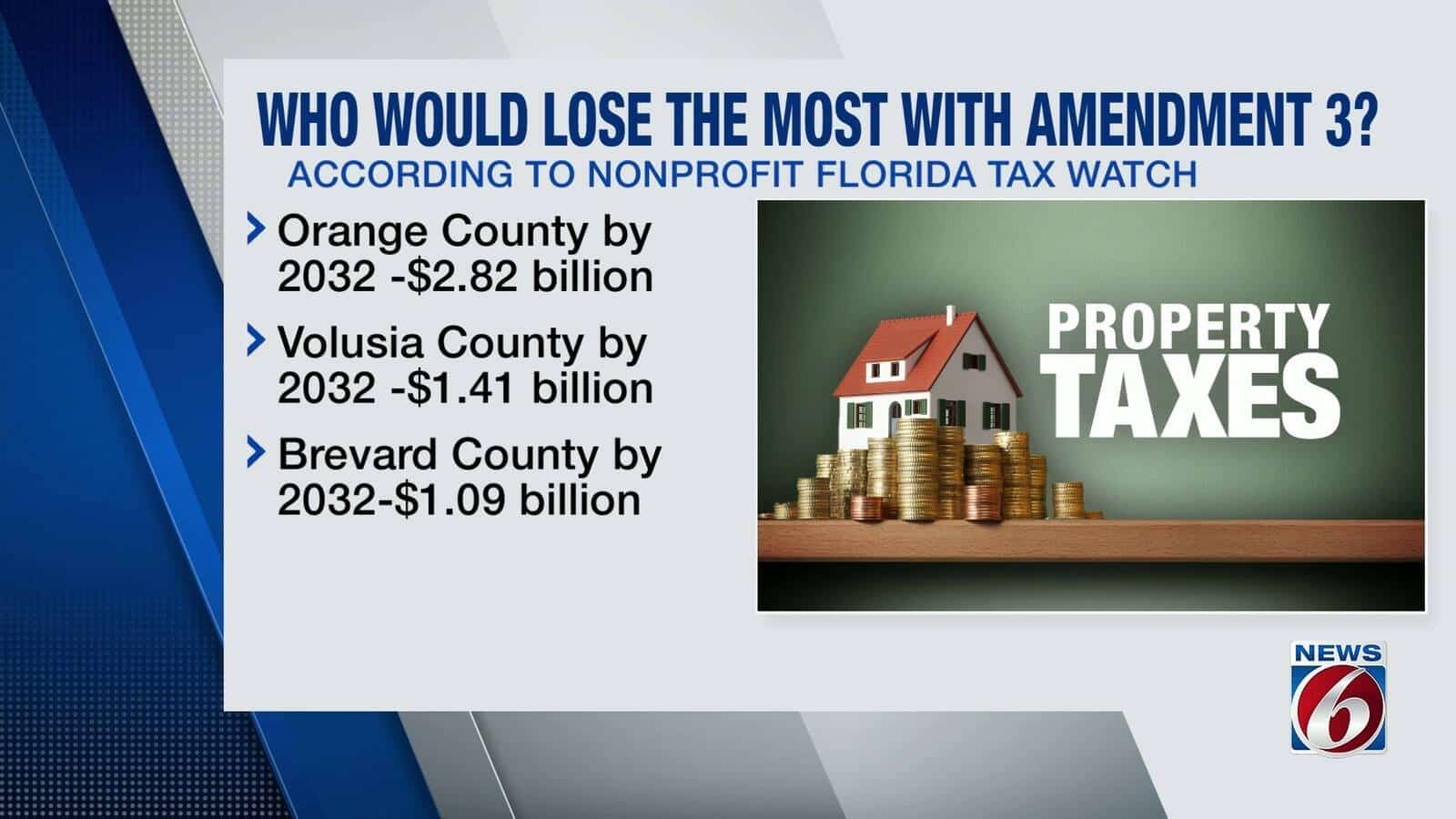
The largest counties face the biggest dollar losses. The 10 counties with the highest projected five-year totals, according to Florida TaxWatch figures published by News 6:
| County | Projected 5-year loss |
|---|---|
| Miami-Dade | $5.16 billion |
| Broward | $4.86 billion |
| Palm Beach | $4.10 billion |
| Hillsborough | $3.43 billion |
| Orange | $2.82 billion |
| Pinellas | $2.31 billion |
| Lee | $1.74 billion |
| Duval | $1.68 billion |
| Pasco | $1.43 billion |
| Volusia | $1.41 billion |
Brevard ($1.09 billion) and St. Lucie ($1.05 billion) round out the list of counties projected to lose more than $1 billion. At the other end, the smallest totals belong to rural counties such as Liberty ($4.5 million), Lafayette ($6.2 million) and Calhoun ($7.3 million), but opponents argue the dollar figures understate the strain on small places with little commercial property to fall back on.
DeSantis pushes it over the finish line
The push to cut property taxes came from Gov. Ron DeSantis, whose office designed the original proposal. The Legislature changed it, most notably by exempting school taxes from the bigger exemption, a change that irked the governor. In June, DeSantis said he did not expect to formally campaign for the amendment, though he would vote for it.
He changed course in the final weeks. On Oct. 21, DeSantis spent more than an hour at a roundtable at the Miami-Dade Sheriff's Office with local officials who backed the measure, including Sheriff Rosie Cordero-Stutz and state Rep. Alex Rizo. "I wish we could snap our fingers and say next time you go to Publix you're going to pay what you were paying back in 2019," DeSantis said. "We don't set those prices at the state level or any government level but this tax is one thing that we do control."
DeSantis has pointed to local property tax revenues that rose from $33 billion to $55.2 billion between 2019 and 2024, arguing that local budgets grew faster than population and inflation justified, and said the state could provide grants to cities and counties for needed services.
Senate president and first responders say vote no
The amendment's most prominent Republican defector is outgoing Senate President Ben Albritton of Wauchula, who voted to put it on the ballot and in June hailed the $250,000 exemption as a fitting way to mark America's 250th birthday. On Oct. 20, in a statement shared by the Florida Sheriffs Association, he said he would vote against it.
"Amendment 3 would eliminate up to 30% of resources for Florida's rural counties, gutting essential services for law enforcement, emergency response services, and critical infrastructure," Albritton said. He suggested the Florida Taxation and Budget Reform Commission, which meets in 2027, would be a better place to work out property tax changes. His predecessor, former Senate President Kathleen Passidomo of Naples, has also said she will vote no. DeSantis responded that Albritton's opposition showed support for the measure came from the grassroots rather than political elites.
The Florida Sheriffs Association, the Florida State Fraternal Order of Police and the Florida Association of Professional Firefighters oppose the amendment. In Broward County, Children's Services Council president Cindy Arenberg Seltzer told WSVN her agency, funded by property taxes, has no other revenue source. "I don't want a tax break today if it means higher fees, higher costs or reduced services tomorrow," one opponent, Merle Malcom, told the station. Supporters such as Coral Gables Mayor Vince Lago say the cut puts money back in residents' pockets, and in Orange County the measure became a point of contention in the mayor's race between Tiffany Moore Russell and Chris Messina.
The 60% hurdle
Constitutional amendments in Florida need 60% of the votes cast on the measure, not a simple majority. A University of North Florida poll released Oct. 21 found 50% of likely voters supported Amendment 3, short of that threshold. Because the change would be written into the constitution, undoing or altering it later would require another statewide vote.
What's next
If Amendment 3 reaches 60%, the first $150,000 exemption would apply to 2027 tax bills, and cities, counties and special districts would begin reworking budgets for the 2027-28 fiscal year. If it falls short, current homestead rules stay in place, and Albritton and other skeptics have pointed to the 2027 Taxation and Budget Reform Commission as the next venue for property tax reform. County results will post on supervisor of elections websites after polls close Tuesday night.
Spotted an issue with this article?
Have something to say about this story?
Write us a letterComments
No comments yet. Be the first to weigh in.
Related Coverage
Donalds and Jolly Make Final Campaign Stops as Florida Heads Into Election Day With 5.2 Million Ballots Already Cast
22h ago
Alexis Calatayud's bipartisan pitch meets Richard Lamondin's call for change in tight Senate District 38 race
1d ago
St. Petersburg Mayor Ken Welch Sues Florida Politics Publisher Peter Schorsch for Defamation Days Before Runoff With Charlie Crist
1d ago
Florida election night 2026: Poll closing times, the races to watch and how fast results come in
1d ago