Artemis III Hardware Stacks Up at Kennedy Space Center
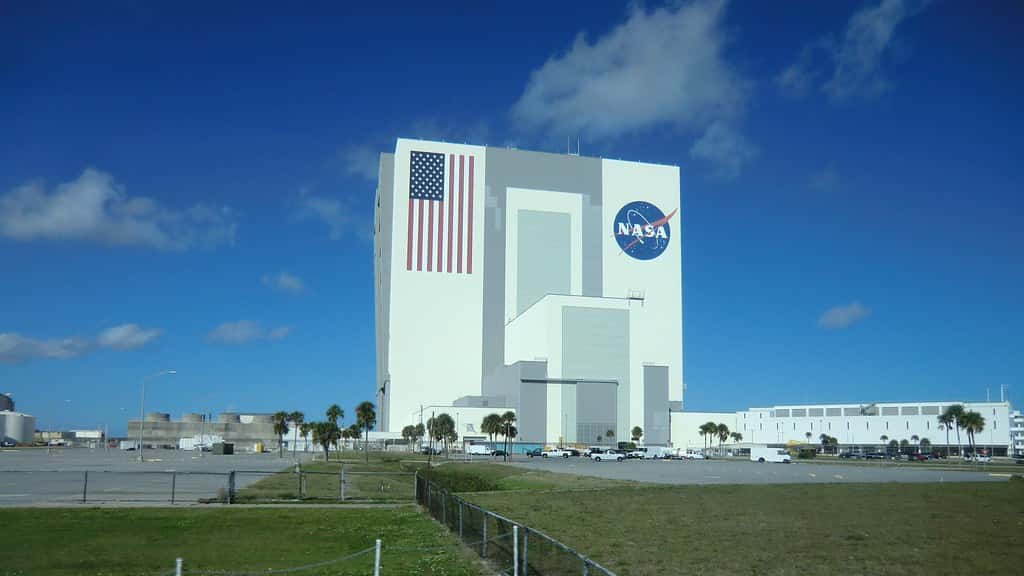
Work on the rocket meant to return astronauts to the surface of the Moon is underway on Florida's Space Coast. Teams at NASA's Kennedy Space Center began stacking the twin solid rocket booster segments for the Artemis III mission in July, with the left-hand and right-hand aft assembly segments secured to the mobile launcher inside the Vehicle Assembly Building on Saturday, July 11.
The pace is notable. Booster stacking began less than three months after the Artemis II crew returned safely from their lunar flyby. Artemis II launched from Launch Complex 39B at Kennedy on Wednesday, April 1, 2026, at 6:35 p.m. Eastern, carrying the first crew to travel beyond low Earth orbit in more than half a century.
Artemis III is the mission that attempts a crewed lunar landing. The hardware now taking shape in the Vehicle Assembly Building, a building that has been assembling launch vehicles on Florida's coast since the Apollo program, is the first physical step in that attempt.
What is being assembled
The Space Launch System rocket is stacked in a specific order, and the solid rocket boosters come first. Each booster is assembled from segments that are stacked vertically on the mobile launcher platform, beginning with the aft assemblies that contain the nozzles and thrust structure.
Those aft assemblies were secured to the mobile launcher on July 11. Additional segments will be stacked on top of them, building the boosters upward before the core stage is lifted into place between them.
Solid rocket boosters provide the majority of thrust at liftoff. Once ignited, they cannot be shut down or throttled, which makes their assembly and inspection process among the most carefully controlled operations in the launch campaign. Each joint between segments must be sealed and verified.
The Vehicle Assembly Building itself is a piece of American industrial history. Constructed for the Apollo program, it was later adapted for the Space Shuttle and has now been reconfigured for the Space Launch System. Its high bays are among the largest enclosed volumes in the world, sized to allow a fully stacked rocket to be assembled vertically and rolled out to the pad.
The Orion heat shield
In parallel with booster stacking, technicians attached the heat shield for the Artemis III Orion crew module. The shield consists of 186 blocks of an ablative material called Avcoat, which protects the capsule during atmospheric reentry.
That component carries specific history. During Artemis I, the uncrewed test flight, the Orion heat shield exhibited unexpected behavior, with material eroding differently than models predicted. NASA conducted extensive analysis and testing in response.
The Artemis III shield incorporates design upgrades intended to achieve uniformity and consistent permeability across the Avcoat blocks. Permeability governs how gases generated during ablation escape from the material, and inconsistency in that property was central to the Artemis I observations.
Reentry from a lunar trajectory is substantially more demanding than reentry from low Earth orbit. A capsule returning from the Moon enters the atmosphere at roughly 25,000 miles per hour, generating temperatures near 5,000 degrees Fahrenheit. The heat shield is the single component with no redundancy and no margin for failure.
Why this matters to Florida's Space Coast
Brevard County's economy is organized around launch. The region encompassing Titusville, Cocoa, Cocoa Beach, Merritt Island, Rockledge, Melbourne and Palm Bay depends on Kennedy Space Center, Cape Canaveral Space Force Station and the contractor and supplier network built around them.
That network includes NASA civil servants, prime contractors on the Space Launch System and Orion, launch operations personnel, engineering firms, machine shops, logistics providers and the commercial launch companies that now share the coast.
The Artemis program's continuation is therefore a direct employment question for tens of thousands of Floridians. Booster stacking for Artemis III represents sustained work following the completion of Artemis II, which is the pattern the region depends on: a continuous flight rate rather than gaps between programs.
The gap between the Space Shuttle's retirement in 2011 and the emergence of commercial crew launches was a difficult period on the Space Coast, with substantial job losses and property market effects. The current era, with NASA's Artemis program running alongside a high commercial launch cadence, is the opposite condition.
The tourism and community dimension
Launches are also an economic event in their own right. Major crewed launches draw visitors to Brevard County beaches, causeways and viewing sites, filling hotels and restaurants along the coast. The Kennedy Space Center Visitor Complex is among Florida's more heavily attended attractions.
An Artemis III launch, carrying astronauts on a mission to land on the Moon, would draw crowds on a scale the region rarely sees. Apollo-era launches brought hundreds of thousands of spectators to the Space Coast, and a return to the lunar surface would plausibly generate comparable interest.
That has infrastructure implications that Brevard County and the state have been planning around, including traffic management on the limited causeway crossings, beach access and emergency services capacity during high-attendance events.
There is a civic dimension as well. Space Coast communities have an identity built around the program, with schools, streets and businesses named for missions and astronauts. The children of the region grow up watching rockets from their yards.
Where Artemis III stands
NASA unveiled the Artemis III crew in June, and the agency has been providing mission updates as hardware processing progresses.
The Artemis III architecture is more complex than Artemis II. Where Artemis II flew a crew around the Moon and returned, Artemis III requires the Space Launch System and Orion to deliver a crew to lunar orbit, where they transfer to a separate human landing system that carries them to the surface and back. That landing system is being developed commercially.
The interdependence of those elements is the program's principal scheduling risk. The Space Launch System and Orion can be ready without the landing system being ready, and vice versa. Both have to converge.
Related systems, including next-generation spacesuits for lunar surface operations, add further dependencies.
The commercial launch industry alongside it
Artemis is the highest-profile program on the Space Coast but no longer the busiest. The commercial launch cadence from Cape Canaveral Space Force Station and Kennedy Space Center has reached a volume that would have been inconceivable a decade ago.
SpaceX operates a high-frequency Falcon 9 campaign from the Cape, and the company reached a milestone this month when it flew a Falcon booster for the 600th time on a Starlink mission. Earlier in July, it launched a booster on a record 36th flight, a reuse rate that has fundamentally changed launch economics.
United Launch Alliance and Blue Origin also operate from the Space Coast, and Space Florida works to attract additional operators and supporting infrastructure to the region.
That density creates its own operational complexity. Range scheduling, airspace and maritime closures, and pad availability all have to be coordinated among operators sharing the same coastline. For Brevard County residents, it also means launches have become routine rather than exceptional, with sonic booms from returning boosters now a regular feature of coastal life.
Why the Moon program matters beyond Florida
Artemis is a national program with an international dimension, and the arguments for it extend past the engineering.
The stated goal is a sustained presence at the Moon rather than a repeat of Apollo's brief visits, with attention focused on the lunar south pole, where permanently shadowed craters are believed to hold water ice. Water is valuable both for life support and because it can be split into hydrogen and oxygen for propellant, which would allow refueling beyond Earth.
The program also operates under the Artemis Accords, a set of principles for cooperative space exploration signed by a large number of countries, and international partners contribute hardware including the European Service Module that powers Orion.
There is a geopolitical dimension as well, with other nations pursuing their own lunar programs on overlapping timelines. That competition has shaped the political support Artemis receives and the urgency attached to its schedule.
For Florida, the practical translation of all of that is straightforward: every element of the program that flies, flies from the Space Coast, and the work of building and launching it happens in Brevard County.
The workforce implications compound that. Aerospace engineering and skilled trades expertise concentrates where the work is, and Brevard County has spent six decades accumulating a labor pool with capabilities that are difficult to reconstitute once dispersed. Technicians who stack solid rocket boosters, weld cryogenic plumbing and integrate spacecraft develop those skills over years on the job.
That is the argument Florida officials have made consistently in defending NASA appropriations: the program is not merely a set of missions but an industrial capability located in a specific place, and gaps in the flight rate erode it. The current pace, with Artemis III hardware moving less than three months after Artemis II returned, is the condition that preserves it.
What's next
Booster stacking will continue through the remaining segments, followed by integration of the core stage, the upper stage and eventually the Orion spacecraft atop the stack. Each phase involves extensive testing and verification.
Once fully stacked, the vehicle undergoes integrated testing inside the Vehicle Assembly Building before rollout to the launch pad on the crawler-transporter, a slow journey along the crawlerway that has itself become a spectator event on the Space Coast.
A wet dress rehearsal, in which the vehicle is loaded with cryogenic propellant and taken through a simulated countdown, typically follows before launch.
For Florida, the significance of the July 11 stacking milestone is that the sequence has begun. Hardware is moving, technicians are working, and the machine that is meant to carry astronauts back to the lunar surface is being built inside a building on the Atlantic coast that has done this work before.
Spotted an issue with this article?
Have something to say about this story?
Write us a letterComments
No comments yet. Be the first to weigh in.
Related Coverage

Advocates Say ICE Plans to Deport Gravely Ill Krome and Broward Detainees to Africa; DHS Denies It
2h ago
ACA Open Enrollment for 2027 Opens Nov. 1: What Florida, the Nation's Largest Marketplace, Faces
2h ago

Trump Revives Cuba Intervention Talk at Florida Rally, Saying Warships Returning From Iran Could Stop Off the Island
21h ago

Federal organ donation crackdown nears as Florida groups await rankings and Tampa nonprofit appeals court loss
1d ago