Artemis III Orion Spacecraft Comes Together at Kennedy Space Center
NASA technicians have joined the Artemis III Orion crew and service modules inside the Neil A. Armstrong Operations and Checkout Building at Kennedy Space Center, completing one of the defining assembly milestones for the mission that will test the rendezvous and docking capabilities needed to land astronauts on the Moon.
The lift took place in the Final Assembly and System Testing cell, where a crane raised the crew module above the service module and lowered it over several hours with dozens of specialists monitoring the operation. The two structures are now a single spacecraft.
The mission will carry NASA astronauts Randy Bresnik, Andre Douglas and Frank Rubio, along with European Space Agency astronaut Luca Parmitano. It follows the Artemis II test flight and is targeted to launch next year, with Kennedy Space Center teams having shifted focus to Artemis III following the conclusion of the Artemis II mission.
What was accomplished
The crew module is the pressurized structure that houses the astronauts, provides life support and carries them through reentry. The service module, built by the European Space Agency, supplies power, propulsion, thermal control, water and air. Neither functions without the other, and joining them is the point at which Orion becomes a spacecraft rather than a set of components.
The operation itself is deceptively delicate. A crane lifts a multi-ton structure and lowers it onto another with tolerances measured in fractions of an inch, with dozens of technicians monitoring alignment, clearances and the umbilical connections that pass between the two sections. It took several hours.
The next step is powering up the combined spacecraft for the first time, an event that validates the electrical interfaces between the two modules and between the spacecraft and ground support equipment. After power-on testing, teams continue integrated testing and complete final hardware installations.
NASA has described the Artemis III integration as outpacing the Artemis II timeline, meaning the assembly sequence has moved faster than it did for the preceding mission. That is the expected pattern, since the workforce has now performed the operations once and the procedures have been validated in practice.
The rocket side
Orion is one half of the launch stack. The other is the Space Launch System, and its hardware has been converging on Kennedy in parallel.
All four RS-25 engines for the Artemis III core stage were delivered to the Vehicle Assembly Building at Kennedy on July 21. The core stage assembly itself arrived at Kennedy earlier in the year, and NASA has reported progress across the rocket hardware elements.
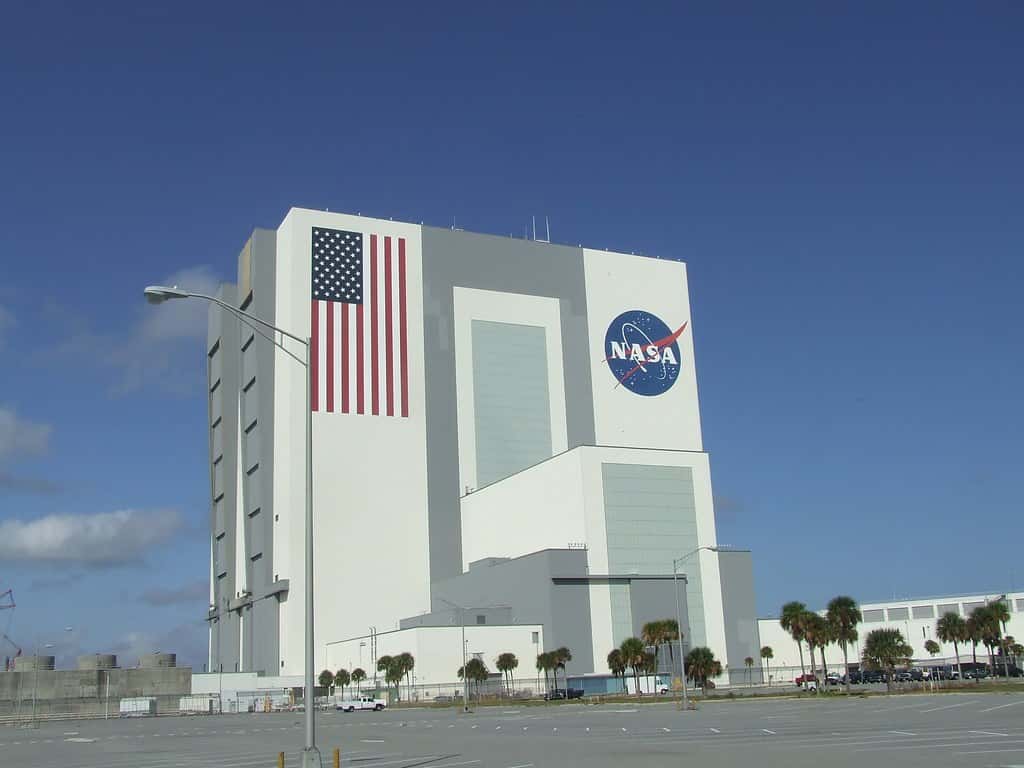
The Vehicle Assembly Building is where the stack comes together, with the core stage, solid rocket boosters, upper stage and eventually Orion integrated on a mobile launcher before rollout to Launch Complex 39B. That sequence has a long critical path, and each element arriving on schedule matters because delays compound.
The RS-25 engines have their own history. The engines flying on Artemis missions are derived from the space shuttle main engine program, with some hardware having flown on shuttle missions before being refurbished for SLS. That reuse has been both a cost advantage and a supply constraint, since the inventory is finite and new production has been ramping.
What Artemis III will do
The mission profile centers on testing rendezvous and docking between Orion and test versions of commercial human landing systems from Blue Origin and SpaceX. That is the capability that has to work before astronauts can descend to the lunar surface, and it has never been demonstrated with these vehicles.
Launching crew aboard Orion on top of SLS to conduct that test in low Earth orbit is a deliberately conservative approach. Testing docking procedures close to Earth, where abort options exist and the crew can return quickly, is the standard risk management approach for demonstrating a new capability before committing to a lunar trajectory.
The human landing system is the element of the Artemis architecture that has driven the most schedule uncertainty. Both Blue Origin and SpaceX are developing lander vehicles that require capabilities, including on-orbit propellant transfer, that have not been demonstrated at operational scale.
Artemis III's targeting for next year places it within a program timeline that has moved repeatedly. Space program schedules slip as a matter of routine, and the assembly milestones now being completed at Kennedy are the concrete evidence that distinguishes progress from projection.
What it means for the Space Coast
Brevard County's economy is built on this work. Kennedy Space Center and Cape Canaveral Space Force Station together employ tens of thousands directly, and the surrounding supplier, engineering and services network extends that employment across the county and into Orange and Volusia.
The region has spent the past decade diversifying beyond NASA. Commercial launch cadence from Cape Canaveral has reached levels that would have been unimaginable during the shuttle era, and companies including SpaceX, Blue Origin and United Launch Alliance maintain substantial Space Coast operations. Artemis is now one significant program among many rather than the sole driver it once was.
That diversification is what changed the region's risk profile. The end of the shuttle program in 2011 produced severe economic dislocation in Brevard County, with thousands of jobs lost and a housing market that took years to recover. A commercial launch sector operating at high cadence provides a floor that did not exist then.
Kennedy Space Center Visitor Complex remains a significant Central Florida tourism draw, and Artemis milestones drive attendance. Launch days bring hundreds of thousands of visitors to Brevard beaches and generate hotel, restaurant and retail activity across the region.
Local impact across the state
Florida's aerospace sector reaches well beyond the Space Coast. Embry-Riddle Aeronautical University in Daytona Beach, the University of Central Florida in Orlando and Florida Tech in Melbourne supply engineering graduates into the workforce, and the state's public university system has aligned programs toward aerospace demand.
Space Florida, the state's aerospace development authority, has pursued infrastructure investments intended to keep launch and manufacturing activity in the state as competition from other states and from commercial spaceports increases.
The supply chain extends into Central Florida manufacturing, South Florida avionics and Panhandle testing facilities. Aerospace employment in Florida is concentrated on the Atlantic coast but not confined to it.
The crew
Artemis III will carry a crew with substantial accumulated spaceflight experience. Randy Bresnik is a veteran of both shuttle and International Space Station missions. Frank Rubio holds the American record for the longest single spaceflight, having spent more than a year aboard the station after a spacecraft coolant leak extended his mission.
Andre Douglas represents the newer cohort of NASA astronauts selected in recent classes, and ESA's Luca Parmitano brings extensive station experience including spacewalks. The inclusion of a European astronaut reflects the partnership structure underlying Artemis, in which ESA supplies the service module and receives crew assignments in return.
Crew assignments for a mission still more than a year from launch serve a practical purpose beyond publicity. Astronauts assigned early participate in the design reviews, procedure development and simulator work that shape how the spacecraft is actually operated, and their input during integration testing has historically caught issues that ground teams missed.
The international partnership dimension extends beyond ESA. Artemis involves agencies and contractors across multiple countries, and the Artemis Accords framework has been signed by a growing number of nations, making the program a diplomatic instrument alongside a technical one.
What Florida gets from the program
Kennedy Space Center's role in Artemis is not merely as a launch site. The Operations and Checkout Building where the Orion modules were joined is a spacecraft assembly facility, meaning the vehicle is built and tested in Florida rather than shipped in complete.
That distinction determines the employment profile. Assembly and integration work requires technicians, quality inspectors, engineers and test conductors on site for years per vehicle, which is a fundamentally different economic footprint than launch operations that occupy a facility for days.
The Vehicle Assembly Building, Launch Complex 39B, the crawler transporters and the mobile launchers all represent infrastructure that exists in Florida and cannot be relocated without enormous cost. That physical anchor is the strongest guarantee the state has that human spaceflight operations remain on the Space Coast.
Florida's broader competitive position in space has nonetheless become contested. Other states have pursued launch and manufacturing operations aggressively, and commercial spaceports have proliferated. Florida's advantages of latitude, over-water launch corridors and established infrastructure remain substantial but are no longer unique.
How the schedule could move
Artemis III is targeted for launch next year, and the assembly milestones now being completed at Kennedy support that target. The elements most likely to move it are not at Kennedy.
Integrated testing of Orion can surface problems that require hardware rework, and rework on a spacecraft this complex is measured in months rather than weeks. Power-on testing in particular is where interface issues between the crew and service modules would appear.
The Space Launch System stacking sequence in the Vehicle Assembly Building has its own critical path, culminating in a wet dress rehearsal that loads propellant and runs the countdown to the final seconds. That test has historically required multiple attempts on Artemis vehicles.
The human landing systems under development by Blue Origin and SpaceX are the elements furthest from demonstrated readiness, and Artemis III as defined requires test versions of those vehicles to be available for the rendezvous and docking demonstration. Their development schedules are outside NASA's direct control.
What's next
The immediate milestone is first power-on of the integrated Orion spacecraft, followed by integrated testing and final hardware installations. Those tests are where interface problems surface, and problems found in the Operations and Checkout Building are far cheaper to fix than problems found later.
On the rocket side, the sequence runs toward stacking in the Vehicle Assembly Building, integrated testing of the full vehicle, rollout to Launch Complex 39B and a wet dress rehearsal before launch. Each of those steps has historically produced schedule adjustments.
The human landing system remains the pacing item for the broader program. Artemis III as currently defined tests docking in low Earth orbit, and the lunar landing missions that follow depend on lander development milestones outside Kennedy's control.
For now, the spacecraft that will carry Bresnik, Douglas, Rubio and Parmitano exists as a single integrated vehicle in a building on Florida's Atlantic coast, which is further along than it was a month ago.
Spotted an issue with this article?
Have something to say about this story?
Write a letter to the editor