Brett Moss Sworn In as Key Biscayne Mayor After Voters Reject the Big Dig Stormwater Plan
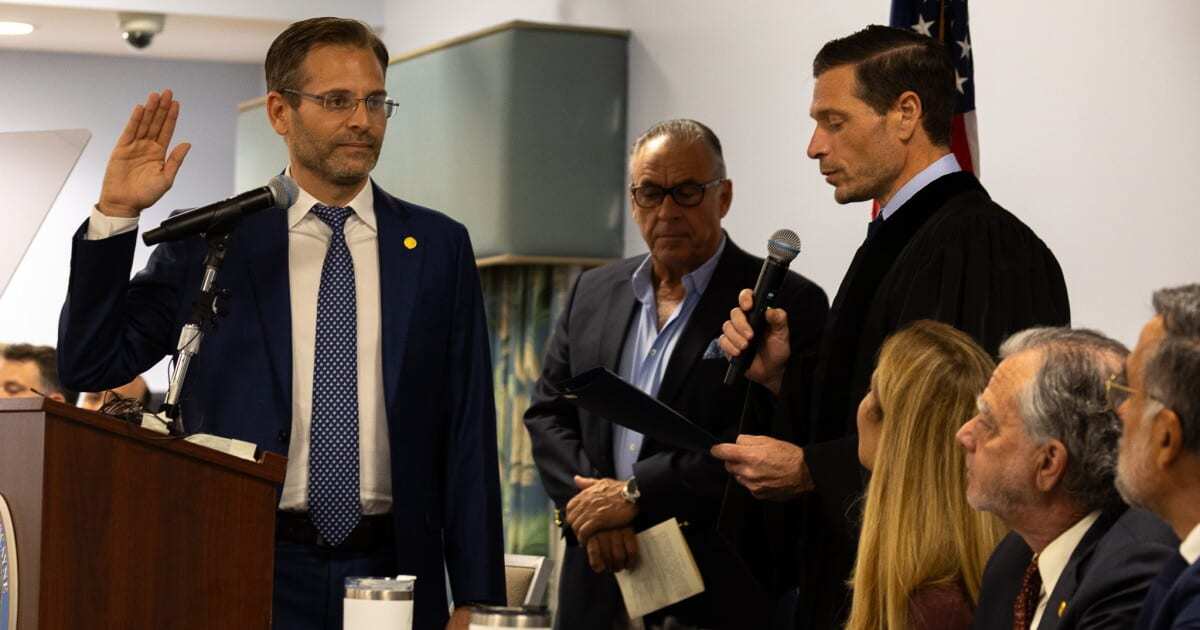
Brett Moss took office as Key Biscayne's 10th mayor on Thursday, Nov. 12, promising to move forward on flood control on the low-lying island after leading the opposition to the "Big Dig," the costly stormwater overhaul pushed by his predecessor, Joe Rasco. Miami-Dade Circuit Court Judge Marcus Bach Armas administered the oath before an audience of about 250 people at the village Community Center, the Key Biscayne Independent reported in a story published by WLRN.
"Resiliency cannot be a buzzword," Moss said. "It must be reflected in the investments we make, the engineering we choose and the beaches we safeguard for the next generation."
His swearing-in caps a year in which the village abandoned the Big Dig after spending at least $8 million on it, its longtime village manager resigned, and voters wrote a permanent limit on big stormwater spending into the Village Charter.
An election that rejected the Big Dig
Moss, an architect, once supported the Big Dig stormwater program but became a fierce opponent as its costs soared. The Independent described his election as evidence of voter repudiation of the plan designed by engineering firm AECOM. In the same Nov. 3 election, voters returned stormwater critic Luis de la Cruz to the council and approved a citizen-initiated charter amendment that requires a community vote before the village pursues any stormwater or flood-prevention project costing more than $50 million over a three-year period. The amendment passed with about 72 percent of the vote, according to election-night reporting by the Independent and Florida Politics.
The amendment reached the ballot through a petition drive backed by the Key Biscayne Neighbors Association. In June, the Miami-Dade Elections Department said a preliminary review had accepted 913 signatures, more than the 839 required; supporters had turned in 1,150, and 237 were rejected for defects. "Don't let staff decide what we want in our community," Ceci Sanchez, who helped gather signatures, said at the time. "The people are at the top of pyramid. The manager needs to remember that."
Village Manager Steve Williamson, the driving force behind the Big Dig, resigned last month, according to the Independent.
How the Big Dig died
The project was meant to protect Key Biscayne from heavier rainfall and rising seas by replacing the island's aging stormwater system with pipes and pumps that would push water into Biscayne Bay, along with burying utility lines, fortifying the coast and re-pitching roads. Rasco had run for office on replacing the stormwater system, and the effort's first phase, known as Zone 1, targeted the often-flooded neighborhood around the K-8 school.
Moss was one of its early skeptics on the council. In October 2024, during his final meeting before term limits forced him off the council, he and Council Member Ed London voted against a key $897,000 contract with Black & Veatch to prepare Zone 1 designs, which passed 5-2. Moss argued then that the village had not secured property for the system's outfalls. "We don't even know if we can do the project," he said.
The plan collapsed on April 22, 2026. Facing two former mayors, several former council members and residents upset that the design called for removing and replacing more than 500 trees, the council voted 7-0 to pursue a different approach from GIT Engineering that relies on a web of shallow injection wells instead of pipes discharging to the bay.
Chief Financial Officer Benjamin Nussbaum told the council that through March 31 the village had spent the following:
| Recipient | Amount | Purpose |
|---|---|---|
| AECOM | $5.8 million | Zone 1 design, estimated at $82 million to build |
| Black & Veatch | $2.6 million | Project management |
| GIT Consulting | $147,325 | Alternative injection well concept |
Outside money was lost too. Colleen Blank, who manages grants and loan applications for the village, told the council the switch meant "leaving $76 million on the table," including a $60 million low-interest loan from the Florida State Revolving Fund and $16 million from Resilient Florida and Biscayne Bay water quality grants. She said state agencies did not consider injecting water into the ground an improvement to bay water quality, and that a new loan application could not be made until 2027. Williamson said at the time the GIT concept was at least 36 months from starting.
"We have to swallow hard, because that cost ain't going down," Rasco warned at the end of that meeting.
A new council takes its seats
Joining de la Cruz in returning to the council is Oscar Sardiñas, the former vice mayor who had backed the AECOM plan alongside Rasco. Newcomer Silvia Tarafa was also sworn in. All three serve four-year terms.
"This island is filled with exceptionalism," Sardiñas said. "Everywhere we look, every grocery store we go to, every CVS, every walk in the evening, we run into each other, and we are exceptional."
Two familiar faces left. Fernando Vazquez, an environmental engineer who worked on the Big Dig for AECOM and supported it for years before opposing it on environmental grounds, was not re-elected; he called his council service "the most remarkable" and "rewarding" experience of his professional career. Ed London, known as the council's frequent dissenting vote, joked about that reputation. "I'm really Mr. Yes, Yes, Yes. The problem was the rest of the Council just didn't understand," he said.
Key Biscayne's mayor has no executive power. The mayor holds one vote alongside six council members, makes appointments and presides over meetings, but serves as the village's chief spokesperson. Moss struck a conciliatory tone, embracing Rasco after the outgoing mayor's final address. "Local government is the most important government in the United States," Moss said. "The authority we hold as elected officials is purely vulnerable. It is a temporary grant of trust by residents of this island."
Rasco's parting numbers
In his final State of the Village speech, Rasco said he was handing over a village in excellent financial condition, with more than $27 million in reserves and only $5.2 million in debt. He highlighted $21.5 million in grants won to support municipal projects.
The Independent noted that the village's low property tax rate, which Rasco touted every year, masks growth in spending: the operating budget rose from $36 million just before Rasco took office to $47 million adopted in October, a 33 percent increase.
Rasco also pointed to a permanent ban on e-bikes, a new basketball court at the K-8 Center, a makeover of the St. Agnes playing field and the village's $950,000 investment in the proposed Shoreline Project, which he called "bold." That effort, championed by Miami-Dade County Commissioner Raquel Regalado, has no county funding path and remains conceptual, according to the Independent.
What it means for the island
The flooding problem that launched the Big Dig has not gone away. Key Biscayne, a barrier island village of about 15,000 people off Miami, still relies on an aging gravity stormwater system, and its leaders now have to rebuild a flood-control plan with a charter cap that sends any project over $50 million in three years to the voters.
In June, Council Member Ed London predicted the injection-well alternative would come in under that threshold. The village also holds untapped authority: in 2020, residents voted overwhelmingly to allow up to $100 million in borrowing for resilience projects, which the council had not used as of June.
What's next
Moss told the Independent he will convene a strategic gathering with the new council to lay out a shared roadmap. The new council also inherits the question of how to pay for the injection-well approach, including whether to seek state revolving fund money again; Blank told the council in April that a new loan application could be made in 2027.
Spotted an issue with this article?
Have something to say about this story?
Write us a letterComments
No comments yet. Be the first to weigh in.
Related Coverage
Florida Legislature Returns Tuesday to Hand the Gavels to Jim Boyd and Sam Garrison
8h ago

Miami Moves to Gut LGBTQ Advisory Board and Repeal Affirmative Action Ahead of Florida DEI Ban
1d ago
Flagler County Sheriff Rick Staly Proposes Dedicated Law Enforcement Tax to Offset Amendment 3 Shortfall
1d ago
Florida Releases Full List of 20 Charged in Statewide Voter Fraud Sweep as Some Cases Draw Questions
2d ago