DeLand Police Announce Arrest of a Teenager in July Double Homicide Behind the Athens Theatre
DeLand police announced this week that a 17-year-old has been arrested in connection with the shooting deaths of two teenagers whose bodies were found in a concealed lot behind the Athens Theatre on July 29. Police Chief Jason Umberger said at an August 5 news conference that the suspect was taken into custody at a hotel in Manatee County and that the victims and the accused knew one another.
The Florida Press is not naming the accused, who is a minor, and is not naming the victims. No one has been convicted in the case, and the accused is presumed innocent unless and until the state proves its case.
The arrest closes the most urgent phase of an investigation that had unsettled the Volusia County city for a week, though the legal proceedings that follow will extend considerably longer.
What investigators have said
According to the announcement, the two victims were shot and killed, and their bodies were found in a concealed lot behind the Athens Theatre, a historic venue in DeLand's downtown district.
Chief Umberger indicated that the victims and the accused were known to one another, a detail that addresses one of the questions that most concerns a community after a killing in a public area. A homicide involving people who knew each other presents a different public safety picture than one involving a stranger.
The arrest occurred at a hotel in Manatee County, on Florida's Gulf coast roughly three hours from DeLand, indicating that investigators tracked the suspect across the state before taking him into custody.
Investigators have not publicly detailed a motive, and additional information is typically withheld during an active prosecution to protect the integrity of the case.
How juvenile homicide cases proceed in Florida
Florida law provides several routes by which a case involving a minor can move from juvenile court into adult court, and the path taken has enormous consequences for the accused.
Direct file gives the State Attorney discretion to charge certain minors as adults without a judicial transfer hearing, and Florida is among the states that grants prosecutors this authority for specified serious offenses. For first-degree murder charges against a 16 or 17-year-old, Florida law provides for indictment by grand jury, and a minor indicted for a capital or life felony is prosecuted in adult court.
The difference between juvenile and adult adjudication is fundamental. Juvenile proceedings are focused on rehabilitation, are generally confidential, and carry dispositions that end when the individual reaches a specified age. Adult proceedings are public, produce a criminal conviction, and carry adult sentencing exposure.
Florida law limits sentencing for minors in ways that reflect United States Supreme Court decisions holding that juveniles are constitutionally different from adults for sentencing purposes. Those rulings prohibit capital punishment for offenses committed by minors and constrain the imposition of life sentences without review.
The presumption of innocence
An arrest represents the beginning of a criminal case rather than its conclusion, and the distinction matters particularly in cases that generate significant community attention.
Probable cause, the standard required for an arrest, means a reasonable basis to believe an offense occurred and that the person arrested committed it. Conviction requires proof beyond a reasonable doubt, a substantially higher standard.
Between those points sit the entire criminal process: the filing decision by the State Attorney, discovery in which the defense reviews the state's evidence, depositions of witnesses, pretrial motions including motions to suppress evidence, and either a negotiated resolution or a trial before a jury.
Cases sometimes change substantially during that process as evidence is examined under adversarial scrutiny. Charges are amended, reduced, and occasionally dropped.
DeLand and Volusia County
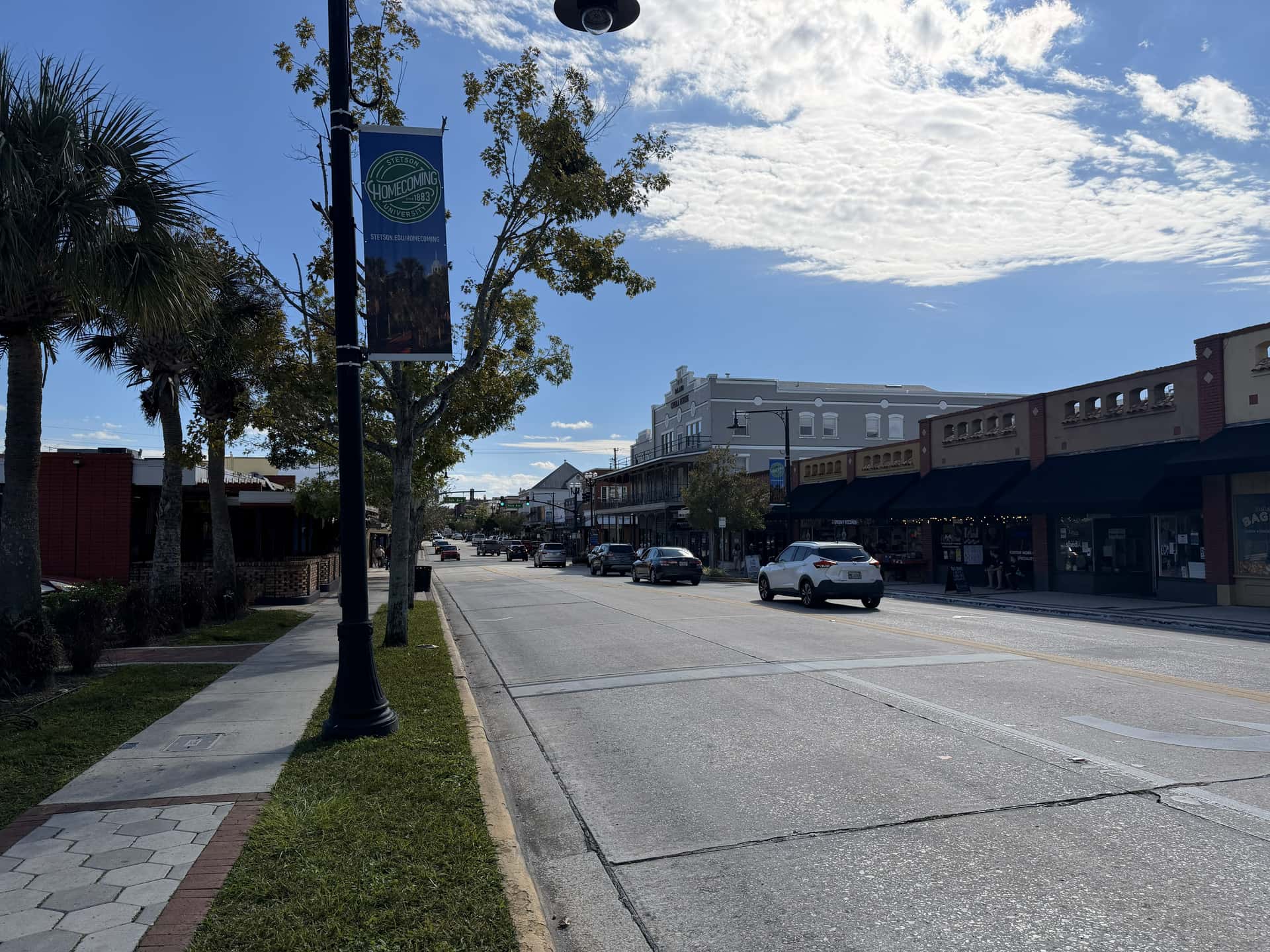
DeLand is the seat of Volusia County and home to Stetson University, with a downtown historic district that has been the focus of substantial revitalization investment. The Athens Theatre, a restored 1920s venue, anchors that district and hosts performances throughout the year.
A double homicide in that setting registers differently than one in a location residents already associate with crime. The downtown area is where the community gathers, and violence there affects the sense of the place in ways that extend beyond the incident.
Volusia County covers a substantial and varied geography, from Daytona Beach on the coast through DeLand and the western communities to rural areas inland. Law enforcement is divided among municipal departments including DeLand Police, the Volusia Sheriff's Office serving unincorporated areas, and agencies in the county's other cities.
The investigation across jurisdictions
The arrest in Manatee County illustrates a routine but important feature of Florida law enforcement: investigations frequently cross county lines, and the systems for pursuing them do so as well.
Florida law enforcement agencies coordinate through the Florida Department of Law Enforcement, which provides statewide investigative support, forensic laboratory services, and criminal justice information systems that connect agencies across the state's 67 counties.
Warrants entered into state and national databases allow any agency encountering an individual to identify an outstanding warrant, and agencies routinely assist one another in executing arrests outside their home jurisdiction.
The practical effect is that leaving the county where an offense occurred provides limited protection. Interstate and interjurisdictional cooperation in homicide investigations is among the more effective functions of American law enforcement.
What happens next in the case
The case moves to the State Attorney's Office for the Seventh Judicial Circuit, which covers Volusia, Flagler, Putnam, and St. Johns counties. Prosecutors will make the formal charging decision based on the evidence investigators have developed.
If the case proceeds in adult court following indictment, the accused will be arraigned and enter a plea, after which discovery begins. Homicide prosecutions in Florida typically take a year or longer to reach resolution, and complex cases take considerably longer.
Court records in adult proceedings are generally public, which means the case will be visible to the community as it develops.
Why the press withholds certain names
The decision not to name a minor accused of a crime, or minors who were victims of one, reflects editorial standards that predate any particular case.
For accused minors, the reasoning rests on the differing purposes of the juvenile and adult systems. Juvenile proceedings are structured around rehabilitation, and publishing a name attaches a permanent public record to a person the legal system is explicitly attempting not to define by a single act. That consideration weakens when a case moves to adult court, where proceedings are public by design, and news organizations weigh the question differently at that stage.
For minor victims, the considerations involve the families, who are experiencing the worst circumstance most people ever face and who did not choose public attention.
These are editorial judgments rather than legal requirements. Florida law does not prohibit publishing the name of a minor charged with a serious offense, and law enforcement agencies frequently release those names. Other news organizations reach different conclusions, and reasonable people disagree about where the line sits.
What does not change is the underlying accuracy standard. Withholding a name does not withhold the facts of what authorities have alleged.
How homicide investigations are built
The week between the discovery of the bodies and the arrest represents an intensive investigative effort whose components are largely invisible from outside.
Scene processing comes first and cannot be redone. Investigators document the location, collect physical evidence, and preserve the scene against contamination. Forensic evidence including ballistics, biological material, and trace evidence is gathered for laboratory analysis.
Digital evidence has become central to modern homicide investigation. Phone records establish location and communication patterns. Social media activity documents relationships and conflicts. Surveillance footage from businesses and residences near a scene frequently captures movement that establishes timelines.
Witness interviews build the human picture. In cases where the parties knew one another, interviews with mutual acquaintances often identify the relationships and disputes that provide investigative direction.
The Florida Department of Law Enforcement provides laboratory services and investigative support to local agencies, and its forensic capacity handles evidence from across the state.
Community response after violence
The effects of a double homicide on a community extend well beyond the criminal case, and they persist long after the news cycle ends.
Schools frequently bear a substantial share of the response when victims are of school age. Districts deploy counselors, adjust schedules, and support students processing loss, and that work continues into the following academic year.
The location matters to how a community absorbs an event. A killing in a downtown district that residents use daily changes the relationship people have with that space, and restoring a sense of ordinary use takes time and deliberate effort.
Volusia County agencies and community organizations maintain victim services that provide counseling, assistance navigating the criminal process, and support accessing state victim compensation funds. Florida operates a crime victim compensation program that can cover funeral expenses, counseling, and lost wages for eligible claimants.
Those services are frequently underused, in part because families in the immediate aftermath are not in a position to research what is available.
What's next
DeLand police have not indicated whether additional arrests are anticipated. Investigators typically continue working a case after an arrest, both to strengthen the prosecution and to determine whether others were involved.
For DeLand, the immediate community impact is the difficult work of processing the loss of two young people in a place residents thought they knew. Schools and community organizations in Volusia County have resources available for students and families affected by violent incidents, and those supports typically remain in place well past the point when public attention moves on.
The legal process now begins, and it will proceed on its own timeline. What the community knows today is that police believe they have the person responsible. What a court determines is a separate question, and answering it will take considerably longer than the week the investigation required.
Spotted an issue with this article?
Have something to say about this story?
Write a letter to the editor