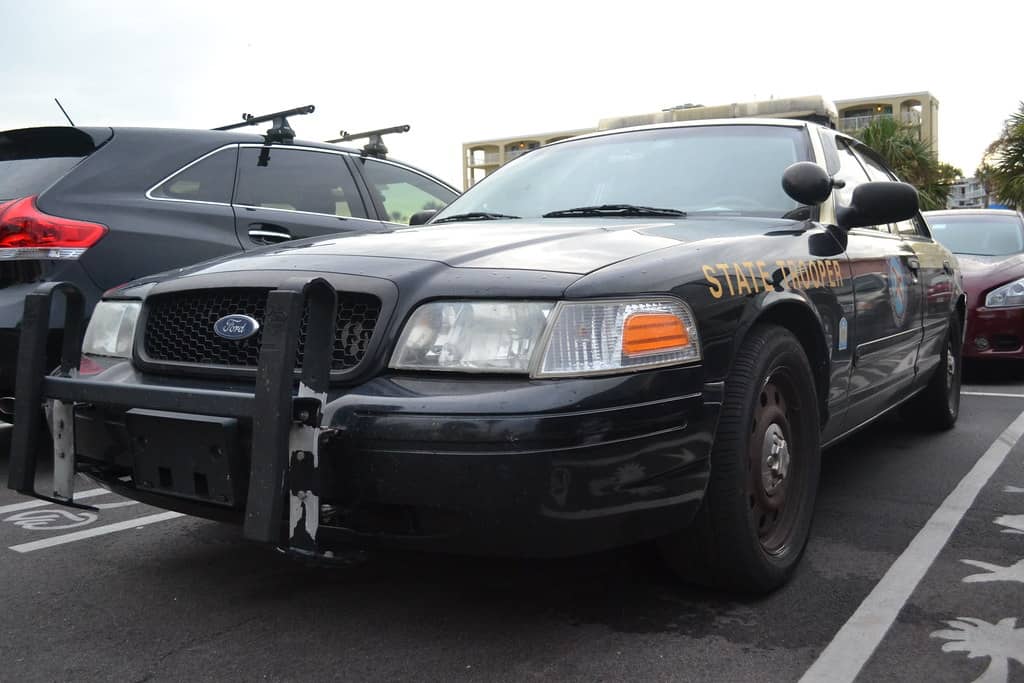
Fort Lauderdale Woman Accused of Taking a Broward Sheriff's Patrol Vehicle

A Fort Lauderdale woman was arrested after a stolen Broward Sheriff's Office patrol vehicle was recovered abandoned on an Interstate 95 off-ramp in St. Lucie County, with authorities saying she was found wearing an outer ballistic vest belonging to the agency.
Shannon Marie Dillon, 42, is accused of taking the patrol vehicle. Broward deputies, Port St. Lucie police officers and Florida Highway Patrol troopers responded to I-95 at about 9:40 p.m. Monday, September 22 after the vehicle was located.
The case crossed three jurisdictions, from Broward County where the vehicle originated, north along the interstate corridor, to St. Lucie County where it was recovered. That geography drew in agencies from each area.
Dillon has been accused and is presumed innocent. The details described here reflect what law enforcement agencies have stated publicly, and the allegations have not been tested in court.
What authorities have described
The patrol vehicle was located abandoned on an off-ramp from Interstate 95. Agencies responding included Broward Sheriff's Office deputies, whose agency owned the vehicle, along with local police and state troopers with jurisdiction over the recovery location.
Authorities said Dillon was found wearing an outer ballistic vest from the Broward Sheriff's Office. Outer carriers are standard equipment for patrol deputies and are typically stored in or worn with the patrol vehicle.
The recovery occurred at approximately 9:40 p.m., roughly 24 hours before Broward County commissioners adopted the county's fiscal 2027 budget, which funds the sheriff's office among other county services.
Agencies have not publicly detailed how the vehicle came to be taken, which is among the questions the investigation would address and which would be laid out in charging documents.
The charges such a case can involve
Taking a law enforcement vehicle can implicate several Florida offenses depending on the circumstances. Grand theft of a motor vehicle is a third-degree felony. Burglary of a conveyance applies where entry was made with intent to commit an offense inside.
Possession of law enforcement equipment raises separate questions. Florida law addresses the unlawful use of police badges and insignia, and impersonating a law enforcement officer is a separate offense carrying its own penalties.
Whether any of those apply depends on facts that have not been publicly established, and the formal charges filed by prosecutors may differ from the offenses an arrest is initially made on.
The case would be handled by the State Attorney's Office for the circuit where the offenses occurred, and multi-county conduct can involve prosecutors in more than one circuit or referral to the Office of Statewide Prosecution.
Why an equipped patrol vehicle is a serious loss
A marked patrol vehicle is not simply a car. It typically carries a mobile data terminal connected to law enforcement databases, a police radio on encrypted channels, emergency lights and siren, and in many configurations a secured firearm rack.
Agencies treat the loss of such a vehicle as a security incident because of what it enables. Marked vehicles command compliance from motorists, and a person operating one has the apparent authority to conduct a traffic stop.
Standard protocol following such a loss includes deactivating radio and database credentials, accounting for weapons and equipment, and notifying surrounding agencies so that officers encountering the vehicle know its status.
The Broward Sheriff's Office is one of Florida's largest law enforcement agencies, providing countywide services including the jail system and regional communications, and contracting municipal policing services to a number of Broward cities.
Vehicle security practice
Law enforcement agencies maintain policies governing when patrol vehicles may be left running, whether they may be left unlocked and how equipment must be secured. Those policies exist precisely because of incidents like this one.
The practical tension is that patrol work often requires an officer to leave a vehicle quickly, and shutting down and securing a vehicle takes time that can matter in an emergency. Policies try to balance operational reality against security risk.
Agencies routinely review their procedures after an incident of this kind, examining whether existing policy was followed and whether the policy itself needs revision.
Take-home vehicle programs, common among Florida sheriff's offices, extend the exposure. A patrol vehicle parked at a deputy's residence overnight sits in a less controlled environment than one in a secured agency lot.
The interstate corridor factor
Interstate 95 runs the length of Florida's east coast, connecting Miami-Dade, Broward, Palm Beach, Martin, St. Lucie, Indian River, Brevard, Volusia, Flagler, St. Johns, Duval and Nassau counties along a single continuous route.
That geography means incidents beginning in one county frequently conclude in another, and it makes interagency coordination along the corridor a routine part of Florida law enforcement operations rather than an exception.
The Florida Highway Patrol has jurisdiction on the interstate system statewide, which makes it the common thread in multi-county incidents that unfold along the highways.
Florida's mutual aid framework allows agencies to operate across jurisdictional boundaries under standing agreements, which is what allows Broward deputies to participate in a recovery operation in St. Lucie County.
Broward County law enforcement in context
Broward County has roughly 1.9 million residents, making it Florida's second most populous county. The sheriff's office provides law enforcement services countywide and under contract in multiple municipalities, alongside independent city police departments in others.
The agency's budget is the largest single draw on the county general fund. County commissioners this week adopted a $9.2 billion budget for fiscal 2027 while holding the overall property tax rate flat at 5.6 mills.
The sheriff's office also handles the county jail system, regional communications and the medical examiner function, responsibilities that extend well beyond patrol and investigations.
Broward Sheriff's Office activity this week also included a murder-suicide investigation in Pembroke Pines and a fatal shooting investigation in Lauderdale Lakes, both on September 22.
Traffic enforcement across Florida this week
The Florida Highway Patrol handled other notable incidents in the same period. A trooper arrested a 22-year-old Deerfield Beach woman for driving 117 miles per hour in a 65 mile per hour zone on Interstate 295 southbound in Jacksonville, taking her into custody just before 9:30 p.m. on September 18.
Speeds at that level trigger Florida's reckless driving provisions rather than ordinary speeding citations, and a 2023 change in Florida law created a specific dangerous excessive speeding offense for driving 50 miles per hour or more over the limit.
Interstate 295 is the beltway around Jacksonville, and the Buckman Bridge segment where the stop occurred carries heavy volume across the St. Johns River.
In the Panhandle, the Walton County Sheriff's Office reported assisting the Florida Highway Patrol and the U.S. Marshals Service with a felony stop and the arrest of a fugitive from Louisiana.
What happens next in the case
The case proceeds through the ordinary criminal process, beginning with the State Attorney's Office decision on formal charges. Prosecutors review arrest reports and investigative findings before filing an information.
First appearance before a judge occurs within 24 hours of arrest under Florida rules, with bond and conditions of release determined at that hearing based on the charges and the defendant's history.
Where a case involves conduct in multiple counties, prosecutors coordinate on which circuit handles which charges, and consolidation is sometimes arranged where the conduct forms a single course of events.
Court records in Florida are generally public, and case status can be tracked through the clerk of court in the county where charges are filed.
How agencies track and recover vehicles
Modern patrol fleets carry automatic vehicle location technology, which transmits position data to dispatch as a routine part of computer-aided dispatch operations. That capability is intended primarily for officer safety and call assignment, and it also supports recovery when a vehicle is taken.
Agencies also enter stolen vehicles into state and national databases, which allows automated license plate readers along highways and at fixed locations to generate alerts when a plate is detected.
Florida's interstate corridors carry substantial automated plate reader coverage operated by various agencies, and that infrastructure has changed how quickly vehicles moving along I-95 and I-75 can be located.
None of those systems is a substitute for physical security. Technology shortens recovery time; it does not prevent the initial loss, which is why agency policy on securing vehicles and equipment remains the primary control.
Public safety in the I-95 corridor
Florida's east coast interstate corridor carries some of the heaviest traffic volume in the Southeast, and the density of population along it means incidents on the highway routinely involve multiple agencies and multiple counties.
The Florida Highway Patrol handles primary enforcement and crash investigation on the interstate system, while county sheriffs and municipal police departments retain jurisdiction over conduct originating in their areas.
That layered structure is the reason mutual aid agreements matter. Florida's statutory framework allows agencies to enter standing agreements that authorize officers to act outside their normal jurisdiction, which is what makes a coordinated multi-county response possible on short notice.
Regional communications systems have improved interoperability substantially over the past two decades, addressing a problem that hampered multi-agency responses in earlier eras when agencies operated on incompatible radio systems.
What's next
The Broward Sheriff's Office investigation continues, and details about how the vehicle was taken would be established through that process and through charging documents when filed.
Agency review of vehicle security procedures is a standard follow-up to an incident of this kind, and any policy changes would generally be internal rather than announced publicly.
Dillon is accused and presumed innocent. The account here reflects statements from law enforcement agencies, and the allegations will be tested through the criminal justice process.
Residents with information about the incident can contact the Broward Sheriff's Office, and anonymous tips in Broward County can be submitted through Broward Crime Stoppers.
Spotted an issue with this article?
Have something to say about this story?
Write a letter to the editor