Gators Open Fall Camp With No Timeline on a Starting Quarterback
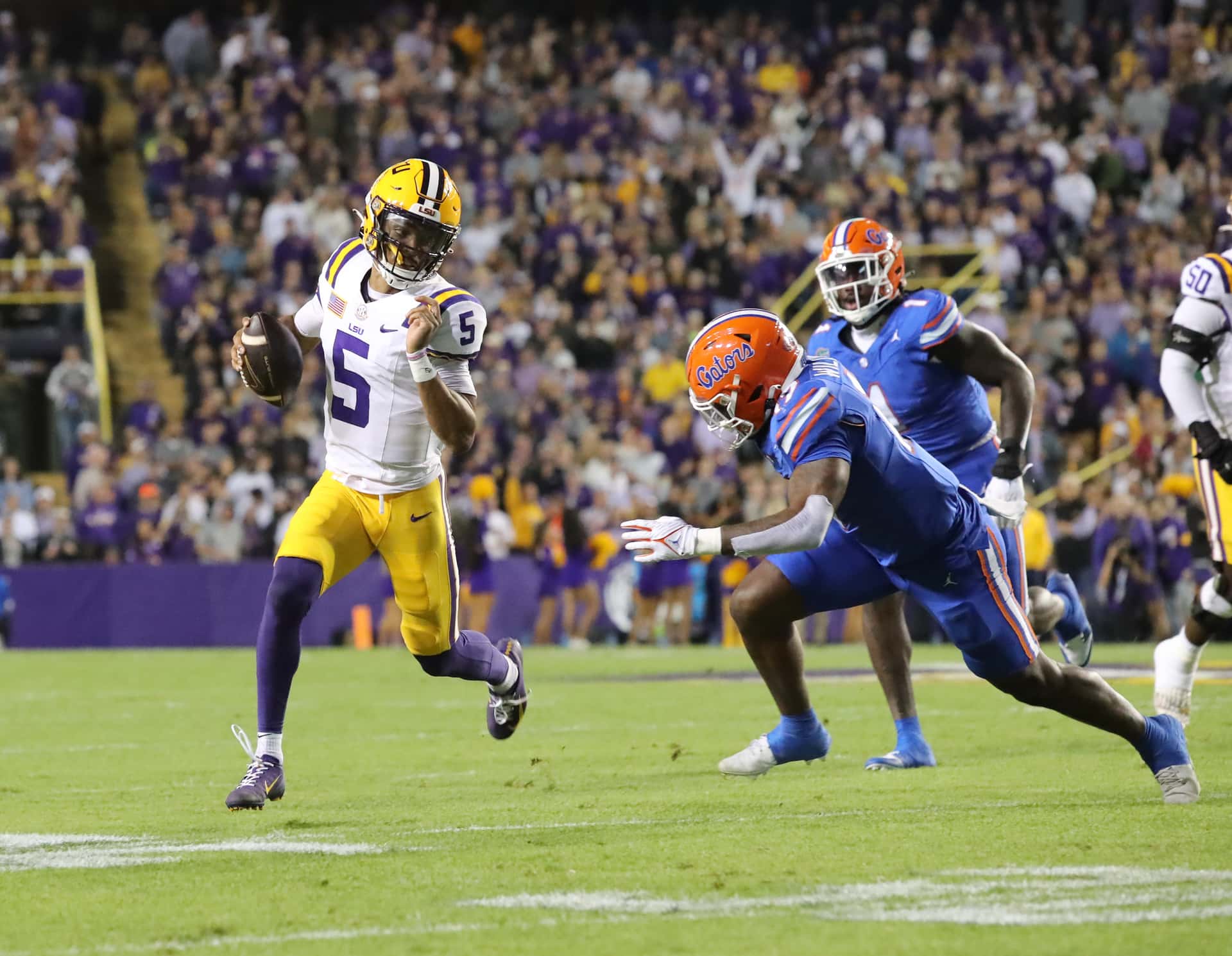
Florida opened its 2026 fall camp in Gainesville with the most consequential question on the roster still unresolved. Coach Jon Sumrall and offensive coordinator Buster Faulkner have both said there is no timeline for naming a starting quarterback, with Aaron Philo and Tramell Jones Jr. continuing to split work as camp progresses. Faulkner has publicly expressed confidence that Florida can win with either.
Camp opened Wednesday, August 5, with scrimmages scheduled for Saturday, August 15 and Saturday, August 22. That structure gives the staff two live evaluation windows before the season, which is the standard mechanism for separating quarterbacks who look similar in controlled practice settings.
The situation carries added weight because it is Sumrall's first fall camp in Gainesville. New coaching staffs face an evaluation problem that established ones do not: they are assessing players they did not recruit, in a scheme those players are learning, without the accumulated context that normally informs these decisions.
The competition
Faulkner has characterized the two quarterbacks in different terms. He has praised Jones for how quickly he picked up the offense, a compliment about processing speed and football intelligence that matters enormously for a position where the mental workload determines how fast a player can operate.
Philo has drawn praise for emerging as a vocal leader, which is a different kind of endorsement. Quarterback leadership is not decorative. An offense functions on the quarterback's ability to direct protection adjustments, change plays at the line and hold teammates accountable, and a quarterback who cannot command a huddle limits what a coordinator will call.
Declining to set a deadline is a defensible approach with real costs. The benefit is that the staff preserves optionality and lets the competition resolve on evidence. The cost is that split repetitions mean neither quarterback accumulates the volume of work with the first-team offense that builds timing with receivers and rhythm in the run game.
Why the decision matters this year
Quarterback play has the largest single effect on outcome variance in college football, and the gap between competent and problematic quarterback play is worth several wins across a season. In the Southeastern Conference, where defensive talent is concentrated and margins are thin, that effect is amplified.
Florida's schedule, like every SEC schedule, offers no soft landing for an offense still sorting itself out. The conference's expansion and the move to a format with more cross-division matchups mean fewer predictable results. A team working through quarterback uncertainty in September can find itself out of contention before the answer arrives.
There is also the transfer portal consideration that now shapes every position battle. A quarterback who loses a competition has a straightforward path to playing time elsewhere, and coaching staffs manage these situations knowing that the player who does not win may not stay. That reality tends to push staffs toward keeping competitions genuinely open rather than signaling an outcome early.
The Sumrall transition
Sumrall arrived at Florida after building a reputation at previous stops as a program builder with a defensive background and a track record of overachieving relative to roster talent. Programs hire coaches with that profile expecting cultural change and improved player development rather than immediate schematic transformation.
First-year transitions in the modern era compress on a timeline that did not previously exist. Portal movement means rosters turn over substantially between seasons, and a new staff inherits a roster assembled for a different scheme by people who are no longer there. Sorting out which returning players fit is a significant part of the first spring and summer.
The staff's public messaging around the quarterback competition, emphasizing patience and confidence in both options, is consistent with that broader project. A coach in year one has more latitude to take time than a coach under immediate pressure.
Florida's broader position
Florida occupies an unusual place in college football. It is a program with legitimate national championship history, enormous resources, and a recruiting footprint in one of the three richest talent-producing states in the country. It has also spent much of the past decade short of the standard those advantages imply.
The state's competitive environment is a factor. Florida State and Miami recruit the same high schools, and the SEC and ACC programs across the Southeast make regular incursions into South Florida, Tampa Bay and Orlando. No program in the state has an assumed claim on in-state talent.
Name, image and likeness economics have further leveled the field. Programs that can organize collective funding compete for players who would previously have been out of reach, and the traditional advantages of history and facilities carry less weight than they once did.
What camp is actually for
Fall camp serves purposes beyond the depth chart. Acclimatization is a genuine physiological requirement, particularly in Gainesville in August, and NCAA rules mandate a progressive schedule limiting equipment and practice duration in the opening days specifically to reduce heat illness risk.
Installation is the other core function. Offensive and defensive systems are taught in phases, with concepts layered week over week until the full package is in place by the opener. A quarterback competition complicates installation, because the coordinator must ensure both players master the same volume of material.
Scrimmages provide the closest available approximation of game conditions. Live tackling, an officiating crew, situational periods and a scoreboard change how players perform relative to controlled practice, and quarterbacks in particular reveal things under those conditions that scripted work conceals.
The economics behind the roster
College football roster construction has been transformed by two changes that arrived within a few years of each other. Name, image and likeness compensation allows players to earn money from their personal brand, and in practice collectives organized around programs have become the mechanism through which rosters are funded.
The transfer portal removed most restrictions on player movement, eliminating the requirement that transfers sit out a season in most circumstances. The combined effect is a system in which rosters turn over substantially each year and in which retention requires active investment rather than following automatically from a signed letter of intent.
For a program like Florida, with a large donor base and substantial revenue, the resources exist. The question is organizational: whether the collective structure, the coaching staff's roster management and the compliance apparatus function together well enough to compete for and retain players.
What the schedule demands
The Southeastern Conference schedule provides no forgiving stretch. Conference expansion brought additional programs into the league and altered the scheduling format, producing matchups that previously occurred rarely or not at all and eliminating some of the predictability that divisional alignment provided.
Florida's traditional rivalry games carry particular weight in evaluating any season. The annual meeting with Georgia in Jacksonville, played at a neutral site under an arrangement that has been periodically renegotiated, and the season-ending game against Florida State are the results that fans weigh most heavily regardless of overall record.
The expanded College Football Playoff has changed the calculus for what a successful season looks like. A team can absorb losses and remain in contention in a way that was impossible under the four-team format, which raises the value of finishing strong and reduces the season-ending consequence of an early stumble.
Recruiting the state
Florida produces one of the largest concentrations of major college football talent in the country, alongside Texas and California, and the competition for it is unrelenting. High school programs in Miami-Dade, Broward, Palm Beach, Hillsborough, Orange and Duval counties send players to programs across the Southeast and beyond every year.
The Gators compete for those players against Florida State, Miami, UCF and USF within the state, and against essentially every SEC and ACC program from outside it. Alabama, Georgia, LSU and Clemson have all recruited South Florida successfully for years, and geography provides no protection.
Program momentum matters enormously in recruiting, which creates a circularity that new coaching staffs must break. Winning attracts players, and players produce winning. A staff in year one is selling a projection rather than a record, which is why the on-field product this fall will shape the roster for several years beyond it.
What the offense needs around the quarterback
Quarterback competitions attract attention disproportionate to the position's isolated importance, because quarterback play is heavily dependent on what surrounds it. An offensive line that cannot sustain protection makes any quarterback look inaccurate, and receivers who do not separate make any quarterback look indecisive.
Florida's evaluation this month therefore extends well beyond the two players taking snaps. The interior offensive line, the ability to run effectively on early downs, and whether the receiving corps can win against SEC secondaries all shape what the coordinator can ask a first-year starter to do.
Running game establishment matters particularly for a young quarterback. An offense that can generate manageable third downs allows a quarterback to operate within a narrowed set of choices, which is how staffs typically protect inexperienced players while they develop.
What's next
The August 15 and August 22 scrimmages are the evaluation points that most plausibly resolve the competition. Coaching staffs frequently name a starter in the week before the opener, which preserves preparation advantage against the first opponent while giving the chosen quarterback enough first-team repetitions to be ready.
It is also possible Florida opens with both quarterbacks playing. Two-quarterback arrangements have a poor historical record over a full season, but they are sometimes used in an opener as a final evaluation when a staff genuinely cannot separate two players.
For Florida fans, the more meaningful signal this fall is not which quarterback starts but whether the offense operates with clarity and pace. A team that knows what it is doing tends to reveal that in the first quarter of the first game, regardless of who is taking the snaps.
Spotted an issue with this article?
Have something to say about this story?
Write a letter to the editor