Messi Scores Four as Inter Miami Routs Montreal 7-1 for a Club Record
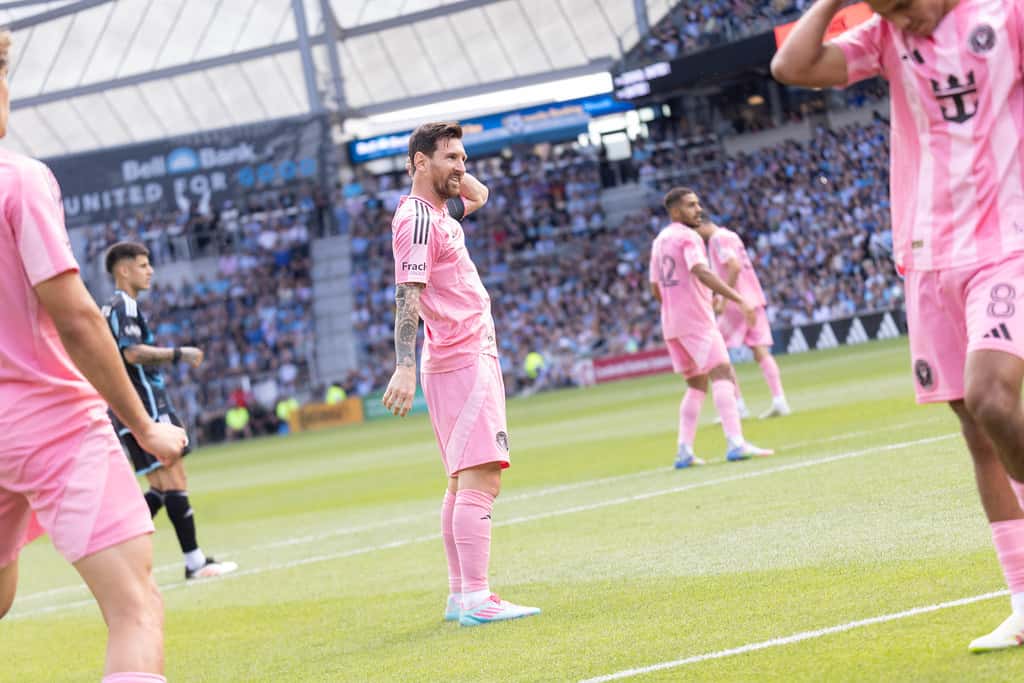
Lionel Messi scored four goals and assisted Luis Suarez as Inter Miami overwhelmed CF Montreal 7-1 on Saturday, producing the largest margin of victory in the club's history and ending a stretch in which the defending MLS Cup champions had struggled to convert their attacking talent into results.
Messi opened his account on a deflected free kick in the 40th minute, added a second after a solo run in the 52nd, completed his hat trick with a chip over the goalkeeper late in regulation, and finished the scoring with another free kick deep into stoppage time. Miami scored six unanswered goals across the run of play, turning a competitive first half into a rout.
The result carries weight beyond the scoreline. Inter Miami had lost four of its previous five matches, a run that raised questions about whether the team could defend its MLS Cup title, and the club sits in the portion of the season where positioning for the playoffs is determined.
How the match unfolded
The scoring pattern, with a first-half opener followed by six unanswered, describes a game that broke open rather than one that was decided early. Montreal remained within reach at the interval, and the second half produced the collapse that turned the result into a club record.
Messi's four goals came through four distinct methods: a deflected free kick, an individual run and finish, a chipped finish over an advancing goalkeeper, and a second free kick in stoppage time. That variety is characteristic of how he has scored throughout his career, and it makes defending him a problem without a single solution.
Free kicks accounted for two of the four. Messi has long been among the most productive dead-ball specialists in the sport, and a team that concedes fouls in dangerous areas against him is accepting a materially higher risk than it would against nearly any other player.
The assist to Suarez reflects a partnership that dates to their years together at Barcelona and that has been central to Inter Miami's attacking structure. Both players are late in their careers, and the effectiveness of that combination has fluctuated with fitness and fixture congestion.
The context of Miami's recent form
Inter Miami entered the match having lost four of five, including a 2-1 defeat to Toronto FC in which Messi scored but the team could not hold the result. Runs of that kind expose the gap between individual quality and collective consistency, which has been the central question surrounding this roster.
Miami returned to MLS play this season as defending champions, having won MLS Cup in 2025 with a victory over the Vancouver Whitecaps. Title defenses in MLS are historically difficult, in part because the league's roster and salary structure limits how much continuity a champion can preserve.
Messi's own season has been shaped by the international calendar. He took an extended break following the World Cup before returning to Inter Miami in early August, and players returning from major tournaments frequently need weeks to rebuild club rhythm and match sharpness.
His season statistics reflect substantial production across the campaign despite the interrupted schedule. Individual output has not been the team's problem; converting it into points has been.
What it means for the playoff picture
MLS uses a conference-based playoff structure in which a substantial portion of the league qualifies, which reduces the consequences of any single result but increases the importance of seeding. Home field advantage in the playoffs is determined by regular season position, and Miami's recent run had put that position at risk.
A seven-goal performance also affects goal differential, which serves as a tiebreaker in MLS standings. In a compressed table, goal differential frequently decides seeding between clubs level on points, and a plus-six night is a meaningful swing in that column.
The psychological component matters too, though it resists measurement. A team that had been losing narrowly and repeatedly now has a performance to build on, and the remaining fixtures determine whether Saturday was a turning point or an outlier against a struggling opponent.
Montreal's own season context should temper conclusions. A result of this magnitude generally requires the losing side to be having a difficult night, and evaluating what it means for Miami requires seeing whether the performance repeats against stronger opposition.
Inter Miami's place in South Florida sports
Inter Miami has changed the profile of professional soccer in South Florida since Messi's arrival. Attendance, television audiences, merchandise sales and secondary market ticket prices all moved sharply upward, and the club became a national draw whose away matches sell out visiting stadiums.
The economics have been distinctive. Messi-era demand has kept even upper-deck seats at premium prices, a departure from MLS norms and a reflection of the fact that many attendees are attending specifically to see one player rather than to follow a club.
That dynamic creates a succession question the organization will eventually face. Building institutional support that outlasts a single player is the challenge every club that has signed a global star late in his career has confronted, and few have managed it smoothly.
South Florida's sports market is among the most crowded in the country, with the Dolphins, Heat, Panthers, Marlins and Hurricanes all competing for attention alongside Inter Miami. Sustaining a share of that market through the fall, when football dominates, is a recurring test.
The World Cup year backdrop
North America hosts the men's World Cup in 2026, with matches distributed across the United States, Mexico and Canada, and Hard Rock Stadium in Miami Gardens among the American venues. The tournament has raised soccer's profile across the region in ways that extend beyond any single club.
Messi's participation with Argentina, the defending champions from 2022, has been a central storyline of the tournament cycle, and his club form and fitness have been followed with corresponding attention.
For South Florida, the tournament brings infrastructure investment, security planning and a substantial influx of international visitors. Local tourism officials have projected significant economic activity, and the region's hotel and hospitality sector has planned around it.
The interaction between the international calendar and the MLS season has complicated club scheduling throughout the year, and Inter Miami has managed a fixture list shaped by tournament commitments as well as league play.
The roster around Messi
Inter Miami's squad construction has been built around a core of veteran players who arrived with Messi or shortly after, including Luis Suarez, whose goal from Messi's assist on Saturday continued a partnership formed at Barcelona more than a decade ago. Assembling that group required navigating MLS roster rules, which limit how many designated players a club can carry outside the salary budget.
The designated player mechanism, introduced when David Beckham joined the LA Galaxy in 2007, allows clubs to sign a limited number of players whose compensation exceeds the league's budget charge. Inter Miami used those slots to build an attacking core of international stars, a strategy that produced the 2025 MLS Cup but that concentrates both the payroll and the on-field production in a small number of aging players.
Depth is where that approach shows strain. When the senior players are unavailable or fatigued, the drop-off is steeper than for clubs that distributed resources more evenly, and Miami's run of four defeats in five matches coincided with a congested stretch of the calendar. Saturday's result came with the core available and effective.
Roster turnover in MLS is constant, driven by the league's salary structure, the transfer windows and the mechanisms clubs use to acquire players. Building continuity within those rules is a challenge every MLS club faces, and it is a substantially different exercise than squad building in leagues without budget constraints.
What's next
Inter Miami continues its MLS schedule through the fall, with the regular season concluding before the playoff tournament begins. The club's remaining fixtures determine both playoff qualification and seeding.
Messi's availability for individual matches has varied with fitness management and international commitments, and the club has at times used him as a substitute rather than a starter to manage his workload across a congested calendar.
The MLS playoff format sends a substantial portion of each conference to the postseason, with a first-round series followed by single-elimination rounds. Home field in each round goes to the higher seed, which is what makes regular season positioning consequential.
Supporters tracking the club should follow official MLS and Inter Miami channels for fixture confirmations and lineup information, since kickoff times and broadcast arrangements have shifted across the season.
Miami's home matches now take place at the club's new stadium in the Miami Freedom Park development, the purpose-built facility the ownership group pursued for years through a contested municipal approval process. The move ends the club's period playing in Fort Lauderdale at the smaller venue it had used since entering the league.
Purpose-built soccer stadiums have been central to MLS economics since the league's early expansion, giving clubs control over scheduling, concessions and matchday revenue that tenancy in an NFL stadium does not provide. Nearly every established MLS club now plays in a soccer-specific venue.
Capacity increases also change the ticket market. A larger venue absorbs more of the demand that has kept Inter Miami prices elevated, though whether that translates into more accessible pricing depends on how the club sets its ticketing strategy rather than on capacity alone.
For supporters planning to attend, MLS matches are broadcast under a league-wide streaming arrangement that differs from the traditional regional sports network model used by most American leagues. That arrangement means following the club requires a specific subscription rather than a local cable package, a change that has drawn both praise for national accessibility and complaints about added cost.
Spotted an issue with this article?
Have something to say about this story?
Write a letter to the editorComments
No comments yet. Be the first to weigh in.
Related Coverage

Trevor Lawrence Throws Three Touchdowns as Jaguars Rout Patriots 35-6 in Jacksonville
1d ago

Rays Finish 98-64 and Await Yankees or Red Sox for ALDS Game 1 at Tropicana Field
1d ago

Florida Gators Jump 13 Spots to No. 8 in AP Poll After 52-28 Rout of No. 4 Ole Miss
1d ago

Baker Mayfield Out at Least Three Weeks as 0-3 Buccaneers Turn to Undrafted Rookie Jalon Daniels
1d ago