Jacksonville Is Betting Its Downtown on Semiconductors and a 19-Story Tower Conversion
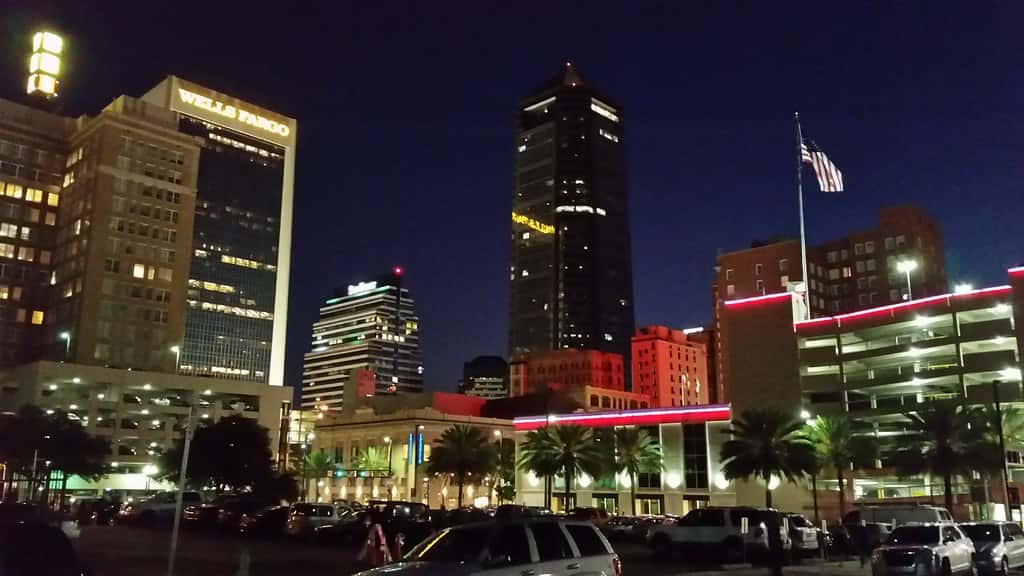
Jacksonville is pursuing two downtown redevelopment bets simultaneously, and together they describe a strategy of converting underused office space into housing while anchoring the district with a research campus. The city-owned utility JEA selected a $1 million bid from Jacksonville-based Live Oak Contracting to buy its former headquarters and convert it into a mixed-use development, and the city has committed a combined $100 million toward a University of Florida graduate campus that will house the Florida Semiconductor Institute in LaVilla.
The JEA transaction, selected September 12, covers the 19-story office tower at 21 West Church Street along with adjacent properties. Live Oak Contracting plans a project called The Jewel at 21 West, with 180 residential units, rooftop amenities, office space, and ground-floor uses. The sale remains pending approval by the JEA board.
For Northeast Florida, the two projects address the same underlying problem from different directions. Downtown Jacksonville has substantial square footage and a small residential population, and a district that empties at five o'clock cannot support the restaurants, retail, and street life that make downtowns function. Adding residents and adding a research institution are both attempts to change that arithmetic.
The JEA tower conversion
The price is the detail that draws attention. A 19-story office tower and adjacent properties selling for $1 million reflects the economics of older downtown office buildings across the country, where a large building with outdated systems and a floor plate designed for a different era can have a value below its replacement cost and in some cases below the cost of demolition.
Office to residential conversion is technically demanding, which is why it happens less often than the supply of vacant office space would suggest. The central problem is geometry. Office floors are deep, built around a service core with large distances from the core to the windows, while apartments need exterior light and air in every unit. Deep floor plates produce interior space that cannot legally or comfortably be bedrooms.
The engineering follows from that. Residential use requires plumbing stacks to individual units, where office buildings concentrate plumbing in core restrooms. Mechanical systems designed to condition open floors must be reconfigured for individually controlled units. Windows often need to be operable or replaced. Life safety systems, egress, and elevator capacity all have to meet residential code.
The 180-unit figure gives a rough sense of the design. Across a 19-story building that is roughly ten units per floor, which is a density consistent with a building whose floor plate can accommodate perimeter units with corridor access. Including office space and ground-floor uses in the program suggests the developer has identified floors or areas better suited to non-residential use.
Why JEA was selling
JEA is Jacksonville's city-owned electric, water, and sewer utility, and the former headquarters became surplus when the utility relocated. A vacant downtown tower is a liability for a public utility, which has ratepayers rather than shareholders and no business reason to carry the cost of an empty building.
Selling at $1 million to a developer with a redevelopment plan produces more public benefit than holding the asset. A converted building generates property tax revenue, adds residents who support downtown businesses, and removes a vacant structure from a district trying to attract investment. Those outcomes are worth more to the city than a higher sale price to a buyer with no plan.
Live Oak Contracting being Jacksonville-based matters for execution risk. Adaptive reuse projects depend heavily on local knowledge of permitting, subcontractor availability, and the specific building, and a local contractor-developer carries advantages over an out-of-market buyer on all three.
The pending board approval is a genuine step rather than a formality. A public utility board has fiduciary obligations and its approval process typically includes review of terms and of the buyer's capacity to perform.
The semiconductor campus
The larger bet is the University of Florida graduate campus planned for LaVilla, in the area surrounding the Prime F. Osborn III Convention Center, which will host the Florida Semiconductor Institute. The Jacksonville City Council unanimously approved transferring more than 20 acres of LaVilla land to the university and an additional $50 million in funding.
The financial structure came together in stages. A prior administration committed an initial $50 million, and Mayor Donna Deegan's administration proposed a second $50 million, bringing the city's total investment to $100 million alongside the land transfer. First classes were planned to begin by the fall of 2026.
The semiconductor focus reflects a national policy environment in which domestic chip manufacturing and the workforce to support it have become explicit federal priorities. The Florida Semiconductor Institute is a University of Florida initiative, and placing it in downtown Jacksonville rather than in Gainesville represents a deliberate choice to distribute research capacity to a major metropolitan area.
For Jacksonville the appeal is that a graduate research campus generates the kind of downtown activity a city cannot buy directly. Graduate students, faculty, and research staff live nearby, work irregular hours, use local businesses, and attract the private research and development activity that tends to cluster around universities.
Why LaVilla
LaVilla's history gives the site particular weight. The neighborhood was the center of Black commercial and cultural life in Jacksonville for much of the twentieth century, a nationally significant music and business district sometimes called the Harlem of the South. Much of it was demolished during urban renewal in the late twentieth century, leaving vacant land near the center of the city.
That history is why the availability of more than 20 contiguous acres adjacent to downtown exists at all, and it is also why development there carries obligations that a greenfield site would not. Community expectations around LaVilla projects consistently include acknowledgment of what was lost and attention to whether new investment benefits existing residents.
The location's practical advantages are real. It sits adjacent to downtown, near the convention center and transportation infrastructure, with enough land for a campus and for the private development that typically follows one. Few American cities have that much developable land that close to a central business district.
What Jacksonville is trying to solve
Downtown Jacksonville's challenge is structural rather than cyclical. The city is geographically enormous, one of the largest by land area in the country, and its development pattern has been suburban and auto-oriented for decades. Downtown has never held the share of regional activity that downtowns in denser cities do.
Residential population is the metric that matters most. A downtown with few residents cannot support grocery stores, pharmacies, or the everyday retail that makes a district livable, and without those amenities it cannot attract more residents. Breaking that loop requires adding enough units quickly enough to reach a threshold where retail becomes viable.
Office vacancy has made the problem worse and the solution more available at the same time. Remote and hybrid work reduced office demand, which hurt downtown daytime population while making conversion economics work on buildings that previously would have been too valuable as office space to convert.
The Downtown Investment Authority is the city entity responsible for coordinating this work, and it has pursued a mix of incentives, land transactions, and infrastructure investment. Multiple projects are underway simultaneously, which is the approach most likely to produce a threshold effect rather than isolated successes.
The broader Northeast Florida economy
These projects sit in a regional economy that has been diversifying. Jacksonville's traditional strengths in logistics, finance, insurance, and military activity remain, and the port and the naval installations at Mayport and Jacksonville anchor substantial employment.
The venture and startup ecosystem has been growing from a small base. A recent example came in mid-September, when Keiretsu Forum-MST, a regional chapter of a global investor network, joined Silicon Beach for a pitch event at the University of North Florida, bringing four portfolio companies to Jacksonville. Events of that kind matter less for the capital deployed than for building the local network that keeps founders in the market.
A research university presence changes that calculation more than any single event can. University research generates intellectual property, spinouts, and a supply of technically trained graduates, and those are the inputs a startup ecosystem needs. The effect operates over a decade rather than a quarter.
What it means for residents
For Jacksonville residents, the most immediate effect is fiscal. The city has committed $100 million and more than 20 acres of public land to the semiconductor campus, which is a substantial allocation that will not produce measurable returns for years. Whether that is a good use of public resources is a legitimate question that residents will judge over time.
The housing effect is smaller than the headline suggests. One hundred eighty units is meaningful for downtown, where the residential base is small, and negligible against regional housing demand. It will not move rents across Jacksonville, and it is not intended to.
The most consequential outcome would be the one hardest to measure: whether enough simultaneous investment changes the trajectory of a district that has resisted change for decades. Cities that have succeeded at downtown revitalization generally did so through the accumulation of many projects over many years rather than through a single anchor.
What's next
The JEA board vote is the immediate milestone for the tower conversion. If approved, the project moves into design and permitting, and adaptive reuse projects of this scale typically take years from sale to occupancy. Construction cost and financing conditions will determine whether the plan as announced is the plan that gets built.
For the semiconductor campus, the measures worth tracking are enrollment, faculty hiring, research funding, and whether private development follows on adjacent LaVilla parcels. That last indicator is the one that distinguishes a campus that catalyzes a district from a campus that sits in one.
Both projects will be evaluated against downtown Jacksonville's residential population and street-level activity, which are the outcomes the city is actually buying. The Downtown Investment Authority publishes development updates, and the JEA board's agenda is the place the tower sale will be resolved.
Spotted an issue with this article?
Have something to say about this story?
Write a letter to the editor