Miami Opens at No. 7 as the Only Ranked Florida Team in the Preseason Coaches Poll
The Miami Hurricanes open the 2026 college football season ranked No. 7 in the preseason USA Today Coaches Poll, the program's highest preseason position since 2004 and a distinction no other Florida program can claim this year. Miami is the only team from the state ranked in the poll.
Florida, Florida State, UCF, USF and FAU all begin the season outside the top 25. That absence represents a significant shift for a state that has historically placed multiple programs in preseason rankings.
The ranking follows Miami's run to the College Football Playoff National Championship Game last season, a result that returned the program to national relevance after two decades of inconsistency. A late-season win over Notre Dame was widely cited as the moment that cemented the turnaround.
How Miami got here
The Hurricanes have climbed steadily over consecutive seasons rather than surging in a single year. That trajectory matters to how voters assess a program, since sustained improvement tends to generate more confidence than a one-year spike.
Last season's championship game appearance was the culmination. Miami entered the expanded playoff field and advanced through it, and the program followed that run with what has been described as an equally successful offseason in roster retention and acquisition.
The transfer portal and name, image and likeness economics have reshaped how programs build rosters, and Miami's location in a talent-rich recruiting region combined with its access to South Florida boosters has positioned it well in that environment.
The No. 7 ranking reflects expectations rather than accomplishment. Preseason polls measure what voters anticipate, and the gap between preseason position and final ranking is frequently substantial across the sport.
Where Florida and Florida State stand
Both Florida and Florida State enter 2026 with significant questions. Reporting on the two programs has cited major roster turnover, new coordinators and unresolved quarterback situations at each.
Florida's program operates in the Southeastern Conference, where the schedule alone makes any rebuilding year difficult. The Gators face a conference slate that offers few opportunities for a team still establishing its identity.
Florida State competes in the Atlantic Coast Conference alongside Miami, which means the two programs' seasons are directly connected through both the standings and the annual rivalry game.
Both programs have recent history demonstrating how quickly college football fortunes shift. Florida State went from an undefeated regular season to a losing campaign within two years, and Florida has cycled through coaching transitions over the past decade.
The AP poll and what polls actually measure
The coaches poll is one of two major preseason rankings. The Associated Press Top 25 preseason poll is compiled separately by media voters and is released on its own schedule. Predictions published ahead of the AP release have generally projected Miami in the top ten.
The two polls frequently differ, sometimes substantially, because their voter pools are different. Coaches vote in the USA Today poll, and their ballots reflect a different set of perspectives and constraints than those of the media voters who fill out AP ballots.
Neither poll determines postseason access. The College Football Playoff selection committee operates independently and issues its own rankings during the season, and those rankings govern playoff selection and seeding.
The practical function of preseason polls is to set expectations and to establish a starting point from which teams rise or fall. A highly ranked team that loses early falls further than an unranked team that wins, which is why preseason position carries some residual effect through the season.
What it means for Florida college football fans
For Miami fans, the ranking establishes genuine expectations for the first time in many years. A No. 7 preseason position means the program is expected to compete for a conference championship and a playoff berth rather than to exceed modest projections.
That expectation cuts both ways. Programs ranked in the top ten face pressure that unranked programs do not, and early losses generate scrutiny that a rebuilding team avoids.
For Florida and Florida State supporters, an unranked start removes that pressure entirely and creates opportunity. Teams that begin outside the rankings and win early games rise quickly, and the absence of expectation can be an asset for a young roster.
The state's other programs, including UCF, USF and FAU, each have paths to relevance through conference play and through the possibility of a signature nonconference result.
Local impact across the state
Miami plays home games at Hard Rock Stadium in Miami Gardens, sharing the venue with the Dolphins. A ranked season drives attendance, local business activity around game days and regional television interest across South Florida.
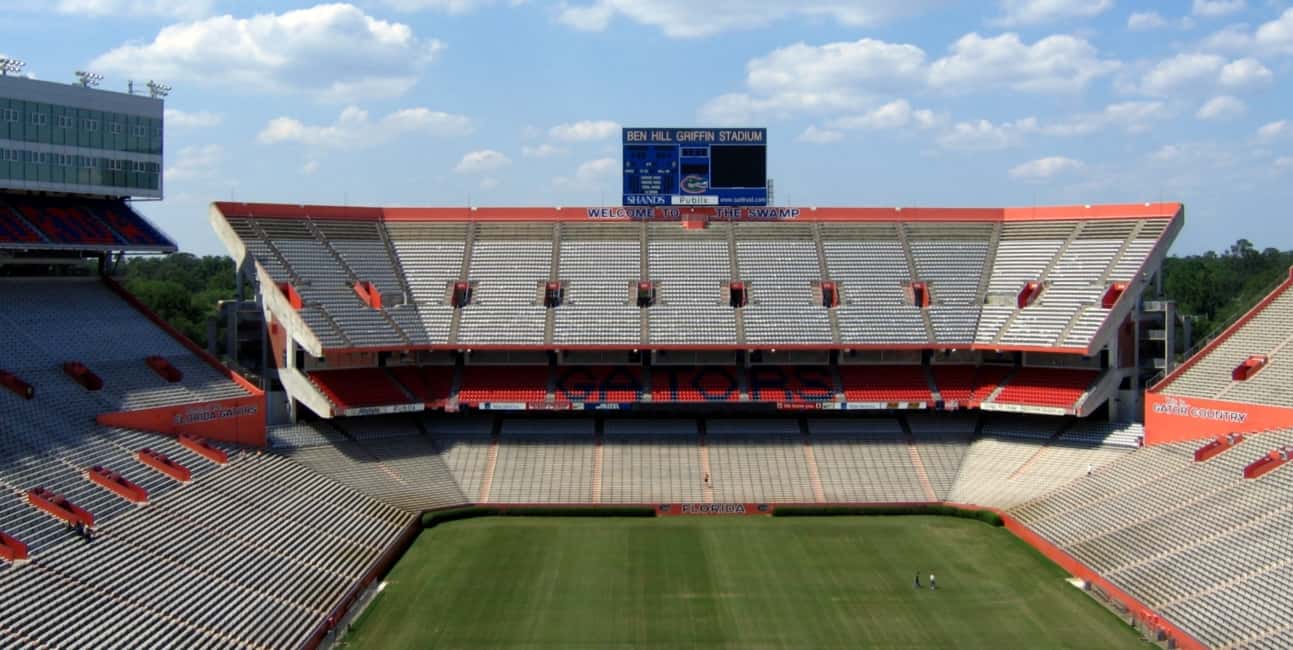
Gainesville and Tallahassee, both college towns where football weekends drive substantial portions of the local economy, feel the effects of program performance more acutely than larger metropolitan areas. Ben Hill Griffin Stadium and Doak Campbell Stadium each host crowds that exceed the permanent population of surrounding areas.
Central Florida programs at UCF and USF compete in markets where professional sports also draw attention, which makes on-field results particularly important for building local following.
Florida high school football, which produces some of the nation's densest concentration of college recruits, benefits from strong in-state programs that retain local talent rather than exporting it.
How the playoff structure changed the stakes
The expansion of the College Football Playoff transformed what a preseason ranking means for a program's realistic ambitions, and Miami's championship game appearance last season occurred within that expanded structure.
Under the larger field, conference champions receive automatic access and additional at-large positions are available, which means a team can absorb a regular season loss or two and remain viable. Under the prior four-team format, a single loss frequently ended a program's realistic chances.
That change alters how coaches approach nonconference scheduling and how they manage risk during the season. Programs have more incentive to schedule difficult nonconference opponents, since a competitive loss to a strong team damages a resume less than it once did.
For a team ranked seventh in the preseason, the expanded field means the realistic goal is not merely contention but participation, with seeding determined by conference championship results and overall record.
The economics behind the rankings
College football's competitive landscape now depends substantially on financial factors that operate outside the traditional recruiting calendar.
Name, image and likeness compensation has become central to roster acquisition and retention. Programs with access to substantial collective funding can retain players who would previously have entered the transfer portal or the professional draft, and that retention capacity shows up directly in preseason expectations.
The transfer portal itself has compressed roster building timelines. A program can address a positional weakness within a single offseason rather than waiting for recruits to develop, which means year-over-year swings in team quality are larger than they were historically.
Conference realignment has reshaped schedules and revenue distribution, and the resulting financial disparities between conferences affect what programs can offer. Miami competes in the ACC, and Florida in the SEC, conferences with different media revenue profiles.
Florida's position as one of the most productive high school football recruiting states in the country remains an asset for all its programs, though the portal has reduced the advantage that geographic proximity to talent once conferred.
What preseason rankings have historically been worth
Preseason polls are compiled before any team has played, which means they measure returning production, recruiting results and reputation rather than performance.
The historical record shows substantial movement between preseason and final rankings. Teams ranked in the preseason top ten frequently finish well outside it, and teams unranked in August regularly finish in the top ten. That volatility has increased as the transfer portal has compressed roster turnover cycles.
Reputation carries measurable weight in early polls, since voters filling out ballots in August rely partly on program history when evaluating rosters they have not seen play. Established programs tend to be ranked higher than their returning production alone would justify.
The polls do correct as results accumulate. By midseason, rankings reflect performance far more than preseason expectation, which is why the committee rankings that begin later carry more analytical weight than August ballots.
The schedule determines the season
For any ranked team, schedule structure shapes the season as much as roster quality does, and the details matter.
Nonconference scheduling involves a tradeoff. A demanding nonconference slate provides resume-building opportunities but risks early losses. A soft slate protects the record but offers little to distinguish a team when the committee evaluates comparable resumes.
Conference schedules vary in difficulty because teams do not play identical opponents. Two teams in the same conference can finish with identical records having faced substantially different competition, and the committee weighs that difference.
Game location matters as well. Road games in conference play are meaningfully harder than home games, and the distribution of home and away dates against the strongest opponents affects a team's realistic ceiling.
Bye weeks and the sequence of difficult games influence health and preparation, and teams facing several strong opponents consecutively without a break tend to accumulate injuries at the worst moments.
What's next
The 2026 season opens with nonconference games that will provide the first real evidence about whether preseason projections were accurate. Early results reshape polls quickly.
Conference play determines championship access, and for Miami and Florida State that means the ACC schedule. Florida's path runs through the SEC.
The College Football Playoff selection committee begins issuing rankings partway through the season, and those become the operative measure for postseason positioning regardless of where teams sit in the polls.
Team schedules, rosters and official releases are published by each athletic department, which remain the authoritative sources for game times, availability and program news.
Spotted an issue with this article?
Have something to say about this story?
Write a letter to the editorComments
No comments yet. Be the first to weigh in.
Related Coverage

Trevor Lawrence Throws Three Touchdowns as Jaguars Rout Patriots 35-6 in Jacksonville
1d ago

Rays Finish 98-64 and Await Yankees or Red Sox for ALDS Game 1 at Tropicana Field
1d ago
Florida Gators Jump 13 Spots to No. 8 in AP Poll After 52-28 Rout of No. 4 Ole Miss
1d ago
Baker Mayfield Out at Least Three Weeks as 0-3 Buccaneers Turn to Undrafted Rookie Jalon Daniels
1d ago