Miami Rolls Past Stanford 45-6 as Toney Sets a Hurricanes Receiving Record
Miami went across the country and dismantled Stanford 45-6, a result that said more about the Hurricanes' offensive ceiling than about the margin itself. Quarterback Darian Mensah completed 27 of 30 attempts for 400 yards and five touchdowns, a line that is close to the theoretical maximum for efficiency at the position. Receiver Malachi Toney set a Miami single-game receiving record with 233 yards on 12 receptions, three of which went for touchdowns. For a program that has spent two decades trying to recapture a standard it set in the 1980s and 1990s, a road demolition of a Power conference opponent in early September is exactly the kind of result that changes how a season is discussed.
What Mensah did
Completing 27 of 30 passes is a completion rate of 90 percent. At any level of football, over a meaningful volume of attempts, that number is extraordinary. Doing it while averaging more than 13 yards per attempt is a different category of performance entirely, because high completion rates usually come with short throws.
Five touchdown passes against three incompletions describes a quarterback in complete control of the offense, with protection holding and receivers winning. Performances like that are typically the product of scheme advantage as much as individual execution, and Miami's staff appeared to have found matchups it could exploit repeatedly.
The efficiency also reflects decision-making. A quarterback throwing at that rate is taking what the defense concedes rather than forcing contested throws, which is the behavior that separates sustainable production from high-variance production.
One game does not establish a season, and Stanford's defense will not be the toughest test on Miami's schedule. But the floor a quarterback shows in a game like this tells evaluators something about how the offense functions when conditions are favorable.
Toney's record
Malachi Toney's 233 receiving yards is now the Miami single-game record, in a program that has produced a long line of NFL receivers. Twelve catches with three touchdowns means Toney was targeted heavily and converted at a high rate near the goal line as well as down the field.
Setting a receiving record at Miami carries particular weight because of the program's history at the position. The Hurricanes have sent receivers to the NFL in every era of the program's success, and the single-game standard had stood against a deep list of candidates.
A receiver producing at that volume tends to attract defensive attention immediately afterward. How Miami's offense responds when opponents commit additional coverage to Toney will determine whether this was a breakout or an outlier.
The complementary question is whether the Hurricanes have secondary options who can punish that attention. Offenses built around a single dominant target are more easily neutralized than offenses with distributed production.
The Florida college football weekend
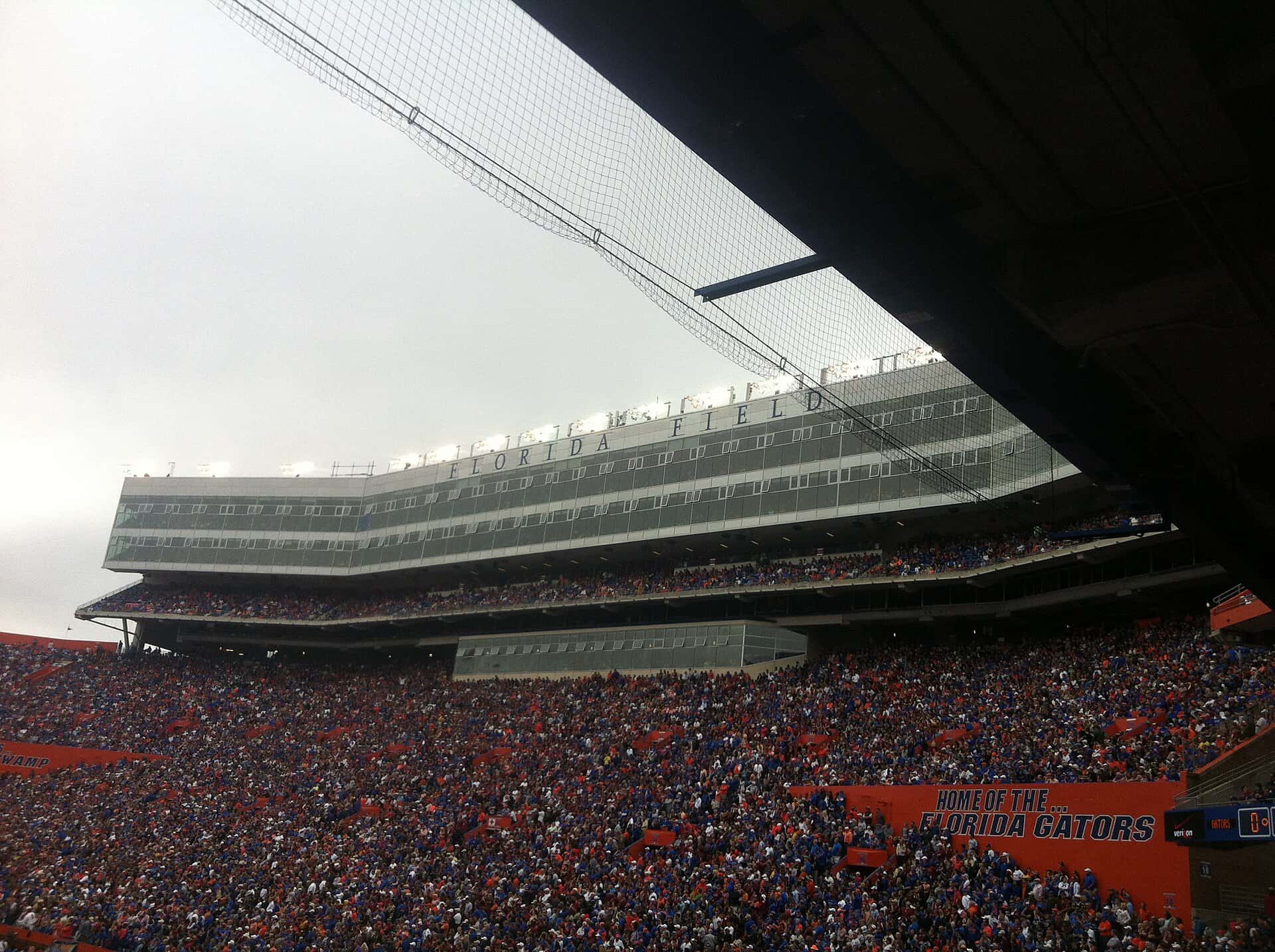
Miami's win came on Friday, September 4. The next night, Florida handled Florida Atlantic 66-21 in Gainesville, a lopsided result of its own that put up a scoring total the Gators rarely reach.
Two of the state's Power conference programs producing dominant early-season performances in consecutive days is not a common occurrence, and it sets up a fall in which Florida football conversation may be more optimistic than it has been in several years.
Florida State's schedule did not include a game that weekend. The Seminoles and Hurricanes are scheduled to meet on October 17, a rivalry game that has historically defined seasons for both programs regardless of records.
Miami and Florida do not meet in the regular season this year, a scheduling reality that has frustrated fans of both programs for decades and that resurfaces every time both teams are playing well simultaneously.
What a road win at Stanford means
Cross-country travel is a genuine competitive factor in college football. Teams flying from the East Coast to the West Coast for an early kickoff face body-clock disadvantages, and programs frequently lose games in that spot that they would win at home.
Winning by 39 points in that circumstance suggests the gap between the teams was wide enough that travel did not matter. It also suggests Miami's preparation and conditioning held up, which is a coaching indicator.
Stanford's program has been rebuilding in a changed conference landscape, and the Cardinal are not the team that competed for Rose Bowls in the previous decade. Evaluators will discount the opponent accordingly.
The value of the result is therefore less about the opponent's quality and more about Miami's own execution. A team that had been inconsistent in previous seasons produced a clean, complete performance away from home.
The ACC picture
Miami competes in the Atlantic Coast Conference, which has undergone substantial change with realignment and which now includes programs from the West Coast. The conference championship path runs through a league that has been top-heavy rather than deep.
Conference play is where Miami's season will be decided. Early nonconference results shape perception and playoff resumes, but the schedule that determines a division or championship berth comes later.
The expanded College Football Playoff format has changed the calculus for programs like Miami. Under the current structure, a team can absorb a loss and remain in contention, which reduces the catastrophic weight of any single September result.
Conference championships also carry automatic access implications, which makes the ACC race the most important variable on Miami's calendar.
What it means for South Florida
Miami football operates as a regional institution rather than simply a college program. When the Hurricanes are relevant nationally, the effect is visible in recruiting, in Hard Rock Stadium attendance and in the broader sports conversation in a market that competes for attention with three professional franchises.
Recruiting is the most consequential downstream effect. South Florida produces as much elite high school football talent as any region in the country, and the ability of the state's programs to keep that talent home depends heavily on perceived trajectory.
Attendance at Hard Rock Stadium has fluctuated with performance, as it does at most programs whose stadium sits away from campus. Winning drives crowds, and crowds drive atmosphere for recruits visiting on game days.
The program's return to national relevance has been declared prematurely several times over the past two decades. Fans have learned to wait for November before drawing conclusions.
The expanded playoff changes the math
College football's expanded playoff format has altered how programs approach September. Under the previous four-team system, a single early loss frequently eliminated a team from realistic contention, which made nonconference scheduling a risk-management exercise.
With a larger field, the calculus shifted. Teams can absorb a loss and still qualify, which reduces the incentive to schedule cautiously and increases the value of quality wins on a resume.
Conference championships also carry weight in seeding and access. That places the emphasis squarely on league play, where Miami's season will be determined, and reduces the relative importance of a September nonconference result.
Selection committees still evaluate the full body of work, which means a dominant road win over a Power conference opponent retains value even against a rebuilding program. It is a data point rather than a decisive one.
Roster construction in the transfer era
College rosters now turn over at rates that would have been unimaginable a decade ago. The transfer portal combined with name, image and likeness compensation has created something close to annual free agency across the sport.
Programs that recruit well through the portal can rebuild a position group in a single offseason. Programs that lose players through it can be gutted just as quickly. Roster continuity has become a competitive advantage in itself.
Miami has been an active participant in that market, as have most programs with the resources to compete. The composition of a modern roster reflects both high school recruiting and portal acquisition, and evaluating a team requires accounting for both.
The practical effect on evaluation is that preseason projections have become less reliable. Teams change enough between seasons that prior-year performance is a weaker predictor than it used to be, which is part of why early results draw outsized attention.
Stanford's changed circumstances
Part of what made this result possible is the disruption Stanford has absorbed through conference realignment. The dissolution of the Pac-12 sent its members to different conferences, and Stanford now competes in the Atlantic Coast Conference alongside Miami despite sitting on the opposite coast.
The travel burden that arrangement creates falls disproportionately on the West Coast members. Stanford players now make cross-country trips for conference games in a way that no previous generation of the program did.
Roster attrition has compounded the disruption. Programs in transition lose players to the transfer portal at higher rates, and rebuilding a roster while changing conferences is a difficult sequence to manage.
Realignment reshaped the ACC in the other direction as well, adding travel obligations for Miami and its eastern peers that did not exist previously. Conference schedules now routinely include cross-country trips for every member, which affects preparation, recovery and academic logistics for players in ways the sport is still adjusting to.
None of that diminishes what Miami did on the field, but it is relevant context for how much predictive weight the result carries. Evaluators discount results against programs in transition, and they should.
What's next
Miami continues its nonconference and conference schedule through the fall, with the October 17 meeting against Florida State circled on both calendars.
The immediate question is whether the offensive performance against Stanford holds up against defenses with better personnel. Efficiency numbers regress, and a 90 percent completion rate is not a sustainable baseline.
Watch the defense as well. A 6-point allowance is a strong result, and whether the Hurricanes can sustain that level of defensive play against more capable offenses will determine their ceiling.
For now, Miami has the kind of early-season result that gets a program mentioned in national conversation. Converting that into a season that matters in December is the harder part.
Spotted an issue with this article?
Have something to say about this story?
Write us a letterComments
No comments yet. Be the first to weigh in.
Related Coverage

Rays await Guardians or White Sox in ALCS after sweeping Yankees; Game 1 Monday at Tropicana Field
20h ago

John Carlson scores twice, Dennis Hildeby makes 34 saves as Lightning hold off Wild 3-2
21h ago

Winless Dolphins host Bengals at Hard Rock Stadium seeking first win under Jeff Hafley
1d ago
Hurricane Isaias Scrambles Florida Sports: FSU Cancels Pensacola Games, FAMU Moves to Friday
1d ago