Rays Carry the AL's Best Record Into a Trade Deadline They Can't Waste

The Tampa Bay Rays have spent most of the 2026 season in a position the franchise rarely occupies: not as a scrappy overachiever hanging around the wild card, but as the team with the best record in the American League. Tampa Bay entered the week reported at 62-43, holding roughly a two and a half game lead over the New York Yankees in the American League East. With the trade deadline set for August 3 at 6 p.m. Eastern, the front office faces a question it has usually been able to avoid.
That question is not whether to buy. A team with the league's best record at the end of July does not sell. The question is how much of a farm system ranked among baseball's deepest the Rays are willing to convert into two months of present-tense help and a postseason run.
For a franchise built on cost control, controllable years, and the constant replenishment of talent from below, that is a genuinely difficult calculation. It is also the calculation that separates good regular seasons from October.
Where the Rays are shopping
Reporting through the week has connected Tampa Bay to a set of targets that speak to ambition rather than incrementalism. The Rays have been linked to Los Angeles Angels shortstop Zach Neto, New York Mets right-hander Freddy Peralta, and have continued to pursue Detroit Tigers ace Tarik Skubal. The club has also been described as among the primary suitors for a two-time reigning American League Cy Young Award winner.
Those names are instructive. A rental reliever or a bench bat would be the conventional Rays deadline move. Pursuing a front-line starter with multiple years of control, or a shortstop who fits the roster beyond this season, reflects a different posture.
Rotation help is the most defensible priority for any contender in late July. Postseason series compress the value of depth and amplify the value of the top three starters, and a team that can hand the ball to an established ace in a winner-take-all game holds an advantage that regular season record does not capture.
Shortstop is the other lever. Infield defense at premium positions carries disproportionate weight in low-scoring October games, and adding a controllable shortstop addresses both the current roster and the years after it.
The prospect cost
Tampa Bay's leverage in any negotiation is its farm system, which is regarded as exceptionally deep. It is headlined by Theo Gillen, a top-10 talent across Major League Baseball who has been ranked as high as ninth overall by MLB Pipeline.
That is precisely the problem. Selling teams know what the Rays have. Reporting has indicated that the Colorado Rockies, among others, have been asking acquiring clubs for their top overall prospects, with Gillen named specifically as the kind of piece it would take.
The Rays' organizational philosophy has historically resisted exactly that trade. The club's competitive model depends on a continuous pipeline of pre-arbitration talent, because Tampa Bay does not operate at the payroll level that allows mistakes to be corrected in free agency. Trading the system's best asset removes a future cost-controlled contributor from a roster that will need one.
The counterargument is straightforward. Prospects, even elite ones, carry substantial attrition risk, and a team with the best record in its league does not get an unlimited number of these seasons. The value of a championship is not linear with the value of a top prospect.
How Tampa Bay got here
The Rays' 2026 season has been built on the elements the organization has consistently produced: pitching development, defensive flexibility, and roster construction that extracts value from players other clubs undervalue. Holding the American League's best record through late July reflects consistency rather than a single hot stretch.
The division lead over the Yankees is real but not comfortable. New York has the payroll capacity to add aggressively at the deadline, and a two and a half game margin can evaporate over a two-week stretch in August. Whatever the Rays do, they should expect their primary division rival to be active.
The Toronto Blue Jays, Baltimore Orioles, and Boston Red Sox have trailed further back in the division, which concentrates the American League East race at the top. That dynamic raises the stakes of the deadline for both Tampa Bay and New York.
What it means for Tampa Bay fans
For a fan base that has watched this franchise develop, trade, and replace star players on a rolling basis for two decades, this deadline is a test of what the organization says it is. The Rays have repeatedly argued that they operate to win, within constraints. A best-record team that stands pat would invite a different interpretation.
There is also a broader context specific to this franchise. The Rays' long-running stadium and location questions have shaped fan sentiment in the Tampa Bay region for years, and on-field success has always been the strongest argument the organization can make for regional investment in it. A deep October run is worth more to this club than to most.
Attendance and local television ratings tend to respond to contention, and a deadline acquisition that signals seriousness has value beyond the player acquired. Front offices generally resist that framing. Fan bases rarely do.
The rest of the American League
Tampa Bay is not shopping in a vacuum. Contenders across both leagues are pursuing the same limited supply of controllable starting pitching, and selling teams have priced accordingly. The number of genuine sellers at any deadline has shrunk as expanded playoff formats keep more clubs mathematically alive into August.
That scarcity is what pushes asking prices toward top-100 prospects and beyond. It also means the Rays are competing against front offices with more payroll flexibility to absorb salary, which is often the mechanism by which a selling team reduces its prospect ask.
Tampa Bay's specific advantage is quantity and quality of minor league talent. The club can construct packages that do not require it to take on significant salary, which is the trade currency it actually possesses.
How the Rays built the league's best record
Tampa Bay's model has been consistent for two decades: acquire undervalued talent, develop pitching at a rate that outpaces the rest of the league, and build a roster where defensive versatility lets a manager create favorable matchups every night rather than relying on a fixed lineup.
The organization's pitching development in particular has become the template other clubs study. The Rays have repeatedly taken pitchers with one plus attribute and turned them into effective major league contributors by reshaping pitch mixes, usage patterns, and mechanics.
Roster construction follows from that. When a club can generate pitching internally, it can allocate its limited payroll and trade capital elsewhere. It also means the Rays are rarely desperate for any single acquisition, which strengthens their position in negotiations.
What is different this year is the margin. A team that holds the league's best record at the end of July has already banked the hardest part of a postseason berth, and the remaining question is seeding and October readiness rather than qualification.
Why seeding matters more than it used to
Under the current postseason format, the top two division winners in each league receive a bye through the wild card round. That bye is worth a great deal, both because it eliminates a three-game series in which any team can lose and because it allows a rotation to reset.
Teams that play through the wild card round arrive at the division series having used their best starters, which compounds across the postseason. The bye is the single most valuable competitive asset available in the regular season standings.
That is the practical argument for Tampa Bay adding at the deadline even at a steep prospect cost. A team on the boundary between a bye and a wild card series has more to gain from marginal wins in August and September than its raw record suggests.
The Yankees are the immediate obstacle in the division and, given the American League's structure, a likely competitor for seeding regardless of how the division finishes. Games between the two clubs over the remaining schedule carry double weight.
The stadium question in the background
No discussion of the Rays is complete without acknowledging the franchise's long-running facility and location uncertainty, which has shaped the organization's economics and its relationship with the Tampa Bay region for years.
Attendance, local media revenue, and corporate sponsorship all depend in part on the stability of that picture, and all of them feed back into what the club can spend. Winning is the variable the baseball operations department controls, and sustained success is the strongest argument available for regional investment.
For fans, that context adds weight to the deadline. A front office that treats an American League-best season as an opportunity to be maximized sends a different message than one that treats it as a fortunate outcome to be preserved cheaply.
What's next
The deadline is August 3 at 6 p.m. Eastern. Historically, the largest share of deadline volume occurs in the final 48 hours, and the market for starting pitching in particular tends to clear late as selling teams wait for competing bidders to raise offers.
Whatever Tampa Bay does or does not do, the schedule continues immediately. The division lead over the Yankees will be decided over roughly two months of remaining games, and the Rays' postseason seeding, which determines home field and whether they avoid a wild card round, is very much undetermined.
Rays fans should watch for how the front office prioritizes: a rotation addition suggests October-first thinking, while a controllable position player suggests the organization is trying to do both at once. The Florida Press will report on Tampa Bay's deadline moves as they are completed.
Spotted an issue with this article?
Have something to say about this story?
Write us a letterComments
No comments yet. Be the first to weigh in.
Related Coverage
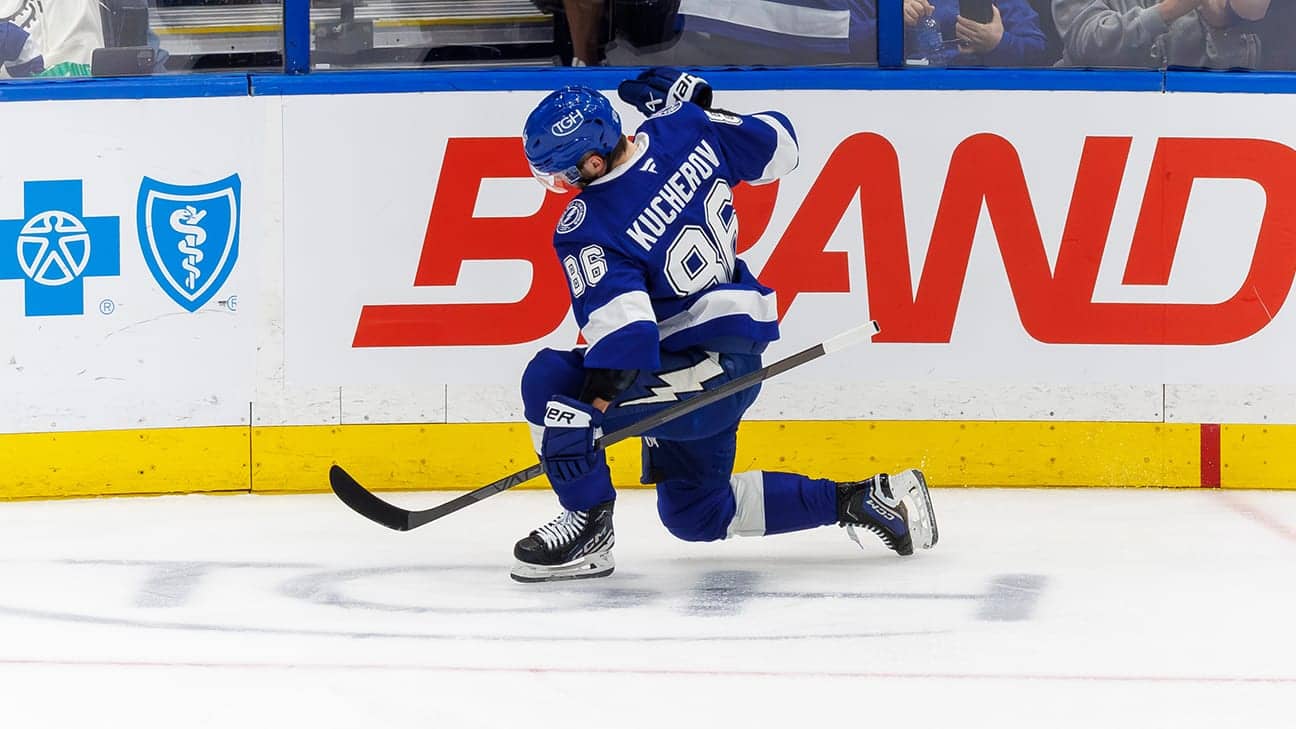
Nikita Kucherov Passes Steven Stamkos as Lightning's All-Time Points Leader in OT Loss to Mammoth
4h ago

Hornets Beat Heat 115-110 as Giannis Antetokounmpo Fouls Out and Miami Falls to 0-3
5h ago

Timberwolves Dominate the Glass, Rout Magic 115-93 at Kia Center as Orlando Falls to 0-2
1d ago

Pistons Beat Heat 128-111 as Giannis Antetokounmpo's 36 Points Can't Fix Miami's Defense in 0-2 Start
1d ago