SpaceX Set to Launch AST SpaceMobile's Largest Satellites From Cape Canaveral
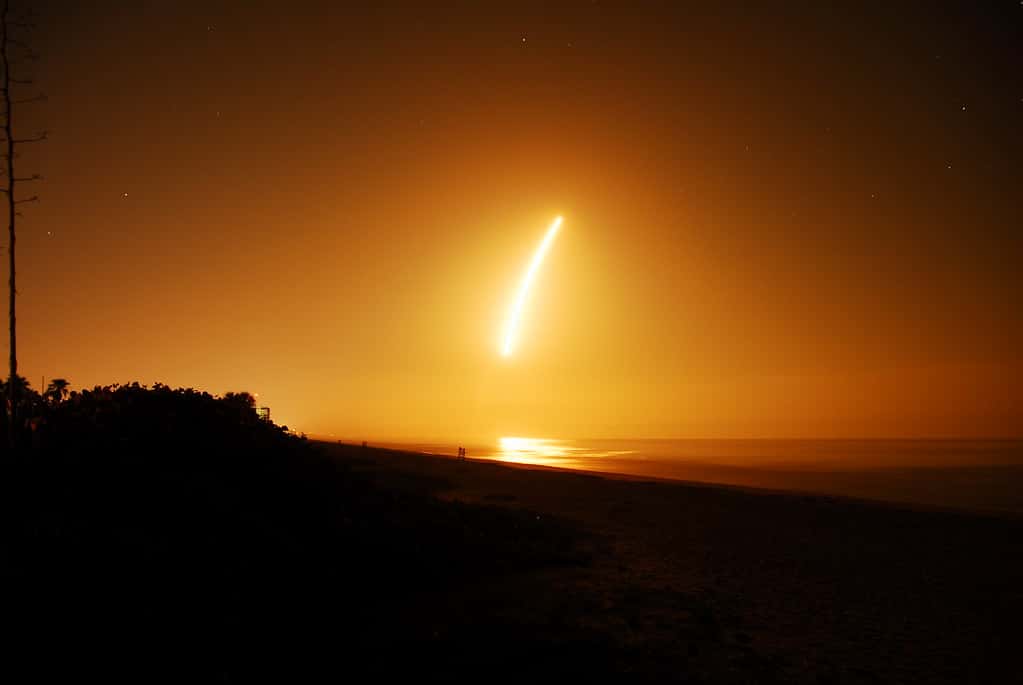
A SpaceX Falcon 9 rocket is scheduled to lift off from Space Launch Complex 40 at Cape Canaveral Space Force Station carrying three AST SpaceMobile BlueBird satellites, in a mission targeted for the pre-dawn hours with liftoff set for 3:42 a.m. Eastern and a backup opportunity at 5:10 a.m. The BlueBird 11, 12 and 13 satellites are designed to deliver cellular broadband directly to ordinary smartphones, and they carry what the company describes as the largest commercial phased arrays ever deployed in low Earth orbit.
What is on board
The three satellites represent the next generation of AST SpaceMobile's constellation. Each carries a phased array antenna spanning nearly 2,400 square feet, a substantial increase over the roughly 693 square feet of the company's first-generation BlueBirds, which previously held the record for the largest commercial arrays in low Earth orbit. Deploying a structure of that size in orbit is itself an engineering challenge, since the array must fold into a payload fairing and unfold reliably once on station.
The size is the point. A larger array captures and transmits a stronger signal, which is what allows an unmodified consumer phone on the ground, transmitting at a fraction of a watt, to connect to a spacecraft hundreds of miles overhead without a specialized antenna or external hardware. The link budget in a direct-to-device system is extraordinarily tight, and array area is the primary lever available on the space side. The company has said the upgraded design is capable of delivering nearly double the peak download speeds of its first-generation satellites.
The mission follows the June 2026 launch of BlueBird satellites 8, 9 and 10, and supports the company's stated plan to begin beta services later this year. Building out a direct-to-device constellation requires enough satellites in orbit to provide meaningful coverage, since a single spacecraft passes over any given point for only a few minutes at a time. That is why launches have come in clusters rather than individually.
Why it matters in Florida
Cape Canaveral's launch cadence is the most visible expression of Florida's aerospace economy, and each mission from Space Launch Complex 40 is part of an industry that has grown into a substantial employer along the Space Coast. Brevard County's economy is tied to that cadence in a way no other Florida county's is, and the effect extends into Orange and Volusia counties as suppliers and workers locate within commuting distance.
The direct-to-device capability itself carries a Florida-specific application. Satellite connectivity to standard cellphones is most valuable exactly where terrestrial networks fail, which in Florida means after a hurricane knocks down cell towers, floods equipment shelters and cuts the fiber backhaul that connects surviving towers to the network. Communication failures have been a recurring problem in the aftermath of Florida landfalls, complicating both emergency response and family reunification.
Emergency managers have historically relied on satellite phones, dedicated radio systems and mobile cell sites for post-storm communication, equipment the general public does not carry and that takes time to deploy. A constellation that connects ordinary phones would change that calculus substantially, though the technology's real-world performance during a major disaster remains to be demonstrated at scale, and capacity limits mean it is unlikely to replace terrestrial networks for routine use.
The broader launch schedule
The Cape's manifest continues past this mission. SpaceX has scheduled a Falcon 9 launch of 29 Starlink satellites to low Earth orbit from the same complex on Monday, August 10, part of the routine cadence that has made Cape Canaveral one of the busiest launch sites in the world by a wide margin.
That pace has practical effects on the Space Coast. Road closures on State Road 401 and the causeways, temporary flight restrictions and marine exclusion zones accompany each launch, and the tourism industry along the Brevard County coast has built viewing offerings, hotel packages and cruise excursions around the published schedule. Port Canaveral cruise departures are occasionally timed to give passengers a view.
Pre-dawn launches produce their own distinctive visual. A rocket ascending before sunrise can catch sunlight at altitude while the ground remains dark, creating the illuminated exhaust plume sometimes called a twilight phenomenon that draws viewers well beyond the immediate launch area, sometimes visible across much of the peninsula and into neighboring states.
How direct-to-device fits the market
AST SpaceMobile is not alone in pursuing satellite connectivity to standard phones. SpaceX has been building direct-to-cell capability into its own Starlink constellation, and other operators have announced competing approaches. The market is being contested before it has been proven commercially.
The business model generally involves partnerships with terrestrial mobile network operators rather than direct consumer relationships. A carrier licenses spectrum and holds the customer, and the satellite operator provides coverage in areas the terrestrial network cannot reach. That structure avoids the need for a satellite company to build a retail business from scratch.
Capacity is the fundamental constraint. A satellite serving a large footprint has far less bandwidth per user than a terrestrial cell site serving a few square miles, which is why early services are oriented toward messaging and basic connectivity rather than toward replacing broadband. That limitation shapes what the technology can realistically deliver during a disaster with millions of people affected.
Florida's aerospace expansion
The launch comes as Florida continues to add aerospace manufacturing capacity. Relativity Space announced an expansion on the Space Coast during the Farnborough International Airshow in July, with Space Florida describing a plan for an additional Terran R production facility and expanded test and launch infrastructure at Kennedy Space Center and Cape Canaveral Space Force Station.
The state has attached public investment to that growth. Relativity Space would be eligible for up to $134 million from the Florida Department of Transportation's Spaceport Improvement Program under the arrangement announced with the expansion, which was developed at a June 2026 Space Florida board meeting under the code name Project Forge.
Separately, members of Florida's congressional delegation have pushed legislation that would relocate NASA headquarters from Washington to Brevard County ahead of the agency's August 2028 lease expiration. That effort is aimed at consolidating agency leadership near the launch infrastructure Florida already operates, and it has drawn bipartisan co-sponsorship from the state's House delegation.
What it means for Floridians
For Space Coast residents, the launch is routine in frequency and consequential in aggregate. The industry supports engineering, manufacturing, logistics, range operations and services employment across Brevard County, and the wage levels in aerospace are well above the Florida median, which affects local housing markets and school enrollment.
For the rest of the state, the connection is less direct but real. Aerospace has become one of the sectors Florida cites when recruiting employers, and the supply chain reaches into manufacturing operations well outside Brevard County, including composite fabrication, machining and electronics work in Central and North Florida.
For consumers, direct-to-device satellite service is still developing. Beta service planned for later this year will be the first meaningful test of whether the technology performs as advertised for ordinary users, and commercial availability, pricing and carrier partnerships in the United States have not been fully established.
Watching a launch from Florida
Launch viewing has become a substantial tourism draw along the Space Coast. Public viewing areas along the Indian River and Banana River in Titusville, Cocoa and Port Canaveral offer clear sightlines, and Kennedy Space Center Visitor Complex sells ticketed viewing packages for many missions.
Visibility extends far beyond Brevard County. A daytime launch is frequently visible from Orlando, Daytona Beach and Melbourne, and night launches can be seen from much of the peninsula and occasionally from neighboring states depending on trajectory and atmospheric conditions.
Booster return adds a second event. When a Falcon 9 first stage returns to a landing zone at Cape Canaveral rather than to a droneship at sea, the reentry burn and landing produce sonic booms audible across Brevard County and sometimes well inland, which occasionally surprises residents unfamiliar with the schedule.
Range operations and the launch cadence
Every launch from Cape Canaveral requires coordination with the Space Force's Eastern Range, which manages safety, tracking and airspace and maritime clearance. Range capacity was historically the constraint on launch frequency, and modernization has been a priority as commercial demand grew.
Automated flight safety systems, which allow a vehicle to terminate its own flight if it deviates from a safe corridor rather than relying on a range safety officer, substantially reduced the personnel and turnaround time each launch requires. That change is among the reasons the cadence has been able to increase.
Airspace and maritime closures still affect the region on launch days. Commercial aviation routes are adjusted, and boat traffic is excluded from designated areas offshore, which affects charter fishing and recreational boating out of Port Canaveral during launch windows.
What's next
Launch times are subject to change based on vehicle readiness, weather and range availability, and the backup window at 5:10 a.m. exists precisely because those variables shift. Weather at the Cape in August frequently includes convective activity, anvil cloud and lightning within the range criteria, any of which can push a launch to a subsequent day.
AST SpaceMobile's constellation buildout continues past this mission, with the company working toward the coverage density required for continuous service. The Starlink mission scheduled for August 10 will follow from the same pad, illustrating the turnaround time SpaceX has achieved at Space Launch Complex 40.
The Florida Press will continue covering launches from Cape Canaveral and Kennedy Space Center, along with the aerospace manufacturing and policy decisions shaping the Space Coast economy through the remainder of 2026.
Investors will also be watching the deployment sequence. AST SpaceMobile's next-generation array has to unfold correctly in orbit before it can demonstrate the performance the company has projected, and the period immediately following separation is when that becomes clear.
The Cape's manifest for the remainder of 2026 includes missions from multiple operators, with United Launch Alliance and Blue Origin holding their own pads at Cape Canaveral Space Force Station alongside SpaceX. The combined schedule keeps Brevard County among the busiest spaceflight regions in the world.
Spotted an issue with this article?
Have something to say about this story?
Write a letter to the editor