Artemis III Rocket Takes Shape at Kennedy Space Center as NASA Readies a 2027 Earth-Orbit Lander Test
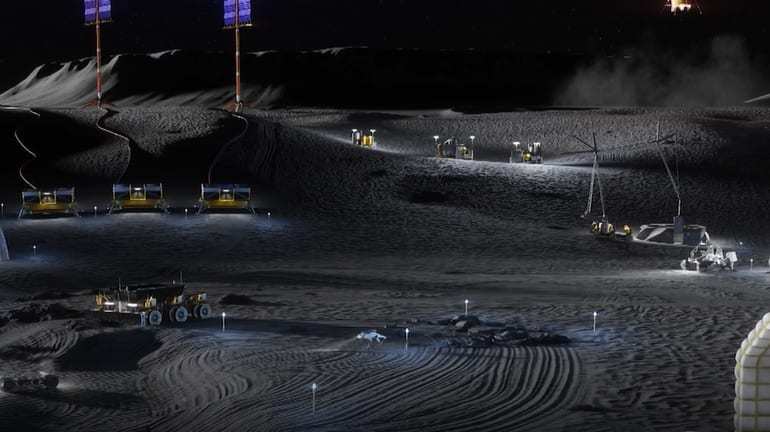
The rocket for NASA's Artemis III mission is now standing inside the Vehicle Assembly Building at Kennedy Space Center, with the Boeing-built core stage joined to its twin solid rocket boosters in High Bay 3 and teams preparing for a fueling test at Launch Pad 39B. The work puts Florida's Space Coast on track for a 2027 launch that NASA Administrator Jared Isaacman has said he is extremely confident the agency will meet, though the mission will no longer land on the Moon. Instead, four astronauts will spend about two weeks in low Earth orbit testing how the Orion spacecraft docks with commercial lunar landers from Blue Origin and SpaceX.
Where the rocket stands
NASA says technicians lifted the 212-foot core stage, the largest section of the Space Launch System rocket, from the transfer aisle of the Vehicle Assembly Building in late October and integrated it alongside the twin solid rocket boosters on the mobile launcher in High Bay 3. Agency photos date the work to Oct. 22 through Oct. 28. The combination of core stage and boosters is what NASA calls the short stack, because it lacks the upper portions of the rocket and the Orion spacecraft.
Boeing, which designs and assembles the core stage, said the stage will remain in High Bay 3 for stacking and final processing ahead of the tanking test and the 2027 launch. FlightGlobal reported in November that Boeing was preparing the stage for fueling and further testing. This stage was the first shipped from NASA's Michoud Assembly Facility in New Orleans without its engine section attached, a change that let teams complete vertical integration at Kennedy. It left Michoud on April 20 and arrived in Florida by barge.
Once checkouts are done, NASA plans to roll the short stack to Pad 39B, where launch teams will load supercooled liquid hydrogen and liquid oxygen into the core stage only and rehearse countdown procedures and timelines. The agency has said the rollout will happen in the coming months but has not announced a date. While the rocket is at the pad, the Artemis III crew is expected to rehearse launch day, suiting up in crew quarters, riding to the pad and walking through the emergency exit route from the mobile launcher.
Recent milestones on the Space Coast and elsewhere are listed below.
| Date | Milestone |
|---|---|
| April 20, 2026 | Artemis III core stage leaves Michoud for Kennedy |
| June 9, 2026 | NASA names Artemis III crew and backup |
| Aug. 14, 2026 | Isaacman says he is extremely confident of a 2027 launch |
| Oct. 13, 2026 | Booster stacking done; four RS-25 engines installed |
| Oct. 22 to 28, 2026 | Core stage joins boosters in High Bay 3 |
| Oct. 23, 2026 | NASA briefing details Earth-orbit mission plan |
| Nov. 7 to 8, 2026 | Crew appears at NASA's MAX POWER expo at Kennedy |
A test flight, not a landing
Artemis III was originally planned as the first crewed lunar landing since Apollo. Under changes Isaacman introduced, it is now a test flight in Earth orbit meant to reduce risk before Artemis IV, which NASA plans as the first crewed landing near the Moon's South Pole in 2028.
According to NASA's mission description published Oct. 23, Blue Origin will first launch a test version of its Blue Moon Mark 2 lander into a circular orbit about 273 miles up, where it can wait for up to 30 days. Days later, SLS will launch Orion and its crew from Kennedy. After about two days of systems checks, Orion will rendezvous and dock with the Blue Moon test article, and the astronauts will spend roughly two days evaluating it, including opening the hatch and entering the cabin to check controls and life support.
SpaceX will then launch a Starship Version 3 test article from Florida. Orion will dock with Starship for up to two hours to test how the two vehicles behave as a joined system; the crew will not enter Starship. Orion will then have up to five more days in orbit for suit evaluations, sensor tests and science experiments before splashing down in the Pacific Ocean off California. NASA's Artemis program manager, Jeremy Parsons, said the mission involves launching three spacecraft on three different rockets and testing how they work together, something the agency has never attempted.
Because there is no trip to the Moon, Artemis III will fly a spacer in place of the rocket's upper stage. NASA said in October that the spacer's primary structure was complete at Marshall Space Flight Center in Alabama and that it and two adapters were on track to ship to Kennedy early next year.
The crew, including a Florida native
NASA named the crew on June 9: NASA astronauts Randy Bresnik, Frank Rubio and Andre Douglas, and European Space Agency astronaut Luca Parmitano, the first ESA astronaut assigned to an Artemis mission. NASA astronaut Bob Hines is the backup.
Rubio, whom NASA describes as a Florida native, holds the record for the longest single spaceflight by an American, 371 days aboard the International Space Station from 2022 to 2023. Bresnik is a veteran of a space shuttle flight and a long-duration station mission, Parmitano has commanded the station, and Douglas, who served as a backup for Artemis II, will be making his first flight.
Bresnik, Rubio, Parmitano and Hines rode through Kennedy Space Center Visitor Complex in vintage Corvettes during a parade on Nov. 7 as part of MAX POWER, NASA's first aerospace expo and air show at Kennedy, and the crew took the stage to preview the mission. The event, held Nov. 4 through 8, drew President Donald Trump and featured a skydive by Isaacman and a performance by the U.S. Air Force Thunderbirds.
Isaacman's confidence and the schedule
Isaacman told reporters in mid-August that he was extremely confident Artemis III would launch in 2027, according to SpacePolicyOnline and Spaceflight Now. He tied that confidence partly to hardware progress at Kennedy and partly to SpaceX keeping up a steady Starship launch cadence. NASASpaceFlight has reported a target of no earlier than June 2027, while NASA's own statements refer only to a 2027 launch.
Key risks remain outside NASA's own hardware. Both landers are still in development, and the mission depends on Blue Origin and SpaceX each delivering a flight-ready test article and launching it on a tight timeline relative to SLS.
What it means for the Space Coast
For Brevard County, Artemis III means a heavy launch campaign concentrated in one mission: an SLS launch from Kennedy, a Starship launch from Florida and the Blue Origin lander flight, all coordinated within days of one another. The processing work in the Vehicle Assembly Building, the pad refurbishment at 39B after the Artemis II launch and the ground systems work all sustain jobs at Kennedy and among the contractors that support it. NASA said in October that the flame deflector at Pad 39B saw minimal damage from Artemis II and is being refurbished.
The state is also pressing to expand its role. Florida has bid to host NASA's new U.S. Space Academy, proposing an interim campus at the University of Central Florida and a 1,000-acre site at Kennedy, as The Florida Press reported Nov. 20. And NASA has announced CAPEWEEK, a new annual aerospace and technology expo at Kennedy's Shuttle Landing Facility set to debut March 27 through April 2, 2028.
What's next
The next visible milestone will be the short stack's rollout from the Vehicle Assembly Building to Pad 39B for the tanking test, followed by the crew's launch day rehearsal at the pad. NASA also expects the spacer and stage adapters to arrive at Kennedy early in 2027, after which full stacking with Orion can proceed toward a launch later in the year.
Spotted an issue with this article?
Have something to say about this story?
Write us a letterComments
No comments yet. Be the first to weigh in.
Related Coverage
Appeals Court Rules I-220A Is Not Parole, Closing a Green Card Path for Thousands of Cubans in South Florida as Miami Lawsuits Press On
1h ago
FedEx MD-11 Cargo Jet Runs Off Runway at Miami International Airport, Snarling Thanksgiving Eve Travel
23h ago

FCC Clears SpaceX to Deploy Up to 1 Million 'Starmind' Data-Center Satellites, a Plan That Would Lean on Florida's Starship Pads
23h ago

Black Friday 2026: Necessities Join Gifts in Florida Shopping Carts as AI Tools and Higher Prices Steer Spending
1d ago