Cape Canaveral Launch Cadence Keeps Climbing as Starlink Missions Dominate
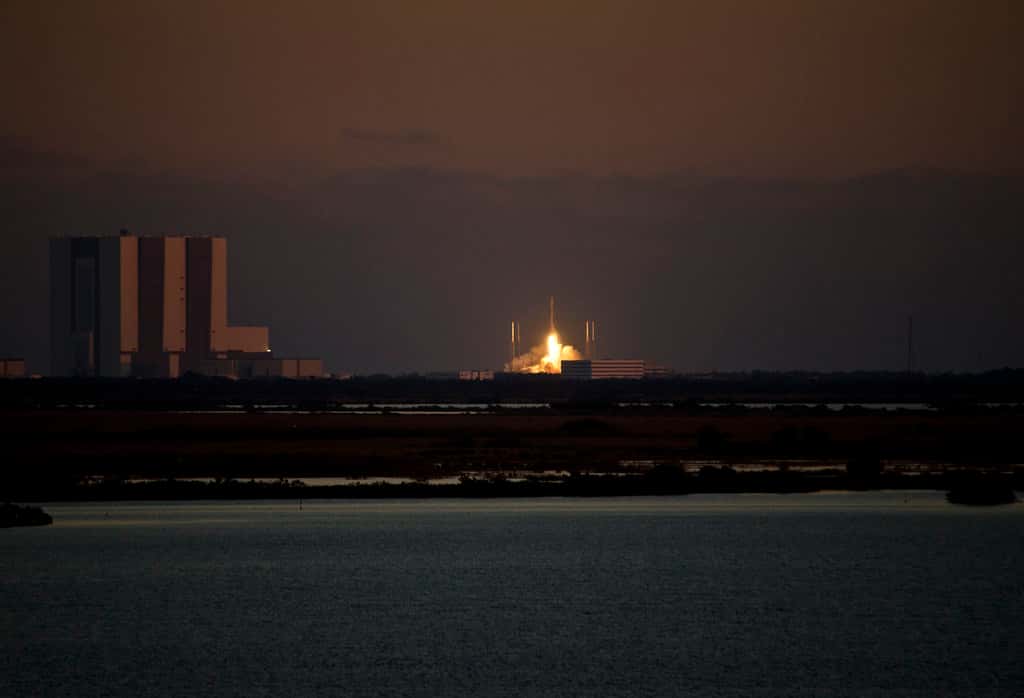
SpaceX launched its 80th Starlink mission of 2026 on a Falcon 9 from Florida's Space Coast on September 5, and followed with a mission carrying the final three O3b mPOWER communications satellites from Space Launch Complex 40 at Cape Canaveral Space Force Station, scheduled no earlier than Sunday, September 13. The pace reflects a launch cadence from Florida that has no historical precedent and that has reshaped the economy of Brevard County and the surrounding region.
For Floridians, the significance is less about any individual mission than about what routine access to orbit from the Space Coast has become. Launches that once drew statewide news coverage and school field trips now occur on a schedule closer to commercial aviation than to the Apollo era, and the infrastructure, workforce and range operations supporting them have scaled accordingly.
The Kennedy Space Center Visitor Complex continues to sell launch viewing as part of general admission, including from The Gantry at Launch Complex 39, a premium location with bleacher seating, launch audio and a live video feed, accessible on a first-come basis via the bus tour.
The cadence numbers
Eighty Starlink missions in roughly eight months works out to a Starlink launch approximately every three days, and that counts only one payload category from one operator. Add commercial customer missions, national security launches, NASA missions, and launches by United Launch Alliance and Blue Origin, and the total Florida launch count climbs substantially higher.
Sustaining that requires booster reuse at scale, rapid pad turnaround, and range operations capable of clearing airspace and maritime traffic at a frequency that would have been considered impossible fifteen years ago. The Space Force has invested in range modernization specifically to raise throughput, including automated flight safety systems that reduce the personnel and time required per launch.
The O3b mPOWER mission completing that constellation is a different kind of milestone. Those satellites operate in medium Earth orbit and serve broadband connectivity markets, and finishing the deployment closes out a multi-year launch campaign.
What it means for Brevard County
The economic effect on Florida's Space Coast has been substantial and uneven. Employment in aerospace and supporting industries has grown sharply, wages in technical occupations have risen, and the region has attracted workers from across the country.
The costs have landed in housing and infrastructure. Brevard County housing prices have risen well beyond historical norms for the area, and road capacity has not kept pace with growth. County commissioners recently delayed consideration of a local gas tax increase intended to fund transportation work, citing reluctance to raise fuel costs for residents.
Municipalities are pursuing consolidation to manage budgets. Palm Bay's city council has been weighing a transfer of its 911 dispatch operations to the Brevard County Sheriff's Office, with supporters projecting annual savings of $1 million to $2 million.
The tourism dimension
Launch viewing has become a durable tourism product rather than an occasional event. The Kennedy Space Center Visitor Complex builds launch access into its admission offering, and hotels along the Space Coast market launch packages.
The value of that product depends on predictability, which launch schedules do not provide. Missions slip for weather, for technical reasons, and for range conflicts, and a visitor who books a trip around a launch date frequently sees it move. The Visitor Complex's approach of including viewing with general admission rather than selling standalone launch tickets partially addresses that.
High cadence helps here too. When launches occur every few days, a visitor staying several nights on the Space Coast has a reasonable probability of seeing one regardless of individual mission slips, which was not true when launches were monthly.
The range as a shared asset
Cape Canaveral Space Force Station is a military installation, and commercial launches occur there under agreements with the Space Force. Kennedy Space Center, adjacent to it, is a NASA facility from which SpaceX operates Launch Complex 39A under a lease dating to 2014, with modifications supporting Falcon 9 and Falcon Heavy.
That arrangement, in which military, civil and commercial space operations share range infrastructure and airspace, is the defining feature of the Space Coast and the reason it has remained the center of American launch activity despite competition from other sites.
It also creates scheduling tension. National security missions take priority, NASA missions have fixed windows tied to orbital mechanics, and commercial missions fill the remainder. As cadence rises, the coordination problem intensifies, and range availability has become a real constraint on how many launches Florida can support.
The Starlink question
The dominance of Starlink in the launch manifest raises a question about what the cadence actually measures. A large share of Florida launch activity is one company placing its own satellites into orbit for its own broadband business, which is a different economic proposition than a launch market serving diverse customers.
The counterargument is that the reusability and operational tempo developed through Starlink launches lowered costs for every other customer, and that the commercial and government missions flying from Florida benefit directly from infrastructure that Starlink volume paid to build.
Either way, the concentration is a risk factor for Brevard County. A regional economy heavily dependent on the launch rate of a single company's internal program is exposed to that program's business trajectory in ways a diversified launch market would not be.
Beyond SpaceX
United Launch Alliance operates from Cape Canaveral, Blue Origin has established launch operations on the Space Coast, and Space Florida, the state's aerospace development authority, has worked to attract additional operators.
Diversification matters for the reasons above, and it also matters for national security launch assurance, the policy principle that the United States should maintain multiple independent paths to orbit rather than depending on any single provider.
Boeing's Starliner program has operated from Florida as well, part of NASA's commercial crew approach of maintaining two independent crew transportation systems.
What reuse changed
None of the current cadence would be possible without booster recovery and reflight. A Falcon 9 first stage returns either to a landing zone at Cape Canaveral or to a droneship positioned downrange in the Atlantic, is refurbished, and flies again. Individual boosters have accumulated flight counts that would have been considered science fiction when the program began.
The economic consequence is that the marginal cost of a launch fell dramatically, which is what made a constellation requiring thousands of satellites financially plausible in the first place. The operational consequence is that launch frequency is limited by pad turnaround, range availability and payload production rather than by how many rockets a factory can build.
Recovery operations have become their own Florida industry. Droneship and support vessel operations run out of Port Canaveral, and the port has adapted infrastructure to handle returning boosters and fairings, adding a maritime dimension to the Space Coast's aerospace economy.
Sonic booms from returning boosters are now a routine feature of life in Brevard County, audible across a wide area. Local governments and the Space Force issue advisories, and the booms have become a recognizable, if occasionally startling, part of the regional soundscape.
The workforce behind the cadence
Sustaining a launch every few days requires a workforce spanning launch operations, propulsion, avionics, range safety, logistics and facility maintenance. Brevard County's technical labor market has tightened accordingly, and employers across the region compete for the same pool of engineers and technicians.
Eastern Florida State College, the Florida Institute of Technology in Melbourne and Embry-Riddle Aeronautical University in Daytona Beach feed that pipeline, and all three have expanded aerospace-related programs as demand has grown. Technical and trade programs producing welders, machinists and electronics technicians have become as important to the sector as engineering degrees.
The Space Force's civilian hiring at Patrick Space Force Base adds a third competitor to the commercial and contractor employers already recruiting locally, which is good for wages and challenging for employers trying to staff up simultaneously.
Housing is the binding constraint. Brevard County's residential market has tightened substantially as the aerospace workforce has grown, and the cost of living increases that follow make recruitment from lower-cost regions harder than it was five years ago.
What comes after Falcon
The current cadence rests on a vehicle that has been flying for well over a decade. The next generation of heavy-lift capability, from SpaceX and from competitors, will eventually change the shape of Florida's launch infrastructure again, with larger vehicles requiring different pads, different propellant handling and wider safety corridors.
Kennedy Space Center and Cape Canaveral Space Force Station have been through this transition before, converting Apollo-era infrastructure to Shuttle use and then Shuttle infrastructure to commercial use. Each transition left behind facilities that had to be demolished or repurposed, and each created a period of uncertainty for the regional workforce.
Space Florida, the state's aerospace development authority, exists in part to manage that continuity, working to attract new operators to facilities as they become available and to finance infrastructure that individual companies would not build alone.
What's next
Launch schedules for the remainder of 2026 are published by the range and tracked by several public sources, and Florida's cadence shows no sign of slowing. Watch for whether range throughput becomes a binding constraint, which would push pressure toward either further range modernization or toward alternative launch sites.
Watch also the infrastructure response in Brevard County. Growth driven by launch activity has outpaced local road, school and housing capacity, and the funding decisions county and municipal governments make over the next several years will determine whether the Space Coast absorbs its growth or is degraded by it.
For Florida residents who want to see a launch, the practical advice is unchanged: check the schedule close to the date, expect slips, and consider that a high-cadence year offers more opportunities than any prior period in the history of American spaceflight.
Spotted an issue with this article?
Have something to say about this story?
Write a letter to the editor