Federal Disaster Dollars Flow to Florida as Hurricane Season Tests the State's Defenses
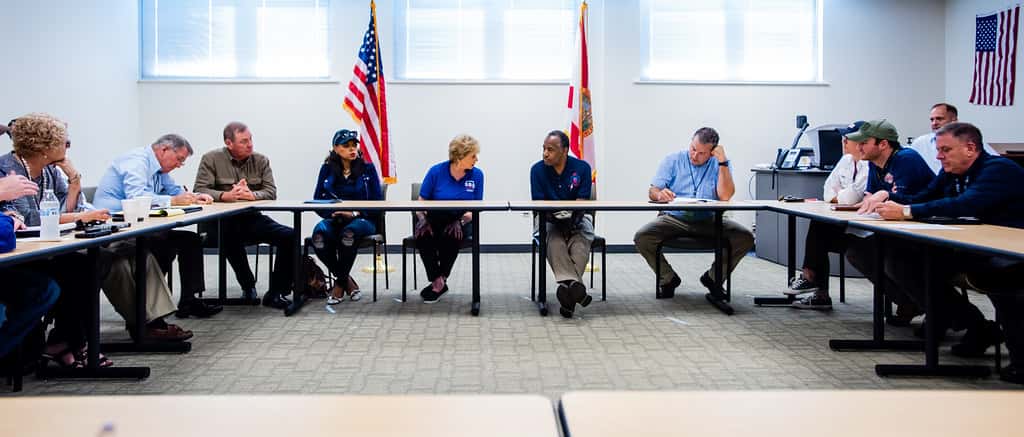
As the Atlantic hurricane season gets underway, federal disaster dollars continue to flow to Florida communities still recovering from past storms and bracing for future ones. The Federal Emergency Management Agency has approved hundreds of millions of dollars in recovery and mitigation funding for projects across the state, even as a national debate over the agency's future role and funding levels casts uncertainty over the federal-state partnership that Florida relies on when disaster strikes.
That partnership has long functioned as a kind of backstop, allowing the state and its local governments to take on disasters whose scale exceeds what any community could manage alone. The dollars now arriving represent both the repair of past damage and an attempt to limit the damage of storms yet to come, a dual purpose that reflects how thoroughly disaster has become woven into the rhythm of Florida life.
Federal funding for Florida
FEMA has directed substantial sums to Florida in recent months, including funding to support recovery from prior disasters through its public assistance program, which helps state and local governments repair and rebuild damaged infrastructure. Since the start of the prior year, the agency has provided billions of dollars to Florida to support infrastructure repair and rebuilding, reflecting the state's frequent and costly encounters with severe weather.
The funding extends beyond recovery to mitigation, which aims to reduce the damage future disasters can inflict. Florida communities have received money for projects designed to harden infrastructure against storms, including measures to protect public buildings, improve drainage and flood control, and install backup power at critical facilities. Such investments are intended to make communities more resilient before the next storm arrives.
Specific projects illustrate the range of the assistance. Coastal and inland communities alike have secured funding for efforts such as installing generators at fire stations and water treatment plants, protecting city buildings against hurricane-force winds, and reducing flood risk for vulnerable properties. These investments target the kinds of failures that can turn a storm into a prolonged crisis.
The scale of the assistance reflects the scale of the need. Each major storm leaves behind a long list of damaged roads, water systems, and public buildings, and the cost of restoring them quickly outpaces what local budgets can absorb. The public assistance program exists precisely to close that gap, allowing communities to rebuild without exhausting their own limited resources.
The mitigation emphasis
The focus on mitigation reflects a growing recognition that preventing damage is more cost-effective than repairing it. Federal programs aimed at flood mitigation and pre-disaster resilience enable states and communities to fortify themselves against the recurring threats they face, an approach particularly relevant to Florida given its exposure to hurricanes and flooding.
Mitigation projects can take many forms, from elevating or floodproofing structures to upgrading infrastructure capable of withstanding extreme conditions. For a state where the question is not whether storms will come but when, investments that reduce vulnerability can pay dividends by limiting future losses and speeding recovery.
The logic behind the emphasis is straightforward. Money spent before a storm to harden a water treatment plant or to keep a fire station powered can prevent far larger expenditures afterward, and it can spare communities the disruption and danger that follow when essential services fail. By shifting some spending from the aftermath to the run-up, mitigation seeks to change the arithmetic of disaster in the state's favor.
The emphasis on resilience aligns with the reality of Florida's geography and climate. With a long coastline, low-lying terrain, and dense coastal development, the state is acutely vulnerable to the wind and water that tropical systems bring. Strengthening defenses in advance is increasingly seen as essential to managing that risk.
A debate over FEMA's future
The flow of funding comes amid a broader national debate over FEMA's role, structure, and funding. Discussions about reshaping the agency and its responsibilities, including how disaster costs are shared between the federal government and the states, have introduced uncertainty into a system on which Florida depends heavily.
Reports of potential changes to disaster funding, including reductions in certain programs, have raised concerns about the reliability of federal support. For a state that regularly draws on federal assistance after major storms, any shift in the federal commitment could have significant consequences for recovery and resilience efforts.
The debate touches on fundamental questions about how the nation prepares for and responds to disasters, and about the appropriate balance of federal and state responsibility. For Florida, the stakes are especially high given the frequency and severity of the disasters it faces, making the outcome of these deliberations a matter of direct practical importance.
At the center of the discussion is the question of who should bear the cost when disaster strikes. Proposals to shift a greater share of that cost to the states would change the equation for Florida, which has built its emergency management around a dependable federal partner. Even the prospect of such a shift complicates the long-range planning that resilience demands, since communities must weigh investments today against an uncertain federal commitment tomorrow.
Background: a partnership built over decades
The federal-state disaster relationship that Florida relies on did not appear overnight; it developed over years of recurring catastrophe, as the limits of local response became clear in the face of storms that overwhelmed individual communities. FEMA emerged as the coordinating body through which federal resources reach disaster-stricken areas, and over time the public assistance and mitigation programs became fixtures of how the state recovers and prepares.
For Florida, that history is more than bureaucratic. Generations of residents have lived through the cycle of warning, impact, and recovery, and the federal role has become a familiar part of how the state weathers its storms. The infrastructure of disaster response, from the programs that fund repairs to those that fund prevention, reflects lessons learned across many seasons of damage.
Understanding that background helps explain why the current debate registers so strongly in Florida. Changes to a system that has been refined over decades are not abstract policy adjustments to the communities that depend on it; they bear on arrangements that have shaped how the state survives its most dangerous months.
What it means for Floridians
For Florida residents, federal disaster funding is not an abstraction. It supports the repair of roads, bridges, water systems, and public buildings damaged by storms, and it underwrites projects that protect communities from future harm. The availability and reliability of that funding directly affect how quickly communities recover and how well they withstand the next disaster.
The mitigation investments, in particular, benefit residents by reducing the risk of catastrophic damage and prolonged disruption. A fire station with backup power, a hardened water treatment plant, or improved flood control can mean the difference between a community that weathers a storm and one that is crippled by it.
The effects are felt unevenly across the state, with the most vulnerable communities often having the most at stake. Areas along the coast and in low-lying terrain face the greatest exposure, and for them the reliability of federal support is not a matter of convenience but of basic safety and recovery. The funding that hardens their infrastructure shapes how their residents experience the next storm.
At the same time, the uncertainty surrounding FEMA's future introduces an element of risk into the planning that communities and the state undertake. Local officials rely on federal partnership to manage disasters that exceed their own resources, and questions about that partnership complicate preparation and recovery efforts.
Florida's outsized disaster exposure
Few states draw on federal disaster assistance as heavily as Florida, a reflection of its singular vulnerability. The state's history is marked by destructive hurricanes that have caused billions of dollars in damage and required extensive federal support to recover. That track record makes the federal-state disaster relationship a cornerstone of Florida's emergency management.
The recurring nature of the threat means Florida is perpetually in some stage of the disaster cycle, recovering from past storms while preparing for future ones. Federal funding flows across that entire continuum, from immediate response to long-term mitigation, underscoring how integral the partnership is to the state's resilience.
This perpetual exposure sets Florida apart even among coastal states. Its geography places it squarely in the path of the systems that form over the Atlantic, and its dense development along the shoreline multiplies the value of what is at risk. The combination ensures that the demands on disaster funding are not occasional but constant, a structural feature of governing in the state.
As climate patterns and development continue to shape the risk landscape, the demands on disaster funding are unlikely to diminish. That reality lends urgency to the national conversation about FEMA and to Florida's interest in ensuring a dependable federal commitment to disaster preparedness and recovery.
Analysis: certainty as a resource
Beyond the dollars themselves, what Florida draws from the federal partnership is a measure of certainty, the assurance that when a storm overwhelms local capacity, help will follow. That certainty is itself a kind of resource, one that allows communities to plan, to invest in mitigation, and to recover with confidence that they will not be left to manage catastrophe alone.
The current debate, then, is consequential not only for the amount of funding available but for the predictability of it. A partnership whose terms are in question is harder to build around, and the uncertainty can ripple into decisions about where to invest and how to prepare. For a state perpetually in the disaster cycle, the value of a dependable federal commitment is difficult to overstate.
That is why officials and residents alike watch the national conversation so closely. The outcome will shape not just the next recovery but the framework within which Florida confronts every season to come, determining whether the backstop it has long relied on remains firmly in place.
What's next
With hurricane season underway, Florida communities will continue to draw on federal funding for both recovery and resilience, while watching closely how the national debate over FEMA's future resolves. The outcome could shape the resources available to the state in the years ahead.
State and local emergency managers, meanwhile, are focused on readiness, encouraging residents to prepare and ensuring that response systems are in place. Federal support remains a central pillar of that effort, integral to the state's ability to manage the storms that are an inescapable feature of life in Florida.
For Floridians, the interplay of federal funding and the uncertainty surrounding it is more than a policy question; it bears directly on the safety, recovery, and resilience of their communities as the state faces another season of potential storms.
Spotted an issue with this article?
Have something to say about this story?
Write a letter to the editor