Florida Education Commissioner Henry Mack Pushes to Remove District Cap on School Voucher Funding
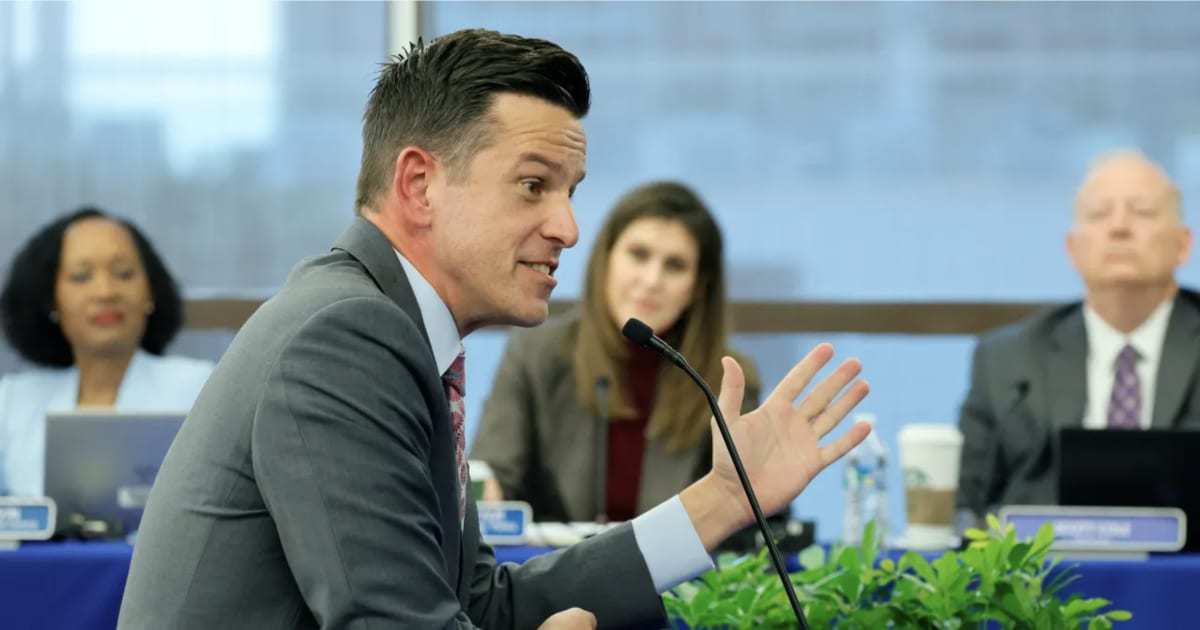
Florida Education Commissioner Henry Mack wants lawmakers to strip a district-by-district spending cap out of the state's school funding formula, a change that could send even more public money to the state's universal voucher program and leave some school districts with no mandatory direct state funding at all. Mack laid out his position in remarks to WLRN on Thursday, Nov. 12, at a Florida Board of Governors meeting at Florida International University in Miami, telling the station, "The more money that can go to vouchers the better."
Florida's universal voucher program, which pays for private school tuition and other education expenses through state scholarships, already costs about $4.5 billion a year and is the largest in the country, according to WLRN's reporting. Mack's proposal would arrive just as the Legislature begins organizing for the 2027 session, with a new governor taking office in January and school districts across the state closing campuses as traditional public school enrollment falls.
What the commissioner wants changed
Under current state law, scholarships "may not" be awarded to a district if voucher spending would exceed 99% "of the school district's share of state funding," according to the statute language cited by WLRN. In practice, that provision works as a cap inside the Florida Education Finance Program (FEFP), the complex formula the state uses to calculate how much money each of its 67 school districts must receive.
"We're taking that cap out of the funding formula. Or, we're trying to propose taking it out," Mack told WLRN. At the same time, he argued that the cap is less of a hard limit than it appears. "In truth, there's no cap on the voucher program at the moment," he said, contending that the way money is appropriated to districts can create the appearance of a funding shortfall when one does not really exist.
Mack described the shift of students and dollars out of district schools as a "right-sizing in the education market" and said competition benefits public education. WLRN asked Mack's office for a detailed written breakdown of the proposal and had not received one at the time of publication. No bills on the subject had been filed as of mid-November.
How the money flows now
Voucher dollars and traditional public school dollars are blended together inside each district's FEFP allocation, which makes it difficult for parents and taxpayers to track where the money actually goes. Miami-Dade County Public Schools, the state's largest district, illustrates the scale. The state allocates about $1.5 billion to the district this year, and $766 million of that is routed to vouchers, according to WLRN. About 76% of the money the formula required for the district went to scholarships. Miami-Dade also received $178 million in discretionary state funding that offset part of that loss.
Several smaller and suburban districts already send an even larger share of their mandatory state funding to vouchers. In the most recent FEFP calculation, the counties with the highest shares were:
| County district | Share of mandatory state funding going to vouchers |
|---|---|
| Monroe | Over 71% |
| Charlotte | Over 71% |
| Sarasota | Just over 70% |
| Collier | Over 60% |
| Indian River | Over 60% |
| Jefferson | Over 60% |
| Palm Beach | Over 60% |
| Miami-Dade | About 76% of required funding, partly offset by discretionary money |
If the 99% cap were removed and voucher demand kept climbing, some districts could see their entire mandatory state allocation consumed by scholarships. Those districts would still be eligible for discretionary money, but that pot is controlled by the Florida Department of Education, which Mack leads. WLRN's analysis concluded the change would make districts far more dependent on decisions made in Tallahassee.
A trade: more flexibility for public schools
Mack paired the proposal with an offer to loosen the strings attached to the money districts do receive. The state currently restricts portions of school funding through "categoricals," dedicated pots that can only be spent on items such as teacher salary increases, school buses and textbooks. "We control those categoricals pretty rigidly," Mack said, adding that public schools "deserve greater flexibility, too" if the cap is lifted.
District leaders have long complained that categorical rules limit their ability to respond to local needs, so the flexibility piece could draw interest from school boards even as the voucher change draws opposition.
Enrollment trends behind the push
The state's own enrollment forecasts point toward continued voucher growth. A state forecast cited by WLRN projects universal voucher enrollment reaching roughly 618,000 students by 2031. As more students leave district schools with their per-student funding, the remaining shares for districts and the students who stay in them shrink.
That trend is already visible on the ground. Traditional public schools are closing in several districts as enrollment declines, including in Broward County, and WLRN has linked the closures in part to the rapid expansion of vouchers since Florida made the program universal.
Problems during the expansion
The voucher program's growth has not been smooth. WLRN reported in 2025 that the rapid expansion hurt some schools serving students with disabilities, a population that had received scholarships before the program became universal, and that some of those schools lost state funding.
Florida's Auditor General also concluded last year that the Department of Education had flaws in how it managed vouchers, problems that resulted in $398 million more going to scholarships than lawmakers originally allocated, according to WLRN.
Sen. Don Gaetz, R-Crestview, proposed legislation last year to separate public school funding from voucher money so the two streams could be tracked independently. It passed the Senate but failed in the House.
What Donalds and other leaders are saying
Gov. Ron DeSantis and Governor-elect Byron Donalds have both hinted that changes to the statewide school funding formula are under consideration, though neither has offered many specifics. Donalds, who takes office in January, told reporters the core problem is how students are counted. Florida checks enrollment three times a year, a structure Donalds said needs updating because students move between schools so often. "That's going to change," he said of the counting system, while insisting public schools are "not going anywhere."
Some local officials are on board with the direction. Miami-Dade school board member Roberto Alonso said he supports the state's approach under Mack. "The dollars have to follow the students," Alonso said, arguing that families should decide where education money goes. He added, however, that "guardrails do need to put in place."
Mack took over the department this summer. The State Board of Education unanimously appointed him commissioner on July 22, 2026, on DeSantis' recommendation. He previously served as U.S. Assistant Secretary of Labor for Employment and Training, and his resume also includes stints as a state education chancellor, a Broward College administrator and an education lobbyist.
What's next
Legislative organizational meetings for the 2027 session begin later in November, and committee weeks will follow over the winter before the regular session. Any change to the FEFP cap would require a bill passed by both chambers and signed by Donalds. The House, which killed the Gaetz separation bill, will again be a key battleground, and the Legislature that convenes in 2027 will include more Democrats after unofficial Nov. 3 results showed Republicans losing their two-thirds supermajority in the state House.
For families and school districts, the immediate question is how much of each district's state money will be left once voucher costs are subtracted, and whether districts that already send more than 70% of their mandatory funding to scholarships will become almost entirely reliant on discretionary dollars controlled by the state.
Spotted an issue with this article?
Have something to say about this story?
Write us a letterComments
No comments yet. Be the first to weigh in.
Related Coverage

Florida College Students Lean on Campus Food Pantries as Hunger-Free Campus Bills Stall and SNAP Stays Out of Reach
29m ago
UCF President Alexander Cartwright Gets Three-Year Contract Extension Through 2029
19h ago
Florida Board of Governors Delays Fix That Would Let Some Undocumented State College Students Into Universities
3d ago
Pinellas School Board Cements Closure Plan With Unanimous Policy Vote as Sunset Hills Parents Keep Up Pushback
3d ago