Florida's Space Coast Sustains a Record Launch Pace as Falcon 9 Flights Pile Up
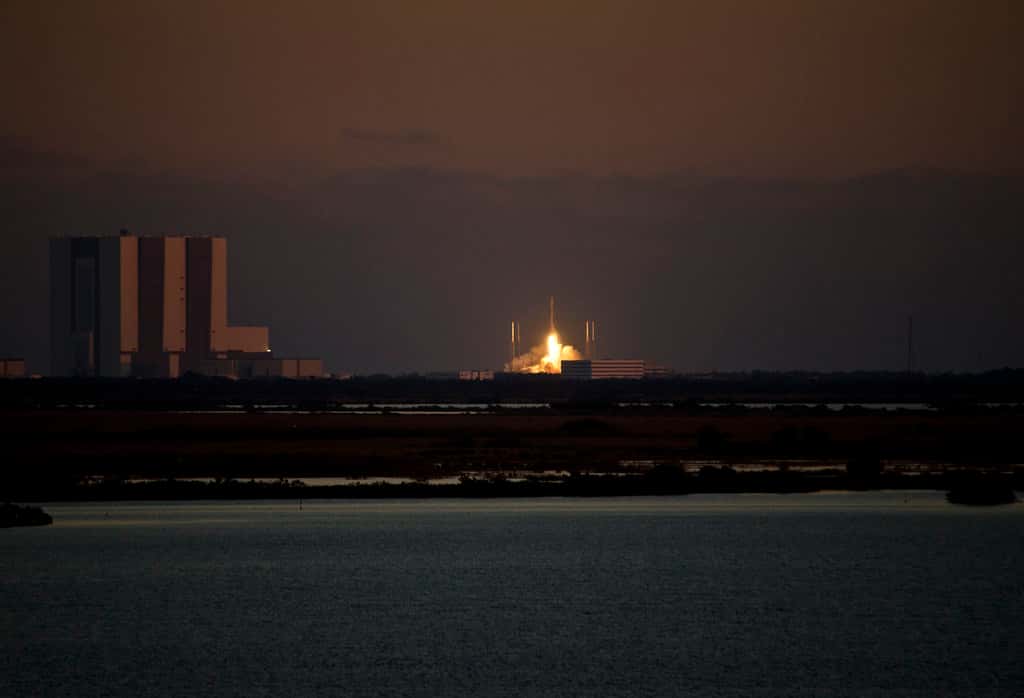
Florida's Space Coast is on pace for another record year of orbital launches, with SpaceX having passed 96 Falcon 9 flights by mid August and the company setting a record in the same month by launching two Falcon 9 rockets just 38 minutes apart. Roughly three quarters of those flights carried Starlink satellites.
Brevard County hosted a record 109 orbital launches in 2025, a figure that already exceeded anything in the history of American spaceflight, and the 2026 cadence has kept pace. The Space Coast now conducts more orbital launches than most countries.
The operational tempo has changed what launch means locally. A rocket departing Cape Canaveral Space Force Station or Kennedy Space Center is no longer an event that shuts down the region. It is closer to a scheduled departure, with residents checking a calendar rather than making a trip to the beach.
Not every attempt goes as planned. SpaceX scrubbed a Falcon 9 countdown at Cape Canaveral this week less than a minute before liftoff to conduct additional ground system checkouts, pushing the attempt to a later opportunity.
What is driving the cadence
Starlink is the dominant factor. SpaceX launches its own satellites, which means it does not wait for external customers, does not negotiate launch windows around another company's schedule and can fly whenever a vehicle and a pad are available.
Booster reuse is the enabling technology. Falcon 9 first stages return to landing zones or to droneships, are refurbished and fly again, with individual boosters accumulating flight counts that would have been unimaginable a decade ago. Reuse compresses both cost and turnaround time.
Pad infrastructure is the constraint that determines the ceiling. SpaceX operates from multiple pads in Florida, and turnaround between launches at a single pad has been driven down through process improvement rather than through new construction.
The 38 minute record between two flights involved different pads and different missions, which is the mechanism by which the shortest intervals are achieved. It is nonetheless a demonstration of range and operational capacity that no other launch site can match.
The range as a shared resource
The Eastern Range, operated by the Space Force, provides the tracking, safety and airspace coordination that every launch from the Cape requires. Supporting more than 100 launches a year required modernizing systems built for a far lower tempo.
Autonomous flight safety systems were the critical change. Rather than relying on a human range safety officer with a destruct command, modern vehicles carry onboard systems that terminate flight automatically if the rocket departs its safe corridor. That removed a major constraint on turnaround.
Airspace and maritime coordination remain a real cost. Each launch requires closing airspace and clearing shipping lanes, which affects commercial aviation routing out of Orlando and Miami and imposes delays that accumulate across a year with this many launches.
The Federal Aviation Administration licenses commercial launches and has had to scale its own processes accordingly, an area where industry has periodically pushed for faster action.
What it means for Brevard County
The economic effect on the Space Coast has been substantial. Employment in aerospace manufacturing, launch operations and supporting services has grown, and the region's population and housing market have responded.
The workforce spans a wide skill range. Engineers and technicians are the visible core, but the sector also supports machinists, logistics workers, security personnel and the service economy that follows a growing payroll.
Tourism is a secondary channel. Kennedy Space Center Visitor Complex draws visitors year round, and launch viewing has become a scheduled attraction rather than a rare occasion. Port Canaveral's cruise business and the launch industry share the same coastline.
Housing and infrastructure have strained to keep pace. Brevard's growth has produced the traffic, school capacity and water infrastructure pressures familiar across fast growing Florida counties.
The other operators
SpaceX dominates the numbers, but it is not alone on the coast. United Launch Alliance operates from Cape Canaveral, and Blue Origin has built launch and manufacturing capacity in the area with its own heavy lift vehicle program.
NASA continues to launch from Kennedy Space Center, including the Artemis program, whose second mission flew crew around the Moon in April 2026 from Launch Complex 39B. That flight was the first crewed lunar mission since 1972.
Competition among operators matters for the region's long term position. A launch coast dependent on a single company carries concentration risk, and state economic development efforts have consistently targeted diversification.
Space Florida, the state's aerospace development authority, provides financing and infrastructure support aimed at attracting operators and manufacturers, treating launch capacity as state economic infrastructure.
Environmental and community questions
A launch cadence this high raises questions that a handful of annual launches did not. Sonic booms from returning boosters are audible across a wide area of Central Florida, and the frequency has generated community discussion.
Environmental review of launch operations covers noise, air quality, water quality around the pads and effects on the wildlife refuge and national seashore that surround Kennedy Space Center. Merritt Island National Wildlife Refuge occupies much of the same land.
Deorbiting satellites are a longer term issue. Large constellations are designed to deorbit at end of life, and the atmospheric effects of reentering satellite material at scale are the subject of active scientific investigation.
Orbital debris and spectrum coordination are international questions that fall outside Florida's control but that determine how large constellations can grow, and therefore how many launches the Space Coast conducts.
Why Florida holds the advantage
Geography explains most of it. Launching eastward over the Atlantic provides a clear downrange corridor with no populated areas underneath, and Florida's latitude gives a rocket a velocity boost from Earth's rotation that higher latitude sites do not get.
Infrastructure is the second advantage. Decades of federal investment produced pads, processing facilities, tracking stations and a workforce that cannot be replicated quickly elsewhere.
The supply chain has followed. Component manufacturers, propellant suppliers and specialized fabricators have located near the coast, which shortens lead times and reduces transportation of oversized hardware.
Competing sites exist. Vandenberg Space Force Base in California serves polar orbit missions, and new commercial spaceports have opened elsewhere, but none approaches Florida's volume for equatorial and geostationary transfer missions.
The workforce behind the numbers
Sustaining more than 100 launches a year requires a workforce that did not exist on the Space Coast a decade ago. Launch operations, vehicle processing, payload integration, range support and recovery operations each employ specialized personnel who work on compressed timelines.
Brevard County's community colleges and Florida's universities have built programs aimed at supplying that workforce. Eastern Florida State College offers aerospace technology programs, and Embry Riddle Aeronautical University in Daytona Beach and the Florida Institute of Technology in Melbourne feed engineering talent into the region.
Recovery operations add a maritime dimension. Droneship landings require vessels, crews and port infrastructure, and Port Canaveral handles booster returns alongside its cruise and cargo business, a combination no other port manages.
The employment is geographically concentrated, which is both a strength and a vulnerability. A region whose economy depends on a single industry is exposed to that industry's cycles, a lesson Brevard learned after the Apollo program wound down and again after the shuttle retirement in 2011.
What sustained cadence has changed
The practical experience of living on the Space Coast has shifted. Launch viewing was once a planned outing. It is now a routine occurrence visible from backyards, and sonic booms from returning boosters are a regular feature of the soundscape across Central Florida.
Schools, hospitals and emergency services have adapted procedures around the launch schedule, particularly for the small number of launches that carry hazardous propellants or that require expanded safety corridors.
Road closures and beach access restrictions accompany certain launches, and Brevard's tourism industry has built products around viewing rather than treating closures purely as an inconvenience.
For Florida overall, the Space Coast's output has become part of the state's economic identity alongside tourism and agriculture, a diversification that state officials have pursued deliberately through Space Florida and related development programs.
The federal budget dimension
NASA's Florida operations depend on annual appropriations, and the agency's Kennedy Space Center workforce and contractor base scale with program funding. Congress has funded federal agencies through a continuing resolution running to December 11.
Continuing resolutions hold agencies at prior year funding levels and generally prohibit new program starts, which slows procurement and delays contract awards even when the eventual appropriation is adequate.
Commercial launch is less exposed, since SpaceX's Starlink missions are funded by the company rather than by appropriations. National security launches for the Space Force, however, run through defense appropriations and are subject to the same budget process.
Florida's congressional delegation has historically advocated for civil and national security space funding on a bipartisan basis, recognizing that the Space Coast's economy depends on it regardless of which party holds the seats.
What is next
The year end launch total will determine whether 2026 exceeds 2025's record. With the cadence holding through the third quarter, another record is likely absent an extended stand down.
New vehicles will shape the next phase. Heavy lift vehicles from multiple operators are in development or early operation, and each brings different pad requirements and different cadence potential.
Federal appropriations affect the NASA portion of the manifest. Congress has funded agencies through a continuing resolution running to December 11, and civil space program funding decisions follow from that.
For Brevard residents, the practical reality is a launch schedule that reads like an airline timetable. The region has normalized something that was extraordinary within living memory, and the economic base has reorganized around it.
Spotted an issue with this article?
Have something to say about this story?
Write a letter to the editor