Hillsborough County Becomes the Epicenter of Florida's Worst Local Dengue Outbreak in Decades
Hillsborough County has become the center of the worst locally acquired dengue outbreak Florida has seen in decades, with health officials reporting 95 local cases in the county out of at least 111 statewide. The county's case count nearly doubled in a single week at the start of September, and mosquito control crews are now treating affected neighborhoods by truck and by helicopter.
Locally acquired means the infection was transmitted by mosquitoes inside Florida rather than picked up during travel abroad. That distinction is the one that matters epidemiologically, because it indicates that the virus is circulating between local mosquito populations and local residents rather than arriving with returning travelers.
State Surgeon General Dr. Joseph Ladapo has appeared in Hillsborough County to urge residents to take precautions, and the Florida Department of Health has issued mosquito-borne illness advisories in multiple counties including Orange. The county's mosquito management program has reported that 14 mosquito pools have tested positive for dengue, confirming that infected mosquitoes are present in the environment rather than only in individual case histories.
What the numbers show
Florida's 2026 local dengue season began with a single confirmed case in Hillsborough County in late July. By early September the county had reported 59 locally acquired infections. Between August 30 and September 5, the county's total jumped to roughly 95, close to a doubling in a week. Statewide, locally acquired cases have climbed past 111.
That growth curve is what concerns public health officials more than the absolute numbers. Dengue transmission is driven by a cycle in which an infected person is bitten by a local mosquito, that mosquito becomes infectious after an incubation period, and it then transmits the virus to additional people. Once that cycle is established in a neighborhood, case counts tend to rise geometrically rather than linearly until intervention or seasonal conditions break the chain.
Hillsborough's concentration relative to the rest of the state is striking. With 95 of roughly 111 statewide cases, the county accounts for the overwhelming majority of Florida's local transmission this year. Neighboring Pinellas County has also reported cases, and mosquito control in both counties has escalated its response.
State health officials have separately been investigating a death in the Tampa area possibly linked to dengue. Confirming a dengue-attributed death requires laboratory work and review, and the investigation had not produced a public conclusion as of this writing, so the case should be understood as under review rather than confirmed.
Why dengue is spreading in Florida now
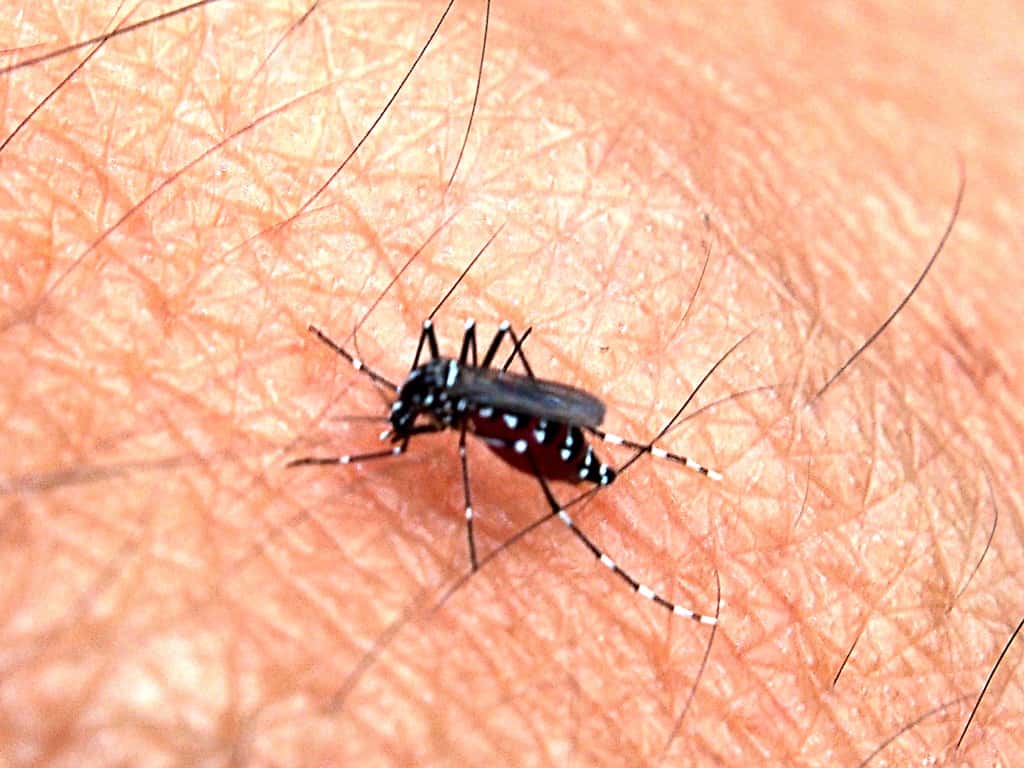
Dengue is transmitted primarily by Aedes aegypti, a mosquito that is well established across Florida. Unlike the species that drive West Nile virus transmission, Aedes aegypti breeds in small containers of standing water around homes rather than in marshes or ditches. A bottle cap holds enough water. So does a plant saucer, a clogged gutter, a tarp fold, a bird bath or a tire.
That biology makes Aedes aegypti difficult to control with the tools that work against other mosquitoes. Aerial and truck-mounted spraying kills adult mosquitoes in flight but does not eliminate larvae developing in containers on private property. Effective control requires residents to eliminate breeding sites around their own homes, which means public cooperation is not optional.
The mosquito is also a daytime biter, concentrating its activity in the morning and late afternoon. Floridians accustomed to thinking of mosquito risk as an evening problem may be unprotected during exactly the hours when dengue transmission is most likely.
Broader conditions have expanded the range and season of dengue-carrying mosquitoes across the Americas. Research published this year has documented Aedes populations extending into territories where they were previously absent or seasonal, including parts of Florida. Warmer average temperatures lengthen the period each year in which the mosquito can complete its life cycle and the virus can incubate inside it.
What dengue does
Most dengue infections are mild or produce no symptoms at all. When symptoms appear, they typically begin four to ten days after the bite and include high fever, severe headache, pain behind the eyes, muscle and joint pain, nausea and a rash. The joint pain gives the disease its old common name, breakbone fever.
A minority of cases progress to severe dengue, which is a medical emergency. The warning signs usually appear as the fever breaks, generally three to seven days after symptoms began, and include severe abdominal pain, persistent vomiting, bleeding from the gums or nose, blood in vomit or stool, rapid breathing, extreme fatigue and restlessness. Severe dengue involves plasma leakage and can lead to shock.
A critical point for Floridians in an outbreak area: there are four dengue serotypes, and infection with one provides lasting immunity only to that serotype. A second infection with a different serotype carries a higher risk of severe disease than a first infection. That means residents who have had dengue before, including while traveling, are not simply protected.
Health officials also advise against taking aspirin or nonsteroidal anti-inflammatory drugs such as ibuprofen when dengue is suspected, because they can increase bleeding risk. Acetaminophen is the generally recommended option for fever and pain, and anyone with warning signs should seek medical care promptly.
How an outbreak like this starts
Locally acquired dengue outbreaks in Florida typically begin with an imported case. A traveler returns from a region where dengue is endemic, carrying the virus in their bloodstream during the viremic period that lasts several days. A local Aedes aegypti mosquito bites that person, becomes infected, and after an incubation period of roughly eight to twelve days becomes capable of transmitting the virus.
From that point the outbreak is local. Each newly infected person becomes a source for additional mosquitoes, and because Aedes aegypti has a limited flight range, often measured in a few hundred meters, transmission tends to cluster tightly within neighborhoods rather than spreading evenly across a county.
Florida receives an enormous volume of international travel from regions where dengue circulates widely, including the Caribbean, Central and South America and parts of Asia. Imported cases arrive in Florida every year in the dozens or hundreds. What varies is whether local conditions allow those imported cases to seed sustained local transmission.
The conditions that allow it include an abundant local mosquito population, warm temperatures that shorten the virus incubation period inside the mosquito, and sufficient human density for the cycle to repeat. Tampa's climate and development pattern provide all three during late summer.
Florida's mosquito-borne disease landscape
Dengue is one of several mosquito-borne diseases Florida monitors, and they are not interchangeable in how they behave or how they are controlled.
West Nile virus, which circulates between birds and mosquitoes with humans as incidental hosts, is transmitted by Culex species that breed in standing water in ditches, storm drains and retention ponds. Control efforts target those larger water bodies, which is a different operation than container source reduction.
Eastern equine encephalitis is rare but has a high fatality rate, and it circulates in swamp habitats among birds and specific mosquito species. St. Louis encephalitis follows a similar bird-mosquito cycle.
Chikungunya and Zika, like dengue, are transmitted by Aedes aegypti and follow the same human-mosquito-human cycle. Florida experienced locally acquired Zika transmission in 2016, concentrated in Miami-Dade County, and the response then established much of the operational playbook being used now.
Malaria, which Florida documented in locally acquired cases in Sarasota County in 2023, is transmitted by Anopheles mosquitoes and requires yet another control approach. The Department of Health maintains surveillance for all of these simultaneously.
What residents can do
Mosquito control agencies consistently emphasize that source reduction on private property is the single most effective intervention against Aedes aegypti, because that is where the mosquito breeds.
- Walk your property weekly and empty anything holding water: plant saucers, buckets, toys, tarps, wheelbarrows, boat covers and pet bowls.
- Clear roof gutters and check that they drain. Clogged gutters are among the most commonly missed breeding sites.
- Scrub bird baths and change the water at least weekly. Eggs stick to container walls and survive drying.
- Cover rain barrels and cisterns with fine mesh screening.
- Repair window and door screens, and use air conditioning where available.
- Use an EPA-registered insect repellent containing DEET, picaridin, oil of lemon eucalyptus or IR3535 during daytime hours, and wear long sleeves and pants when practical.
Residents in Hillsborough and Pinellas counties can report standing water and request mosquito control service through their county mosquito management programs. Neighborhood-level reporting is how control agencies identify hot spots, and an unreported breeding site on one property affects everyone within flight range.
The public health response
Mosquito control in Hillsborough and Pinellas is treating affected areas by truck-mounted sprayer and by helicopter. Aerial application covers larger areas quickly and is generally reserved for situations where ground treatment cannot keep pace with transmission.
The Department of Health has issued mosquito-borne illness advisories and alerts in the affected counties, and has extended surveillance statewide for the full range of mosquito-borne diseases that circulate in Florida, including West Nile virus, Eastern equine encephalitis, St. Louis encephalitis, chikungunya and malaria. Orange County issued its own advisory after confirming a locally acquired dengue case.
Florida's surveillance system relies on clinician reporting, laboratory confirmation and mosquito pool testing working together. The 14 positive mosquito pools in Hillsborough are the environmental confirmation that matches the human case data, and that combination is what justifies escalated control operations.
What's next
Transmission typically declines as temperatures fall and rainfall decreases, which in Florida generally means late autumn. Until then, the county's case trajectory will depend on how effectively spraying and source reduction interrupt the transmission cycle in the affected neighborhoods.
The longer-term question is whether Florida is entering a period in which locally acquired dengue becomes a recurring seasonal feature rather than an occasional cluster. Aedes aegypti is permanently established in the state, Florida receives enormous numbers of travelers from regions where dengue is endemic, and the conditions favoring transmission are lengthening.
For residents, the practical takeaway does not change with the epidemiology. The mosquito that spreads dengue breeds in containers in yards, it bites during the day, and the most effective single action anyone can take is to walk the property once a week and dump out the water.
Spotted an issue with this article?
Have something to say about this story?
Write a letter to the editor