Orphaned Pacific Walrus Calf Annautaq, Rescued From an Alaska Beach, Arrives at SeaWorld Orlando
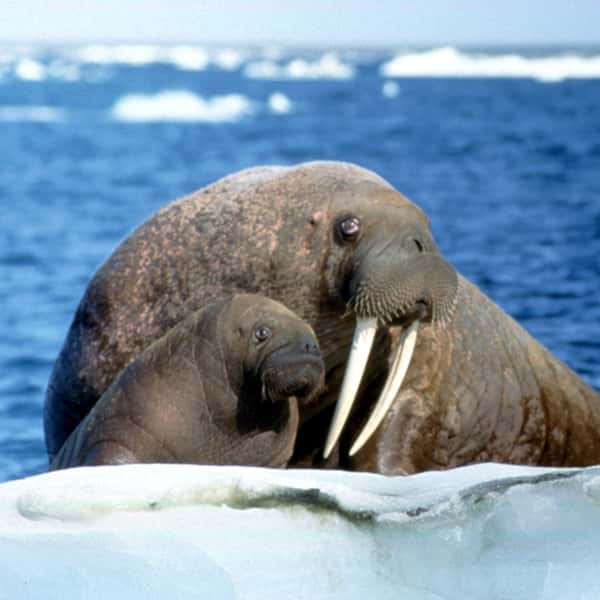
An orphaned Pacific walrus calf found hiding between two dead adult walruses on a remote Alaska beach has a new permanent home in Central Florida. SeaWorld Orlando said the 5-month-old male, named Annautaq, arrived at the park after weeks of rehabilitation at the Alaska SeaLife Center and is now in a 30-day quarantine before he is gradually introduced to the park's three resident walruses. Federal wildlife officials determined the calf could not survive if returned to the wild.
Found alone near Point Lay
The calf was discovered in September on an isolated beach near Point Lay, a small Iñupiat community on Alaska's northwest Arctic coast. U.S. Geological Survey walrus biologist Tony Fischbach and Violet Anniskett, a wildlife research intern, Ilisaġvik College student and Point Lay community member, found him tucked between two adult walrus carcasses after heavy surf had pushed a nearby herd away from the area, according to the Alaska SeaLife Center and ClickOrlando.
Scavenging birds were already working on the carcasses, and officials said the calf likely would not have survived without help. Because the beach was so remote, he received several days of on-site care before he could be moved, ClickOrlando reported. The U.S. Fish and Wildlife Service, which manages Pacific walruses under federal law, had to approve the rescue before the response team could begin caring for him, and the effort had the support of the Native Village of Point Lay, according to reports on the rescue.
Anniskett chose his name. Annautaq means "axe" in Iñupiaq, and she named the calf after her father's Iñupiaq name, according to SeaWorld Orlando.
Weeks of round-the-clock care in Seward
The calf was flown to the Alaska SeaLife Center in Seward, where he was admitted on Sept. 14 weighing about 200 pounds. Staff estimated he was about five months old and noted dehydration and several superficial wounds, though he was alert and in good body condition, according to the center's account of the rescue as reported by outlets including The Cool Down.
Walrus calves are intensely social and depend on constant contact with their mothers, so the center staffed his care with at least two people per shift around the clock. In an Oct. 6 update, the center said he had reached stable health and no longer needed critical rehabilitation. By Oct. 12, center staff said he was doing well and had been transferred. He is only the 12th orphaned Pacific walrus calf the center has treated since 1998, according to the center.
Jane Belovarac, wildlife response curator at the Alaska SeaLife Center, said the case showed the value of having this kind of care in the state. "Annautaq's story shows why having specialized marine mammal rehabilitation capacity in Alaska is so important," she said, according to ClickOrlando.
Why he cannot go back to the wild
Pacific walrus calves rely entirely on their mothers during their first year, for milk, protection and guidance, and a calf separated from its mother has little chance of surviving on its own. Fish and Wildlife Service officials ruled Annautaq non-releasable, determining he likely would not survive in the wild. The Alaska SeaLife Center has also noted that the close human contact a young calf needs to survive rehabilitation makes a later return to the wild unworkable.
That left a permanent placement in human care. Few places can take a walrus: SeaWorld Orlando is one of only four institutions in the United States currently able to house them. A statement from the walrus care community involved in the decision said the placement was guided by Annautaq's long-term care and social needs, including the chance to grow up alongside other walruses.
The trip to Orlando
Once he was strong enough, Annautaq made the long trip from Alaska to Central Florida. Reports differ on the distance. Fox 35 Orlando's headline put it at 4,800 miles, while the body of that story, ClickOrlando and other coverage based on SeaWorld's announcement described it as about 4,000 miles. SeaWorld staff helped prepare him for the trip, according to coverage of the transfer. The calf has gained weight since his rescue and weighed roughly 220 pounds when SeaWorld announced his arrival, ClickOrlando reported.
Quarantine, bottles and a surrogate mother
For his first 30 days in Orlando, Annautaq is in quarantine with around-the-clock care. He receives up to six bottle feedings a day of a high-fat milk formula developed by SeaWorld's veterinary team, along with veterinary care and 24-hour support.
After quarantine, he will be gradually introduced to SeaWorld Orlando's resident walrus herd:
| Walrus | Age | Background |
|---|---|---|
| Garfield | 44 | Male, rescued as an orphaned calf in Alaska and hand-raised at SeaWorld Orlando |
| Kaboodle | 23 | Female, experienced surrogate mother to rescued calves, including Uki |
| Uki | 2 | Rescued in Alaska, rehabilitated at the Alaska SeaLife Center, moved to Orlando in 2024 |
Jim Kinsler, a curator at SeaWorld Orlando, said Annautaq needs more than nutrition and veterinary care: he also needs close companionship. Kinsler said Kaboodle's experience and the chance to bond with Uki, who followed a similar path from Alaska, make the herd "a promising setting for him to learn, build relationships and grow."
When guests can see him
There is no date yet for Annautaq's public debut. SeaWorld Orlando said his animal care team will decide the timing of his introductions to the herd and to guests. In the meantime, visitors can see Garfield, Kaboodle and Uki at the park's Expedition Odyssey area, the Arctic-themed attraction that opened in 2025 in the former Wild Arctic space, where guests exit a flying theater ride into an encounter area with beluga whales, seals and walruses.
What's next
Annautaq's 30-day quarantine runs into November. If he continues to gain weight and stays healthy, his care team will begin slow introductions to Kaboodle, the herd's surrogate mother, and Uki, the young walrus who made the same journey from the Alaska SeaLife Center two years ago. For Florida, the arrival adds a fourth walrus to one of the very few herds in the country, and a calf whose life began on an Arctic beach thousands of miles from Orlando.
Spotted an issue with this article?
Have something to say about this story?
Write us a letterComments
No comments yet. Be the first to weigh in.
Related Coverage

St. Petersburg Gears Up for World Series at Tropicana Field: Security, Block Parties and a Mayor's Race
2d ago

St. Pete Pride Asks Supporters to Raise $289,000 by Nov. 30 to Erase Its Deficit Before the 25th Anniversary
5d ago

Joe Redner, Tampa's 'Strip Club King' and longtime courtroom combatant, dies at 86
Oct 17

SeaWorld Orlando closes Mako after fatal fall on similar Georgia coaster
Oct 16