SpaceX Adds Another Starlink Launch to a Record Year on the Space Coast
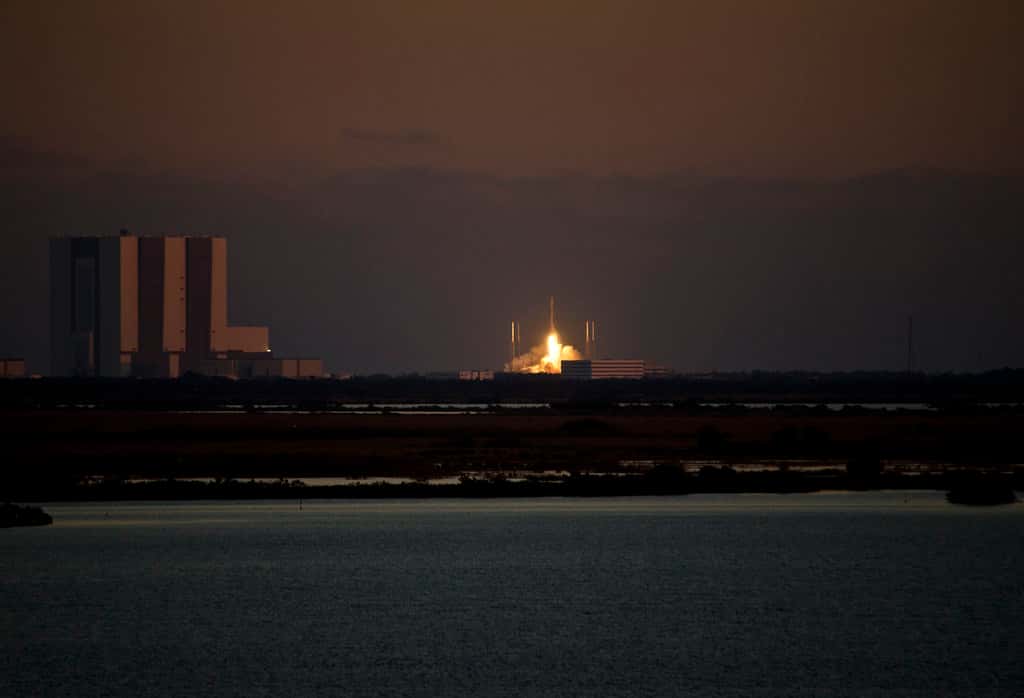
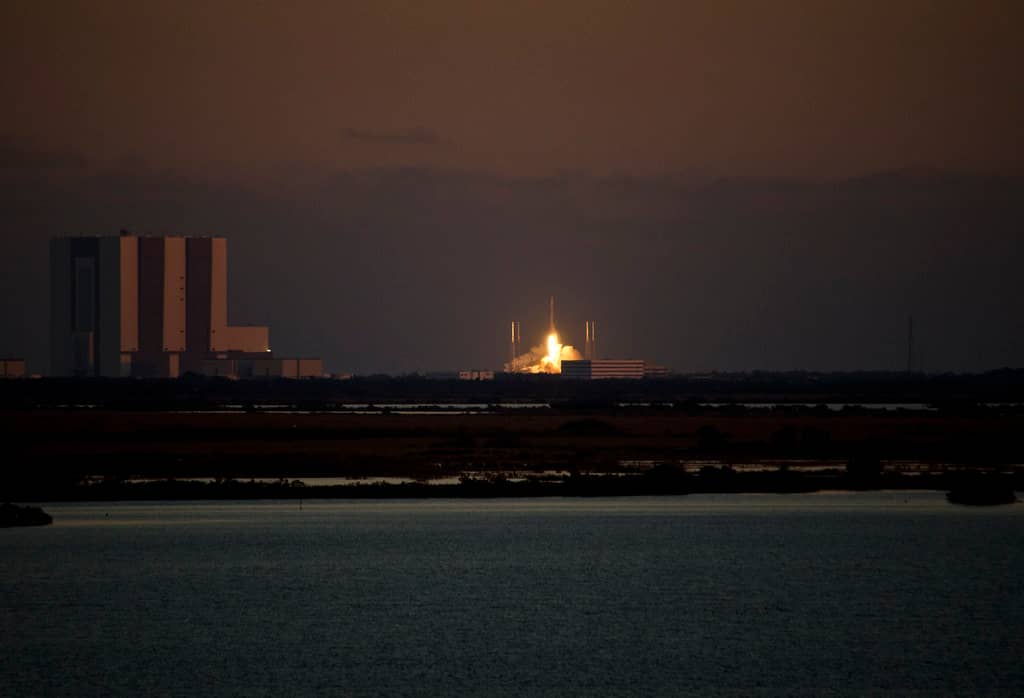
A SpaceX Falcon 9 rocket lifted off from Space Launch Complex 40 at Cape Canaveral Space Force Station at 11:58 a.m. Tuesday carrying 29 Starlink satellites to low Earth orbit, one day after a launch scrub delayed the mission. The Starlink 10-19 flight marked the 72nd dedicated Starlink mission of 2026 out of 93 total Falcon 9 launches this year.
About eight and a half minutes after liftoff, the rocket's first stage landed on the droneship A Shortfall of Gravitas stationed in the Atlantic. It was the 18th flight for that particular booster, designated B1085, continuing a reuse record that has become routine enough to draw little attention.
The launch is unremarkable on its own terms, which is precisely what makes it significant. Florida's Space Coast has moved from a cadence of a few dozen launches a year to a rhythm in which a Falcon 9 flight is a twice-weekly occurrence, and the infrastructure, workforce, and regional economy have reorganized around that pace.
The cadence and what it took
Ninety-three Falcon 9 flights through early August puts SpaceX on pace for a total that would have been considered implausible a decade ago, when the entire world managed fewer orbital launches in a year than Florida now handles in a few months.
Booster reuse is the mechanism. B1085's 18th flight reflects a refurbishment process that has been compressed from months to weeks, allowing the same hardware to fly repeatedly with inspection and replacement of a limited set of components between missions.
Droneship recovery makes that reuse possible for missions where the booster lacks the propellant margin to return to a landing zone. A Shortfall of Gravitas operates out of Port Canaveral alongside Just Read the Instructions, and the vessels' turnaround cycle is now a component of launch scheduling.
The scrub and recycle pattern is also part of the routine. Monday's scrub and Tuesday's successful launch reflect a system designed to stand down and try again quickly rather than to absorb a lengthy delay, which is what allows the overall cadence to hold.
What Starlink is building
Starlink is a satellite internet constellation now numbering in the thousands of active spacecraft in low Earth orbit. The V2 Mini Optimized satellites flown on this mission represent an iteration of the design intended to increase capacity per launch.
For Florida specifically, Starlink has practical relevance beyond the launch economy. Rural counties in the Panhandle and the interior peninsula have persistent broadband gaps that terrestrial providers have been slow to close, and satellite service has become a real option for households and businesses in those areas.
The service has also become part of hurricane response planning. Portable satellite terminals have been deployed after recent Florida storms to restore connectivity for emergency operations and for residents in areas where cellular and fiber infrastructure was destroyed, and Florida's emergency management apparatus has incorporated the capability into its planning.
The constellation's growth has drawn criticism from astronomers concerned about optical interference and from space traffic analysts concerned about collision risk and orbital debris, questions that have not been resolved and that grow more pressing as the constellation expands.
The Space Coast economy
Brevard County's economy is more tied to launch activity than at any point since the Apollo program. The county has added aerospace jobs steadily as SpaceX, Blue Origin, United Launch Alliance, and a growing set of smaller companies have expanded operations at Kennedy Space Center and Cape Canaveral Space Force Station.
That growth has driven residential demand along the coast from Titusville through Melbourne, with housing prices and construction activity following the employment. It has also strained infrastructure, including roads that were never designed for the traffic volumes that accompany major launches.
Launch viewing has become a tourism product in its own right. Kennedy Space Center Visitor Complex, beachfront communities, and cruise passengers departing Port Canaveral all factor launch schedules into their plans, and a night launch visible from Orlando adds a regional dimension.
The concentration carries risk. An economy organized around a small number of companies operating in a technically demanding field is exposed to setbacks, and Brevard County has lived through the aftermath of program cancellations before, most acutely after the Space Shuttle program ended in 2011.
The federal and regulatory layer
Launch operations depend on federal infrastructure and authorization. Cape Canaveral Space Force Station is a military installation, Kennedy Space Center is a NASA facility, and the Federal Aviation Administration licenses commercial launches and manages the airspace and maritime closures each launch requires.
The cadence has forced adaptation across all three. Airspace and maritime closures that were exceptional events are now routine, and the FAA has revised procedures to reduce the disruption to commercial aviation traffic in one of the busiest air corridors in the country.
Environmental review has been another pressure point. Increasing launch rates require updated environmental assessments covering noise, deposition, wildlife impacts on adjacent protected lands including Merritt Island National Wildlife Refuge and Canaveral National Seashore, and the cumulative effect of operations at multiple pads.
Florida's congressional delegation has consistently supported expanded launch capacity, and Space Florida, the state's aerospace development authority, has worked to attract additional operators and infrastructure investment.
What it means for Floridians
For most residents, the direct effects are modest: an occasional sonic boom during booster return, periodic road closures near the Cape, and the visible spectacle of a launch from a considerable distance along the coast.
The economic effects are more consequential and more concentrated. Brevard County's employment base, its housing market, and its tax revenue all reflect the launch industry, and adjacent counties in Central Florida supply workers and services.
Educational institutions have responded. Embry-Riddle Aeronautical University in Daytona Beach, the University of Central Florida in Orlando, and Florida Institute of Technology in Melbourne all feed the regional aerospace workforce, and Eastern Florida State College has built technical programs aimed at launch operations roles.
The broader question for the state is durability. Florida's launch dominance is a function of geography, which does not change, and of federal infrastructure investment and commercial company decisions, which can. Competing spaceports in Texas, California, and elsewhere have drawn some activity, though none has approached the Cape's volume.
Why launches happen from Florida
The Space Coast's dominance is not an accident of history or politics. It reflects orbital mechanics, and the underlying reasons have not changed since the site was selected in the 1940s.
Launching eastward from a location closer to the equator provides a velocity assist from the Earth's rotation. At Cape Canaveral's latitude of roughly 28 degrees north, that assist is meaningful, adding several hundred meters per second to a vehicle heading to orbit. Higher-latitude sites get less.
The Atlantic Ocean provides the second requirement: open water downrange. Rockets ascending eastward drop spent stages and, in a failure, debris along a path that must not cross populated areas. Florida's east coast offers thousands of miles of ocean in exactly the required direction.
Those two factors make Florida optimal for the low-inclination orbits that most commercial satellites and all missions to geostationary orbit or beyond require. Polar orbits, which need a north-south trajectory, are typically flown from Vandenberg Space Force Base in California, where the Pacific provides the equivalent downrange corridor.
Weather is the trade-off. Florida's afternoon thunderstorm pattern, lightning risk, and hurricane season all produce launch delays that higher-latitude desert sites would not, which is why scrubs and recycles are built into the operating rhythm.
Competition for the pads
Launch complexes at Cape Canaveral Space Force Station and Kennedy Space Center are finite, and the competition for them has become one of the more consequential quiet negotiations in American aerospace.
SpaceX operates from Space Launch Complex 40 at Cape Canaveral and Launch Complex 39A at Kennedy, giving it two Florida pads and the ability to alternate while one is refurbished between flights. That redundancy is a major reason the company can sustain its cadence.
Blue Origin operates from Launch Complex 36 and has built manufacturing capacity nearby. United Launch Alliance flies Vulcan from Space Launch Complex 41. Several smaller operators have secured or are seeking pad access, and the Space Force has worked through a process for assigning underused complexes to new entrants.
The constraint is not only concrete and steel. Range support, including tracking, safety analysis, and airspace and maritime coordination, has to scale with launch volume, and the Space Force has invested in automation to raise the ceiling. How high that ceiling can go is an open engineering and staffing question that will shape the Space Coast economy over the next decade.
What's next
Brevard County residents can sign up for launch notification alerts through county emergency management, which distributes information about road closures and sonic boom advisories associated with booster returns to the landing zones.
SpaceX's launch schedule continues at a pace of multiple missions per week from Florida, with additional Starlink flights, commercial payloads, and crewed missions for NASA on the manifest. Launch schedules shift frequently for weather and technical reasons, and published times should be treated as provisional.
Other operators are ramping as well. Blue Origin has been building toward higher cadence from its Cape Canaveral facility, and United Launch Alliance continues Vulcan operations. Each additional active operator increases the pressure on range scheduling and infrastructure.
NASA's Artemis program remains the highest-profile activity at Kennedy Space Center, with the crewed lunar flyby mission and subsequent missions driving major infrastructure use at Launch Complex 39B.
Residents and visitors who want to watch a launch can find schedules through the Space Coast tourism office and through NASA and Space Force public affairs channels. The Florida Press will continue covering launch activity and its effects on the region.
Spotted an issue with this article?
Have something to say about this story?
Write a letter to the editor