SpaceX Launches Globalstar Replenishment Mission From Cape Canaveral
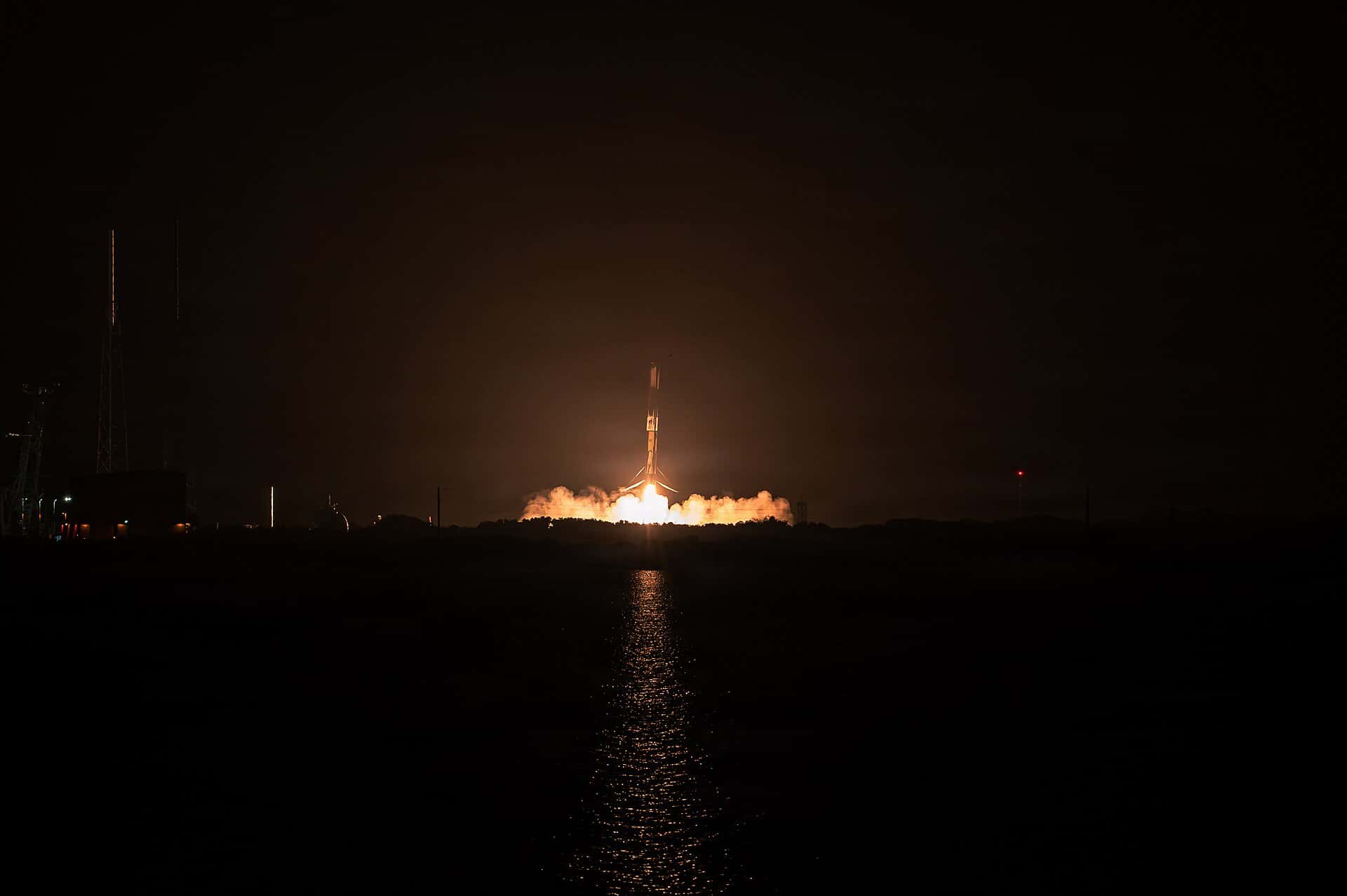
SpaceX targeted Saturday night for a Falcon 9 launch of the Globalstar 2-R Launch 1 mission from Space Launch Complex 40 at Cape Canaveral Space Force Station, continuing a launch cadence that has made Florida's Space Coast the busiest orbital launch site in the world.
Liftoff was scheduled for 9:12 p.m. Eastern, carrying satellites intended to replenish the Globalstar constellation in low Earth orbit. The Florida launch was scheduled less than forty minutes before a separate Falcon 9 launch from Vandenberg Space Force Base in California.
Two launches from opposite coasts within the same hour illustrates the operational tempo the company has reached. That cadence has transformed Brevard County's economy and reshaped what launch activity means for Florida residents.
What the mission carries
Globalstar operates a satellite constellation providing mobile satellite services, including voice, data and asset tracking for customers in maritime, aviation, government and industrial sectors. The company's network has also supported satellite connectivity features in consumer devices.
A replenishment mission adds new satellites to an existing constellation to replace aging spacecraft and maintain service continuity. Satellites have finite operational lives, constrained by propellant, degradation of solar arrays and component reliability, and constellation operators plan replacement launches accordingly.
Low Earth orbit operations require regular replenishment because atmospheric drag at those altitudes gradually lowers orbits, requiring propellant to maintain altitude until it is exhausted.
The Falcon 9 has become the workhorse vehicle for missions of this class, and its booster reuse capability has been the principal driver of the increased launch rate from both Florida and California.
Florida's launch economy
The Space Coast, centered on Brevard County, has undergone a substantial transformation over the past decade. What was once an infrastructure supporting a small number of government launches per year now supports a launch rate that has repeatedly set records.
Cape Canaveral Space Force Station and NASA's Kennedy Space Center together host launch complexes operated by SpaceX, United Launch Alliance, Blue Origin and others. The concentration of pads within a relatively small stretch of coastline is unmatched anywhere.
The economic effects extend well beyond launch operations themselves. Manufacturing, payload processing, range support, logistics and the supporting professional services base have all expanded, and Brevard County population growth has followed.
Tourism has become a meaningful component as well. Launch viewing draws visitors to Brevard County beaches and to the Kennedy Space Center Visitor Complex, and launch schedules now factor into travel planning for a significant number of visitors.
What frequent launches mean for Floridians
For Brevard County residents, launches have become routine enough that they are part of ordinary life rather than exceptional events. Sonic booms from returning boosters are audible across a wide area, and the Space Force issues advisories when booms are expected.
Road closures and beach access restrictions accompany launches at some pads, and residents and visitors planning to view a launch should consult official viewing guidance rather than assuming access.
Air traffic and maritime traffic are restricted during launch windows, which affects general aviation, commercial flights routed near the range and boaters offshore. Those restrictions are published in advance through standard aviation and maritime notices.
The employment picture is the most consequential effect. Aerospace jobs on the Space Coast span engineering, manufacturing, technician and operations roles, and they have supported wage levels above the Florida average in a region that previously experienced significant contraction after the shuttle program ended.
The federal and policy backdrop
Launch activity from Florida operates within a federal framework. The Federal Aviation Administration licenses commercial launches, the Space Force operates the Eastern Range and provides range safety, and NASA manages Kennedy Space Center facilities.
Range capacity has become a genuine planning consideration as launch rates have climbed. The infrastructure supporting launches, including tracking, safety and airspace coordination, was designed for a fraction of the current tempo, and modernization has been an ongoing federal investment area.
Space Florida, the state's aerospace development authority, works to attract aerospace investment and to finance infrastructure supporting the industry. State-level participation has been a factor in several facility developments on the coast.
Florida's congressional delegation has historically prioritized space policy given the concentration of activity in the state, and federal appropriations for NASA and for range infrastructure carry direct Florida employment implications.
Local impact across the state
Brevard County receives the most direct benefit, and the communities of Titusville, Cocoa Beach, Merritt Island and Melbourne have all seen development activity tied to the industry's growth.
Orlando, roughly an hour inland, supplies workforce and supporting services and benefits from the visitor traffic launches generate. The University of Central Florida has expanded aerospace-related programs serving the regional employer base.
Embry-Riddle Aeronautical University in Daytona Beach and Florida Institute of Technology in Melbourne both feed engineering talent into the Space Coast workforce.
Statewide, the aerospace sector has become a component of Florida's economic diversification away from dependence on tourism, agriculture and construction, sectors that are more cyclical.
How booster reuse changed the cadence
The launch rate Florida now sustains would have been impossible under the expendable-vehicle model that governed spaceflight for its first several decades, and the change traces primarily to first stage recovery.
The Falcon 9 first stage returns after separation, either to a landing zone at Cape Canaveral or to an autonomous droneship positioned offshore. Landings at the Cape produce the sonic booms audible across Brevard County and beyond.
A recovered booster is inspected, refurbished and flown again, and individual boosters have accumulated substantial flight counts. Eliminating the need to manufacture a new first stage for each mission removes both the cost and, critically, the production time that once limited launch rates.
Fairing recovery and reuse contributes as well. The protective shroud covering the payload separates during ascent, descends under parachute and is retrieved from the ocean, adding another recoverable component to the vehicle.
The range and its constraints
Launches from Florida operate on the Eastern Range, infrastructure managed by the Space Force that provides tracking, telemetry and public safety functions for every launch.
Range operations impose real limits. Each launch requires the range to be configured, airspace and maritime areas to be cleared, and safety systems to be verified. Turning the range between launches takes time, which historically constrained how frequently launches could occur.
Automated flight safety systems, in which the vehicle carries onboard equipment capable of terminating flight without ground command, have reduced that constraint substantially. The change removed a significant portion of the ground infrastructure previously required for each launch.
Weather remains the most common cause of delay. Florida's summer convective activity produces frequent violations of launch weather criteria, which cover lightning, cumulus clouds, precipitation and upper-level winds. Scrubs during the summer months are routine rather than exceptional.
Recovery weather adds a second constraint, since sea states at the droneship location must permit a landing attempt.
Why satellites launch from Florida
The Space Coast's geography is not incidental to its role, and the reasons it was selected in the 1950s continue to apply.
Latitude matters for orbital mechanics. A launch site closer to the equator benefits more from the Earth's rotational velocity, which provides free additional speed toward orbit for eastward launches. Cape Canaveral sits at roughly 28 degrees north, considerably more favorable than sites at higher latitudes.
The Atlantic Ocean to the east provides an unpopulated corridor for ascending vehicles and for jettisoned hardware. Launching over open water rather than over populated land is a fundamental range safety requirement.
Weather is generally workable year-round, though Florida's summer thunderstorm season produces frequent scrubs. Cold weather launch constraints that affect northern sites are largely absent.
The accumulated infrastructure is now its own advantage. Payload processing facilities, propellant handling, transportation access and a skilled workforce concentrated in one region create efficiencies that a new site would take many years to replicate.
What launch viewing involves
Launch viewing has become a substantial component of Space Coast tourism, and the practical considerations differ from what many visitors expect.
Schedules change frequently. Weather, technical issues and range conflicts produce delays and scrubs, and a launch scheduled for a given evening may slip by hours or days. Visitors planning trips around a specific launch should build flexibility into their plans.
Viewing locations vary in quality and access. Beaches in Brevard County offer public viewing at no cost, while the Kennedy Space Center Visitor Complex sells tickets to closer viewing areas for some launches. Distance from the pad affects what is visible, particularly for daytime launches.
Night launches produce the most dramatic viewing, with the exhaust plume visible across a wide area and, under certain conditions, illuminated by sunlight at high altitude in a phenomenon visible for hundreds of miles.
Traffic around launch times is a genuine consideration. Causeways and bridges connecting the mainland to the barrier islands carry heavy volume before and after high-profile launches, and departure can take considerably longer than arrival.
Satellite connectivity and why constellations matter
The service Globalstar's satellites support illustrates why replenishment missions carry commercial significance beyond the launch itself.
Mobile satellite service provides connectivity in areas terrestrial networks do not reach, including open ocean, remote terrain and regions where infrastructure has been damaged. Maritime operators, aviation, government users and industrial asset tracking all depend on it.
Florida has direct interest in that capability. The state's extensive commercial and recreational maritime activity operates well beyond cellular coverage, and offshore communication depends on satellite systems.
Disaster response is the other Florida application. When hurricanes damage terrestrial communications infrastructure, satellite connectivity provides the fallback for emergency responders and for restoring coordination in affected areas.
Satellite connectivity features in consumer devices have brought the technology to general users, extending capabilities like emergency messaging beyond cellular coverage to ordinary phones.
What's next
Launch schedules from Cape Canaveral and Kennedy Space Center change frequently based on weather, range availability and vehicle readiness. Published schedules are provisional until shortly before launch.
Additional Globalstar replenishment missions would follow the pattern of constellation maintenance, and the operator's public filings describe its deployment plans.
The broader Florida launch manifest includes government and commercial missions across multiple providers, and the annual launch total has been a closely tracked figure as the cadence has increased.
The 45th Space Wing, NASA and the launch providers themselves publish authoritative schedule and mission information, and the FAA issues the licensing and airspace notices governing each launch.
Spotted an issue with this article?
Have something to say about this story?
Write a letter to the editorComments
No comments yet. Be the first to weigh in.
Related Coverage

Supreme Court Opens New Term Oct. 5 With Florida's Six-Person Felony Juries on the Docket
1d ago

Rubio Calls Cuba a Failed State, Warns Havana Cannot Wait Out Trump as South Florida Watches
1d ago
No Shutdown at Fiscal Year's End: What the Dec. 11 Funding and Flood Insurance Deadline Means for Florida
1d ago
The Fed's First Rate Hike Since 2023 Pushes Mortgages Past 7% and Freezes Florida's Housing Market
2d ago