US Loses Measles Elimination Status After 26 Years as Florida Logs 163 Cases and Fights Over School Vaccines
The United States has lost the measles elimination status it held for 26 years, a setback that lands in Florida during a year in which the state has logged more than 160 measles cases and its health department is trying to strip several vaccines from school entry requirements. An independent commission of experts that advises the Pan American Health Organization concluded that the virus has spread continuously inside the country for more than a year, according to reporting first published Friday by The Wall Street Journal and confirmed to CNN by a source close to the process.
The decision ends a designation the country first earned in 2000. For Florida families, it changes nothing on paper overnight, but public health experts say it confirms what the case counts have shown since early 2025: measles is once again circulating in the United States rather than arriving only with travelers.
What the commission decided
The panel, PAHO's regional monitoring and re-verification commission for measles and rubella, treats measles as endemic when the same strain passes from person to person for at least 12 months inside one country. It uses viral genetic sequencing to make that call. The commission recommends; PAHO Director Jarbas Barbosa signs off, and reports say a formal announcement could come as soon as next week.
The strongest evidence came from Utah. In August, scientists at Utah's public health laboratory published a preprint showing that a single strain had circulated in the state for more than a year and accounted for more than 95% of its cases. That strain spread from southwestern to central Utah and caused more than 600 cases between June 2025 and June 2026. Sustained outbreaks were also reported in South Carolina, Pennsylvania, Wisconsin and New York.
Dr. Peter Hotez of Texas Children's Hospital called the loss "incredibly embarrassing." Dr. Demetre Daskalakis, a former director of the CDC's National Center for Immunization and Respiratory Diseases, said elimination is "a vital sign for our public health system."
A record national year
The country has logged record numbers of measles cases, hospitalizations and deaths for two straight years. More than 5,400 cases have been reported in 2026, the most since 1991, according to CNN's tally, while the CDC's confirmed count stood at 5,182 as of Thursday, well above the 2,289 cases recorded in all of 2025. Most 2026 cases are tied to 43 new outbreaks this year, and nearly all are in people who were unvaccinated or whose vaccination status is unknown.
The CDC reports that roughly 1 in 9 cases has required hospitalization, and state reports show at least 10 deaths. Two doses of the MMR vaccine cut an exposed person's chance of getting sick by 97% compared with an unvaccinated person.
CDC Director Erica Schwartz told Reuters before the decision that losing the status would leave the agency doing "the same exact thing," working with states to encourage immunization. Losing the designation carries no penalty and triggers no automatic policy change.
Florida's 2026 measles count
Florida has reported 163 measles cases in 2026 as of Nov. 7, according to state figures cited by the Palm Beach Post. The CDC's state-by-state data listed 149 Florida cases as of Nov. 5; the federal count includes only confirmed cases and runs on a different schedule than state reporting. Tracking the state picture has become harder: in May the Florida Department of Health removed county-level disease data from its website, and there is currently no public measles dashboard for the state.
Most of Florida's cases trace to an outbreak that began in late January at Ave Maria University in Collier County. The county's count reached 106 cases, most of them among people ages 15 to 24, before new infections stopped at the end of March. Cases elsewhere in the state, including Hillsborough, Broward and Palm Beach counties, pushed the total higher through the spring before reports slowed to a near halt in early summer.
The table below shows how Florida's reported total climbed during the year.
| Date | Florida cases reported in 2026 |
|---|---|
| Feb. 21 | 114 |
| July 18 | 155 |
| Late October | 162 |
| Nov. 7 | 163 |
Exemptions are rising in Florida schools
Florida's kindergarten vaccine exemption rate reached 5.9% in the 2025-26 school year, according to CDC data compiled by KFF, up from 5.1% the year before and 4.8% in 2023-24. Almost all of it is non-medical: 5.5% of kindergartners had a religious exemption, the only non-medical exemption Florida law allows, while 0.3% had a medical one. Becker's Hospital Review ranked Florida fifth among states for its overall exemption rate, behind South Dakota, Missouri, Hawaii and Pennsylvania.
Public health agencies generally aim for about 95% vaccination coverage to keep measles from spreading in a community, the level at which outbreaks tend to stay small.
Ladapo's push against school mandates
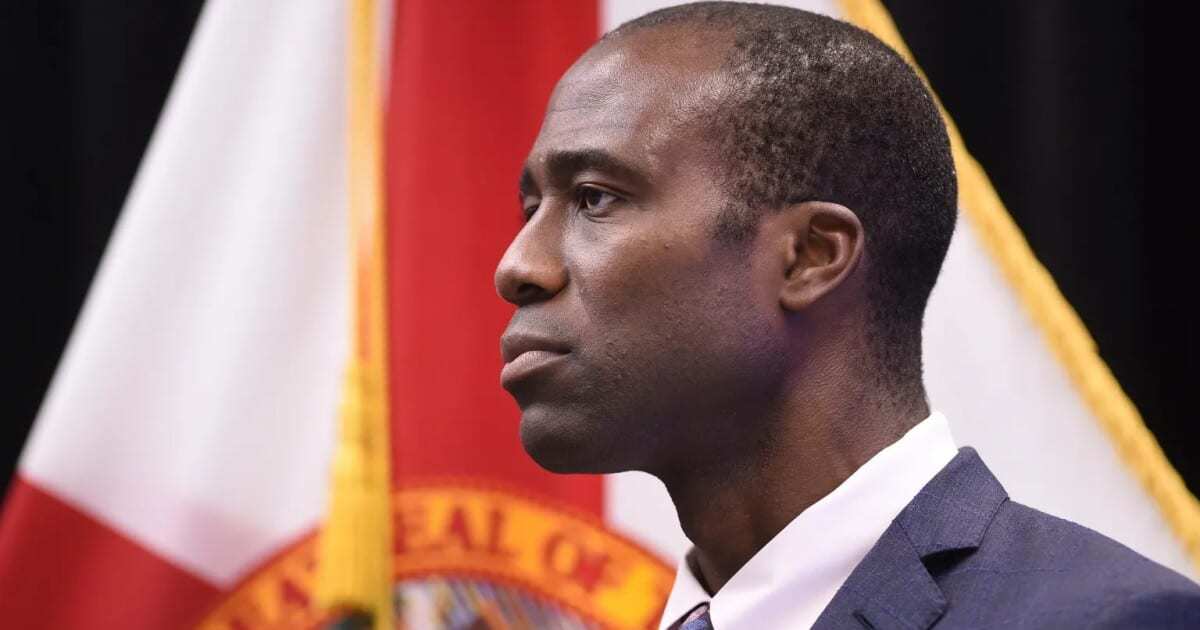
State Surgeon General Joseph Ladapo has made ending school vaccine mandates a signature goal. In September 2025, he and Gov. Ron DeSantis asked the Legislature to roll back all vaccine mandates. No legislator filed a bill in the 2026 sessions to remove the requirements written into state law, and several "medical freedom" bills that would have expanded exemptions passed the Senate but died in the House.
That matters for measles specifically. The MMR vaccine, along with polio, diphtheria and tetanus shots, is required by statute for K-12 public school attendance, so only lawmakers can remove it. Ladapo's department has moved on its own against four vaccines that are set by agency rule rather than law: hepatitis B, chickenpox, Hib and pneumococcal conjugate. The proposed rule would also broaden religious exemptions to include moral and ethical beliefs and let families opt out of the state vaccine registry.
At a public hearing in Lake Mary in October, Ladapo said the change is about families' right to choose, not the effectiveness of vaccines, arguing that public health "cannot supersede the right of a parent" to decide what is best for a child. The American Academy of Pediatrics said the move would put children at risk of getting sick.
The rule is now on hold. In October, the Florida Academy of Family Physicians filed a petition challenging it, arguing the department exceeded its authority and missed a 180-day deadline to finalize the rule. A department spokesperson, Isabel White, said the timeline "will be contingent on legal outcomes." Every vaccine on the current school list remains required while the challenge is pending.
Ladapo has drawn criticism on measles before. During a 2024 outbreak at a Broward County elementary school, he sent parents a letter leaving it to them whether to keep unvaccinated children home, contrary to standard CDC guidance.
What it means for Floridians
For most Floridians, the practical risk depends on vaccination. Measles is among the most contagious viruses known and can cause pneumonia, severe diarrhea and a loss of immune memory that leaves children vulnerable to other infections. A rare complication, subacute sclerosing panencephalitis, is progressive and fatal years after infection. Infants too young for their first MMR dose and people with weakened immune systems depend on the vaccination of those around them.
Florida's position as a hub for international travel and tourism also means imported cases will keep arriving. Canada lost its own elimination status last year after a lengthy outbreak, and Mexico, with several large outbreaks, is at risk of losing its status too.
What's next
To regain elimination status, the United States would need to go at least 12 months without continuous spread of any single strain, which Dr. William Moss of Johns Hopkins said will not be "a trivial task." In Florida, the next markers to watch are the court ruling on the Florida Academy of Family Physicians' challenge, any bills filed ahead of the 2027 legislative session to change school vaccine law, and whether the state's case count, now largely flat since spring, starts climbing again as winter travel picks up.
Spotted an issue with this article?
Have something to say about this story?
Write us a letterComments
No comments yet. Be the first to weigh in.
Related Coverage
Florida Health Agency Puts $1 Placeholder in Budget Request for Autism Therapy Task Force Recommendations
2d ago

On Veterans Day, Florida's Veterans Agency Asks Lawmakers for Millions More to Staff and Repair State Nursing Homes
3d ago

Hillsborough Unanimously Bans Concentrated Kratom and 7-OH Products, Makes Sales a Misdemeanor
3d ago

Florida Regulators Hit 13 Pharmacy Benefit Managers With $12.66 Million in Penalties Under 2023 Drug Pricing Law
3d ago