Artemis III Rocket Takes Shape at Kennedy as SLS Core Stage Joins Its Boosters Ahead of a Pad 39B Tanking Test
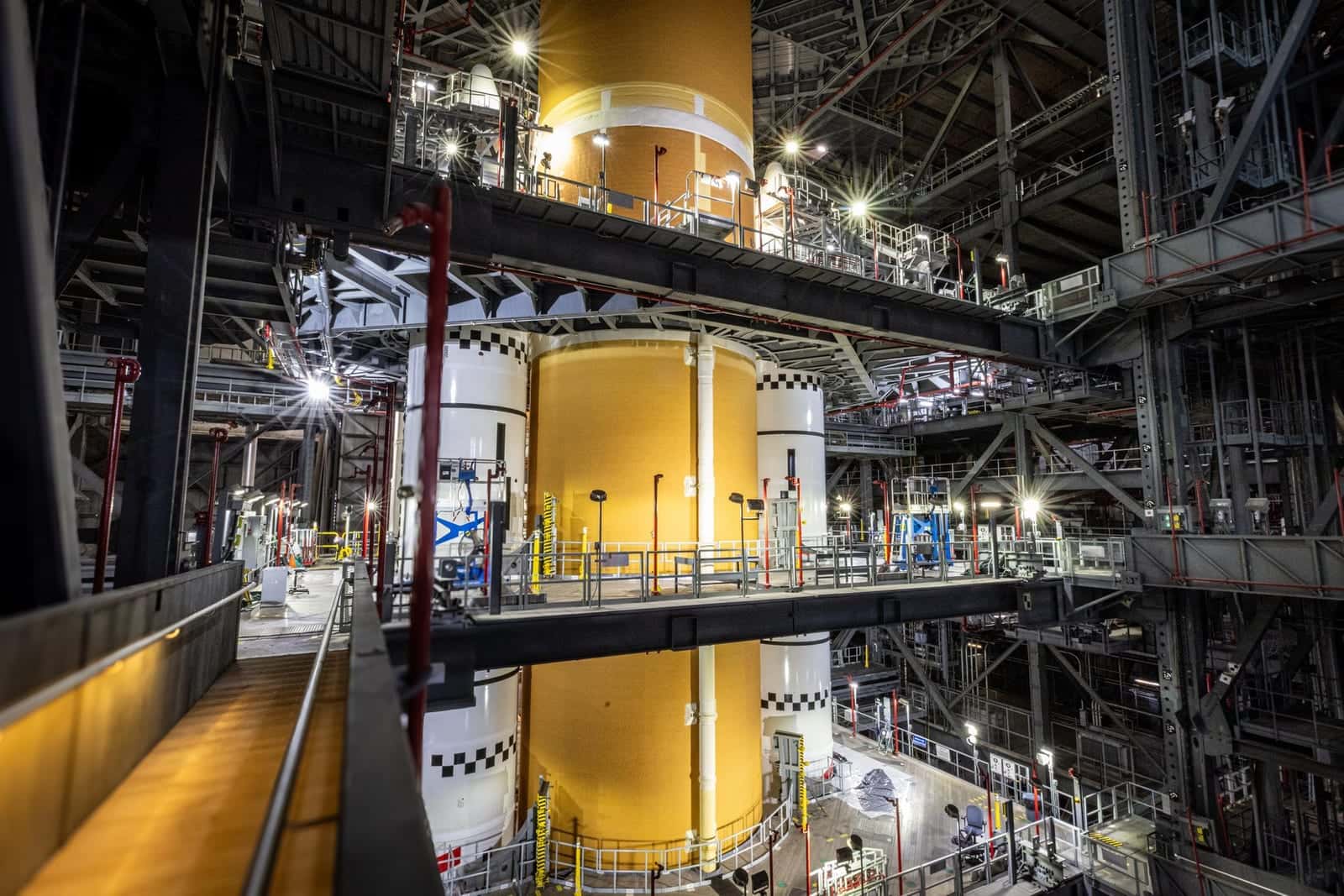
NASA has joined the core stage of its Artemis III Space Launch System rocket to the twin solid rocket boosters inside the Vehicle Assembly Building at Kennedy Space Center, the agency said Wednesday, Oct. 28. The milestone completes what NASA calls the rocket's “short stack” and sets up a fueling test at Launch Pad 39B, the next major step toward a crewed Earth-orbit test flight from Florida's Space Coast in 2027.
How the stack came together
Technicians lifted the 212-foot core stage from the Vehicle Assembly Building's High Bay 2 using a one-of-a-kind lifting beam designed to place the stage onto the mobile launcher, according to NASA. Photos released by the agency show the stage being raised from the building's transfer aisle on Thursday, Oct. 22, resting horizontally there on Oct. 23 and integrated alongside the booster segments in High Bay 3 on Sunday, Oct. 25.
The core stage holds the rocket's liquid hydrogen and liquid oxygen and its four RS-25 engines, all of which were installed earlier this fall. The twin boosters will provide more than 75% of the rocket's total thrust at liftoff from Pad 39B, NASA said.
The milestone follows months of work in the same building. NASA's timeline for the Artemis III rocket so far:
| Date | Milestone |
|---|---|
| May 2026 | Core stage connected to its engine section in the VAB; monthly countdown simulations begin |
| June 2026 | Booster segments arrive at Kennedy by train; first RS-25 engines delivered |
| July 11, 2026 | Both aft booster assemblies secured to the mobile launcher |
| Sept. 30, 2026 | Booster nose cones installed, finishing booster stacking |
| Oct. 13, 2026 | NASA reports all four RS-25 engines installed on the core stage |
| Oct. 25, 2026 | Core stage integrated between the boosters, completing the short stack |
The boosters stand on the same mobile launcher used for Artemis II in April, which has been repaired since that launch, according to NASA.
Next up: a tanking test at Pad 39B
Once testing and checkouts are complete inside the VAB, teams will roll the core stage and booster stack out to Launch Pad 39B for a tanking test, NASA said. Launch controllers will load liquid hydrogen and liquid oxygen into the core stage only and practice countdown procedures and timelines.
The Artemis III crew will also use the pad visit for a launch day rehearsal and an emergency exit walkdown, according to an Oct. 13 NASA update. The astronauts will suit up in crew quarters, ride to the pad, climb the mobile launcher and walk the escape route they would use in an emergency during a countdown.
At a news conference at Kennedy on Oct. 23, NASA Administrator Jared Isaacman described the path ahead as a year-end tanking test followed by a summer 2027 launch, Aerospace America reported. NASA has not announced a launch date. At the pad, crews are refurbishing the flame deflector, which NASA said saw minimal damage during the Artemis II launch.
A mission that stays in Earth orbit
Artemis III will not go to the Moon. NASA reworked the mission this year into a planned 14-day test in low Earth orbit. NASA astronauts Randy Bresnik, Frank Rubio and Andre Douglas and European Space Agency astronaut Luca Parmitano will fly Orion to practice rendezvous, docking and habitation with test versions of the lunar landers being built by Blue Origin and SpaceX.
According to NASA's mission overview, Blue Origin will first launch a test version of its Blue Moon Mark 2 lander into orbit about 273 miles above Earth. Orion and its crew will launch on SLS from Kennedy days later, once Blue Moon is confirmed healthy, and the crew will spend about two days aboard the docked lander. SpaceX will then launch a Starship Version 3 test article from Florida for a second docking of up to two hours, during which the crew will not enter Starship. Orion will splash down in the Pacific Ocean off California.
“Every piece of this mission in Earth orbit is designed to reduce risk before we put astronauts back on the Moon,” Artemis program manager Jeremy Parsons said in the overview. NASA plans to land astronauts near the Moon's South Pole in 2028.
Other pieces of the rocket are still being built. At NASA's Marshall Space Flight Center in Alabama, workers have finished the primary structure of a spacer that NASA says will represent the upper stage's dimensions during the mission, and engineers are converting two structural test articles, the Orion stage adapter and the launch vehicle stage adapter, into flight hardware, the agency said.
Orion and crew preparations
The Orion spacecraft is being prepared in Kennedy's Neil A. Armstrong Operations and Checkout Building. In July, technicians attached the crew module's heat shield, made of 186 blocks of an ablative material called Avcoat, with design upgrades after unexpected behavior seen on the Artemis I heat shield, NASA said. Engineers with ESA and Airbus have since inspected the solar array wings, each of which generates 11 kilowatts and spans about 63 feet.
The crew has completed underwater helicopter escape training, recovery training with NASA and military partners in San Diego, including water lifts by Navy helicopters, and suited drills in the Orion Crew Survival System suits. In September, the full crew and backup astronauts visited Florida together for the first time, seeing their Orion spacecraft and the stacked boosters and visiting SpaceX and Blue Origin.
What it means for the Space Coast
For Brevard County, Artemis III means a cluster of high-profile launches in a short window: the crewed SLS from Pad 39B and a Starship test vehicle from Florida, with NASA saying it has never before launched three spacecraft on three different rockets to work together. The Kennedy launch team has been running monthly countdown simulations in the Rocco A. Petrone Launch Control Center since May.
The program's push to speed up is also reshaping jobs at the spaceport. A Florida WARN notice filed by NASA subcontractor Aetos Systems lists 126 employees at Kennedy who could lose their jobs as NASA brings that work back in-house, with those who decline offers from the agency expected to be let go by Dec. 31, according to local news reports.
What's next
The near-term target is rollout of the short stack to Pad 39B and the tanking test, which Isaacman has framed as a year-end goal. A chart shown at the Oct. 23 briefing indicated a possible Artemis III launch window from May through September 2027, according to reports from the briefing. Before launch, Blue Origin and SpaceX must have their test landers ready to fly within days of the SLS, and NASA must stack the spacer, adapters and Orion atop the rocket in the Vehicle Assembly Building.
Spotted an issue with this article?
Have something to say about this story?
Write us a letterComments
No comments yet. Be the first to weigh in.
Related Coverage

UN Votes on Cuba Embargo for 34th Year After Former Florida Congressman Mike Waltz Clashes With Cuba's Foreign Minister
16h ago

Port of Fernandina Gets $11 Million Federal Grant to Fight Flooding and Repair Docks, Sen. Ashley Moody Says
17h ago

Miami Real Estate Brokers Oren and Tal Alexander and Brother Alon Sentenced to 30 Years Each for Sex Trafficking
17h ago
Iran War Has Cost at Least $47 Billion, Says Tampa-Based CENTCOM, as Florida Gas Holds Above $4
19h ago