Blue Origin Expands Across Cape Canaveral as It Rebuilds From a Pad Explosion
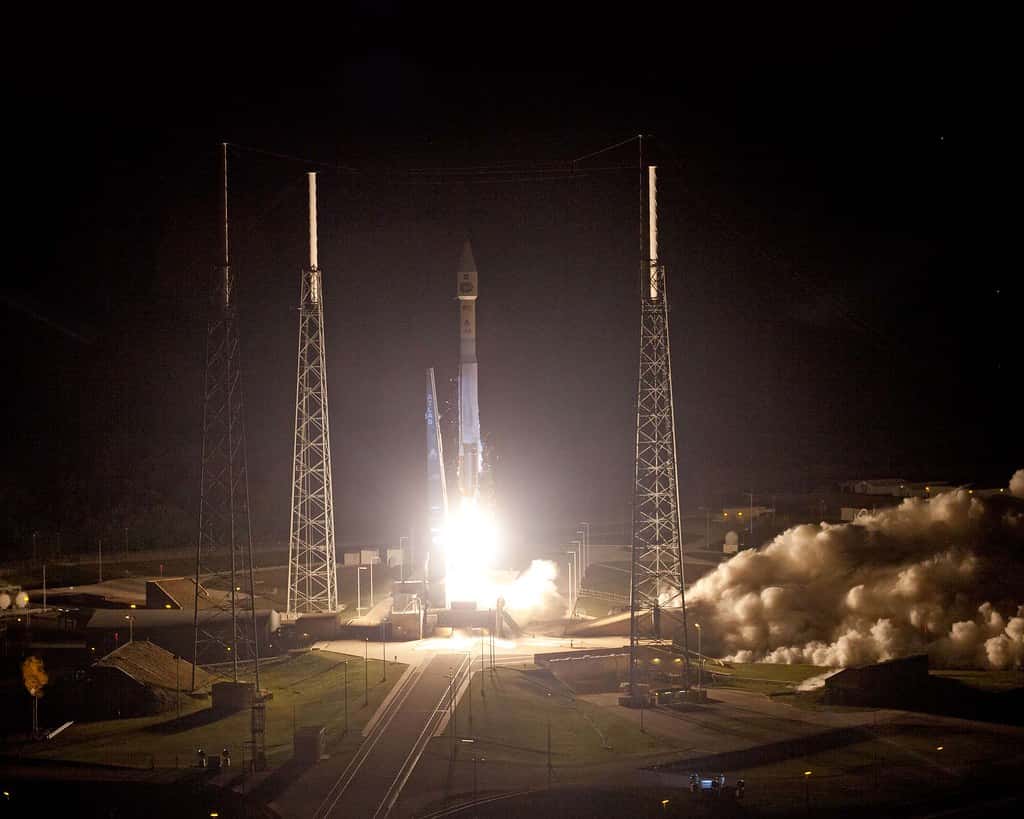
Blue Origin is expanding its footprint across Cape Canaveral and Kennedy Space Center on several fronts at once, four months after a New Glenn rocket exploded during a static fire test and severely damaged the company's only operational launch site for the vehicle.
The company has broken ground on a new $80 million payload processing facility at Cape Canaveral Space Force Station, designed to support 16 missions a year and expected to open in early 2028. That work sits alongside a new test site on Merritt Island, production buildings at the company's Rocket Park complex, the rebuild of Launch Complex 36, and early work on additional processing facilities nearby.
For Brevard County, the buildout represents sustained construction employment and a longer-term expansion of the aerospace workforce on the Space Coast, in a region that has been transformed over the past decade by the growth of commercial launch operations.
What happened at Launch Complex 36
On May 28, a New Glenn rocket exploded during a static fire test at Launch Complex 36 at Cape Canaveral Space Force Station. Engineers were counting down to a brief test firing of the vehicle's seven methane-fueled BE-4 first stage engines when something went wrong at the base of the rocket around 9 p.m. Eastern.
The 188-foot first stage became enveloped in a rapidly growing fire, and the 86-foot upper stage tilted and fell. The vehicle was destroyed and the launch complex was severely damaged. No one was injured, according to officials at Cape Canaveral Space Force Station.
The explosion was among the largest ever to occur on a launch pad, with reports of the blast being visible from up to 100 miles away. Blue Origin issued warnings about debris in the aftermath.
On August 5, the company confirmed that the explosion was caused by one of the rocket's BE-4 engines. Static fire testing exists precisely to find failures like that on the ground rather than in flight, though the cost when a test fails at that scale is enormous.
Why the company is building anyway
Expanding capital investment months after losing a vehicle and a launch complex might look counterintuitive. It is not, and the reason reveals something about how the commercial launch industry now operates.
Launch is capacity-constrained. Demand for orbital launch, driven by satellite constellations, national security payloads, and commercial customers, has outrun the industry's ability to supply it. The companies that can launch frequently capture that demand, and frequency depends on ground infrastructure as much as on rockets.
A payload processing facility supporting 16 missions a year is a statement about intended launch cadence. Satellites arrive at the Cape needing clean-room environments for final assembly, fueling, and encapsulation in the rocket's fairing before they can be mated to the vehicle. Processing capacity is a hard ceiling on how often a company can launch regardless of how many rockets it builds.
Blue Origin has substantial contracted work ahead, including a Griffin Mission One flight on Falcon Heavy scheduled for November 2026 from Kennedy Space Center and a role in NASA's lunar program. Meeting those commitments requires the ground infrastructure now under construction.
The Space Coast transformation
Brevard County's economy was built around government spaceflight and went through a wrenching contraction after the Space Shuttle program ended in 2011, with thousands of jobs lost and a regional economy that took years to recover.
What replaced it is different in character. SpaceX established high-cadence operations at Cape Canaveral and Kennedy Space Center, with Falcon 9 launches occurring at a pace that would have been unimaginable during the shuttle era, including a Falcon 9 mission scheduled no earlier than September 19 from Cape Canaveral. Blue Origin, United Launch Alliance, and other operators have built alongside.
The result is a launch cadence from Florida's Space Coast that exceeds anything in the region's history, including the Apollo era. Launches have become routine enough that residents no longer stop to watch most of them.
The employment base has shifted with it. Commercial launch work involves manufacturing, integration, ground operations, and range support, and those positions are distributed across multiple companies rather than concentrated in a single government program, which makes the regional economy less vulnerable to any one program's cancellation.
The US Space Force has been an active participant, selecting Blue Origin's bid for expanded satellite processing at Cape Canaveral.
What it means for Central Florida
For Brevard County residents, the immediate effect is construction. An $80 million facility, a rebuilt launch complex, a Merritt Island test site, and production buildings represent multiple years of building trades employment, followed by permanent operational positions once facilities open.
For the regional housing market, sustained aerospace employment growth supports demand in Titusville, Cocoa, Melbourne, and the surrounding communities, which have seen substantial price appreciation as the industry has expanded.
For Florida's tourism economy, launch viewing has become a genuine draw. Port Canaveral, which handles both cruise and cargo traffic, sits adjacent to the launch complexes, and the combination of a cruise departure and a rocket launch has become a marketable Space Coast experience.
For Florida's educational institutions, the demand for aerospace engineering and skilled technical workers supports programs at the Florida Institute of Technology, Embry-Riddle Aeronautical University, the University of Central Florida, and the state college system, which has built technical training programs specifically aimed at launch operations.
The competitive landscape
Blue Origin operates in a market where SpaceX has established a dominant position through launch frequency and reusability. New Glenn is Blue Origin's answer to that, a heavy-lift vehicle with a reusable first stage designed to compete for the same payloads.
The May explosion set that effort back materially, costing a vehicle and a launch complex. The rebuild timeline determines when the company can return to flight, and the broader infrastructure investment determines what cadence it can sustain once it does.
United Launch Alliance, the Boeing and Lockheed Martin joint venture, also operates from Cape Canaveral and competes for national security launch contracts. The presence of three major operators at one range creates scheduling complexity that the Space Force manages.
NASA's own programs continue in parallel. The Artemis II crewed lunar flyby launched from Kennedy Space Center in April 2026 with astronauts Reid Wiseman, Christina Koch, and Victor Glover along with Canadian astronaut Jeremy Hansen, and the SLS core stage for Artemis III arrived at Kennedy in late April.
What a static fire test is meant to catch
Static fire testing is a standard step in launch vehicle preparation. The rocket is secured to the pad, fully fueled, and its engines are ignited for a brief period while the vehicle is held down. The purpose is to verify that engines, propellant systems, and ground support equipment all function together before anyone commits to flight.
The logic is that finding a failure on the ground is preferable to finding it in the air, where a failure means a lost payload and, for a crewed vehicle, lost lives. In that sense the May test performed its function, though at a cost that included the vehicle and the launch complex.
The BE-4 engine identified as the cause is Blue Origin's own design and is also supplied to United Launch Alliance for its Vulcan rocket, which means the failure investigation had implications beyond New Glenn. Engine development is among the hardest problems in aerospace, and methane-fueled staged combustion engines of the BE-4's class represent a relatively recent technology generation.
Failures of this kind are part of the development history of essentially every launch vehicle ever flown. What distinguishes programs is how quickly they diagnose the cause and return to flight, and the August 5 confirmation of the engine as the source represents a completed root cause investigation roughly ten weeks after the event.
The range and how it schedules three operators
Cape Canaveral Space Force Station and Kennedy Space Center together form the busiest launch range in the world, and coordinating multiple operators on shared infrastructure is a nontrivial problem. The Eastern Range provides tracking, safety, communications, and airspace and maritime clearance for every launch, and those resources are finite.
SpaceX drives the majority of the cadence, with Falcon 9 flights occurring at a rate that would have been considered impossible during the shuttle era. United Launch Alliance flies national security and commercial payloads. Blue Origin is building toward regular New Glenn operations. NASA runs its own programs, including the Artemis lunar campaign, from Kennedy Space Center's Launch Complex 39B.
The Space Force has invested in range modernization specifically to increase throughput, automating safety systems that previously required manual configuration between launches and shortening the turnaround time between operations.
For Brevard County, the practical consequence is road closures, airspace restrictions, and marine exclusion zones that recur multiple times per month. Residents have adapted to a rhythm that would have seemed extraordinary twenty years ago.
What's next
The payload processing facility is targeted to open in early 2028. The Launch Complex 36 rebuild timeline will determine when New Glenn returns to flight, and Blue Origin has not published a firm date.
The Griffin Mission One flight on Falcon Heavy from Kennedy Space Center is scheduled for November 2026, which would be a near-term Space Coast milestone.
For Brevard County, the practical measure is launch cadence. Every additional launch from Cape Canaveral and Kennedy Space Center represents work for range personnel, contractors, and the supply chain that has grown around the industry, and the infrastructure now under construction is designed to push that number higher.
The larger arc for Florida is that the Space Coast has become genuinely competitive rather than a single-operator range, and competition among launch providers is what drives the cadence that supports regional employment. Brevard County spent a decade recovering from the end of one government program. It now depends on several private ones, which is a more resilient arrangement even when any individual company has a bad year.
Spotted an issue with this article?
Have something to say about this story?
Write us a letterComments
No comments yet. Be the first to weigh in.
Related Coverage

Nine Florida HIV Prevention Groups Lose Direct CDC Grants as Federal Money Shifts to State Health Department
54m ago

Customs Rule That Could Cut Off Mailed Prescriptions From Canada for Florida Seniors Delayed to Jan. 20
3h ago

Cuba Says Florida-Based Speedboat Raiders Confessed and Face Terrorism Charges That Carry Death Penalty
4h ago

USDA's $8 Billion Harvest Fuel Relief: What Florida Growers and Fishermen Can Expect
21h ago