Could South Florida Build the Navy's Next Drone Boats? Boatbuilders Eye Defense Work
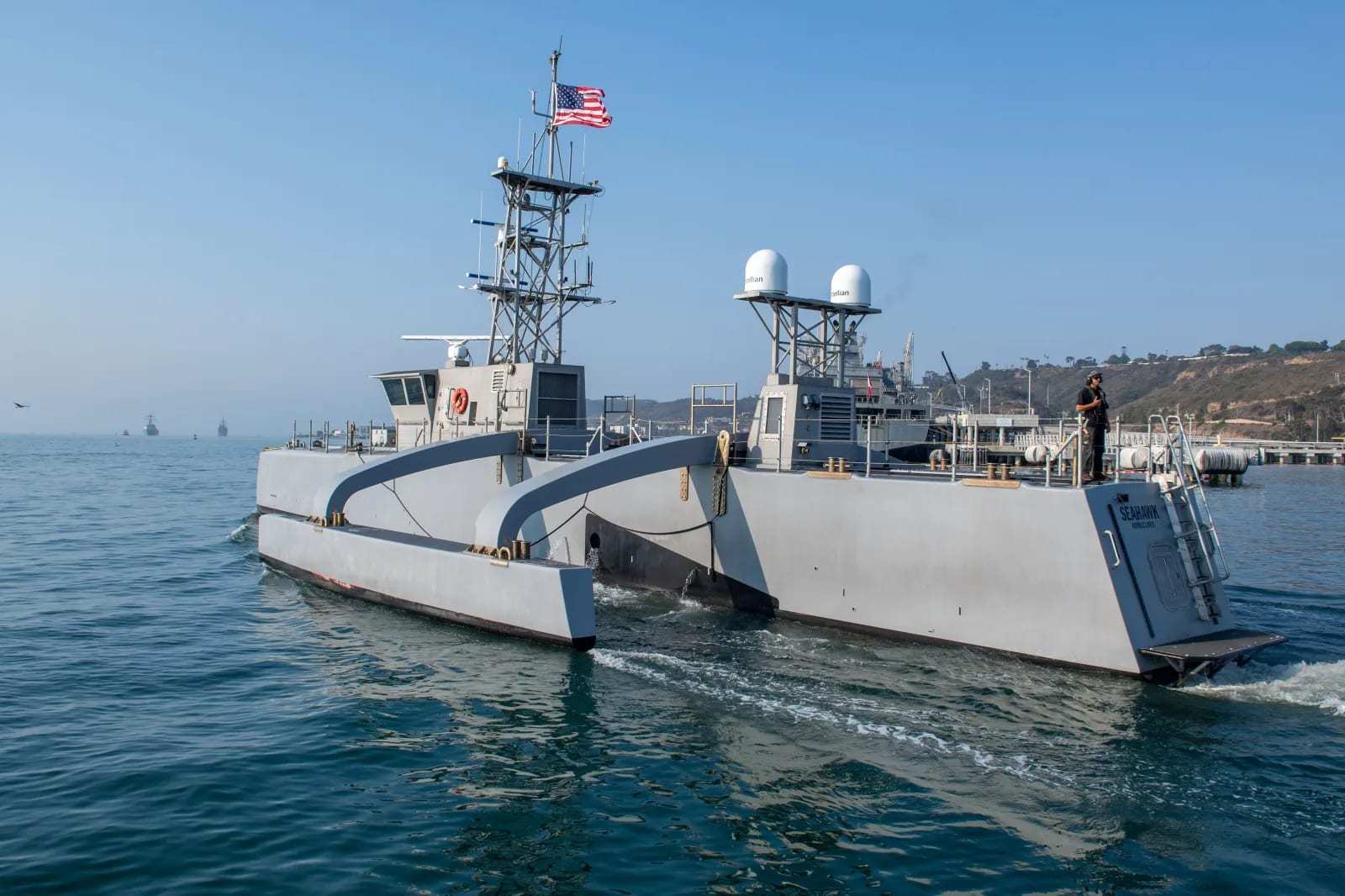
South Florida's recreational boatbuilding industry, best known for the yachts that fill the Fort Lauderdale International Boat Show, is pitching itself as a ready-made supply base for the Navy's push into autonomous vessels. Regional defense advocates and drone boat makers argue that the same shipyards, carbon-fiber shops and electronics suppliers that build pleasure craft could build unmanned "gray boats" for the U.S. military and its allies, as the Navy begins buying them by the dozen.
The case was laid out this week on WLRN's Sunshine Economy, where special correspondent Tom Hudson interviewed Rick Miller of the South Florida Defense Alliance and Bruce Hanson, owner of the drone boat maker Maritime Tactical Systems, known as MARTAC.
The pitch: recreational boats in wolf's clothing
Hanson told WLRN that his autonomous vessels are very similar to recreational boats. Most of his designs are carbon-fiber catamarans, and the main difference is the autonomy technology that replaces the crew. He called them "recreational boats in wolf's clothing."
Because commercial builders already have most of the pieces, Hanson said, the capital investment needed to move into defense work is relatively small. Requirements such as the Pentagon's Cybersecurity Maturity Model Certification, known as CMMC, can come later. The question military buyers keep asking, he said, is simply whether a company can get it done and scale up.
Miller, a retired Navy captain who leads the nonprofit alliance covering Palm Beach, Broward, Miami-Dade and Monroe counties, said South Florida is "uniquely positioned to take advantage of this." He pointed to the region's boat builders, supply chains, component vendors and workforce, along with a Navy test and evaluation range off Fort Lauderdale where both manned and unmanned vessels can be assessed. He said the region has test and training range space at a scale not found elsewhere in the country, allowing local firms to design, build, test and demonstrate systems close to home.
Miller cited the war between Russia and Ukraine, where small drone boats have played a major role, and rapid advances in autonomy as drivers of military interest. He argued the United States faces competitors with growing industrial and military capabilities, and that autonomy at scale opens new national security options.
What the Navy is buying
The Navy's appetite for unmanned surface vessels has grown quickly in 2026, though its programs have shifted along the way. In March, the service canceled its Modular Attack Surface Craft program and replaced it with a new marketplace for medium unmanned surface vessels, according to USNI News. That effort received roughly $2.1 billion from the 2025 federal budget reconciliation law, according to trade press reports.
On May 29, the Navy named seven companies for at-sea testing: Sea Machines, Leidos, Saronic Technologies, Galliano Marine Services, PacMar Technologies, Birdon and Huntington Ingalls Industries. In late September, it awarded production agreements to three of them, Galliano Marine Services, Huntington Ingalls Industries and Saronic Technologies, each for 10 vessels at an average cost of about $40 million apiece, Military Times reported. That works out to 30 drone ships worth roughly $1.2 billion. Deliveries are expected to begin by the end of fiscal 2027.
None of the three winners is a South Florida company. That is the opening Miller and Hanson describe: as the Navy and other militaries scale up, prime contractors and drone makers will need hulls, composites, electronics and skilled labor, and South Florida has those in quantity. Florida Trend has reported that Saronic plans to tap Florida's boat makers to build hulls, though the scope of that work has not been detailed publicly.
Florida companies already in the water
MARTAC, based in Melbourne on the Space Coast, is one of Florida's established military drone boat makers. In June, it announced a manufacturing partnership with Florida boatbuilder Intrepid Powerboats that the companies said could scale production of MARTAC's Devil Ray vessels to 200 to 300 a year, using Intrepid's production capacity and hull-building workforce. MARTAC has named Mystic Powerboats as an earlier co-production partner.
The model is the one Miller and Hanson are pitching to the rest of the region: an autonomy company supplying the brains while established recreational builders supply the hulls.
Another Florida yard took part in the Navy competition. Sea Machines, one of the seven finalists, teamed with St. Johns Ship Building and other partners on its STEAMRACER design, according to Naval News. Sea Machines was not among the three companies selected in September.
Foreign customers are another market. Hanson told WLRN that buyers abroad will pay for American autonomy technology they cannot get elsewhere, through direct commercial sales that require State Department approval. He noted that Taiwan paid for vessels directly through its government, and he described the market as worldwide. Defense margins can be strong, he said, for companies that scale and manage their supply chains well.
The state is paying to map the opportunity
Florida is putting modest money behind the idea. On Aug. 31, Gov. Ron DeSantis announced nearly $23 million in defense, space and workforce awards, including $125,000 through the state's Defense Reinvestment Grant Program for the Greater Fort Lauderdale Alliance's Broward Maritime Defense Readiness and Diversification Initiative. The governor's office said the project will model the county's existing and potential maritime-industrial readiness, prepare vendors for defense production and match Florida capabilities to defense and dual-use needs.
The alliance said in September that a $37,500 local match brings the project to $162,500, and that it will produce research on expanding from recreational boatbuilding into Navy shipbuilding, including smaller, modular, autonomous and unmanned vessels. The South Florida Defense Alliance and the South Florida Regional Planning Council are partners.
In announcing the awards, DeSantis said nearly 900,000 Floridians work in defense and related industries and that the investments are meant to keep the state a leader in attracting defense, aerospace and shipbuilding companies.
What it would mean for South Florida
The marine industry is already one of the region's economic engines. Organizers of the Fort Lauderdale International Boat Show, which closed earlier this month after five days with more than 1,300 boats on display at six waterfront locations, estimate the show alone generates about $1.8 billion in annual economic impact across Florida.
Defense work would not replace that business, but it could give boatbuilders and their suppliers a second, steadier customer base. Broward County also has history to draw on: Broward Marine yards once built sub chasers and minesweepers for the Navy.
The hurdles are real. Builders new to defense must meet cybersecurity certification, export controls for foreign sales and the scale and schedule demands of military buyers. No specific contract values or job counts for South Florida yards have been announced.
What's next
The Broward initiative's research is expected to identify which local companies and sites could support Navy, Coast Guard and other unmanned maritime missions. Meanwhile, the Navy's first 30 medium drone vessels are moving toward production, and any further rounds of buying will test whether South Florida's boatbuilders can turn their pitch into contracts.
Spotted an issue with this article?
Have something to say about this story?
Write us a letterComments
No comments yet. Be the first to weigh in.
Related Coverage

CMS Lets States Delay Medicaid Work Requirement Enforcement to June 30, 2027: What It Means for Florida
1h ago

Civil rights groups ask DHS watchdogs to investigate Miramar ICE office where detainees say they were held for days and denied medication
2h ago

Haiti Closes Candidate Enrollment for Its First Elections in a Decade, With 33 Presidential Hopefuls and South Florida's Diaspora Watching
22h ago

Florida Builders Warn Immigration Enforcement Is Thinning Crews and Could Raise Home Prices
1d ago