DeSantis Says Florida Will Begin Testing Electric Air Taxis This Year
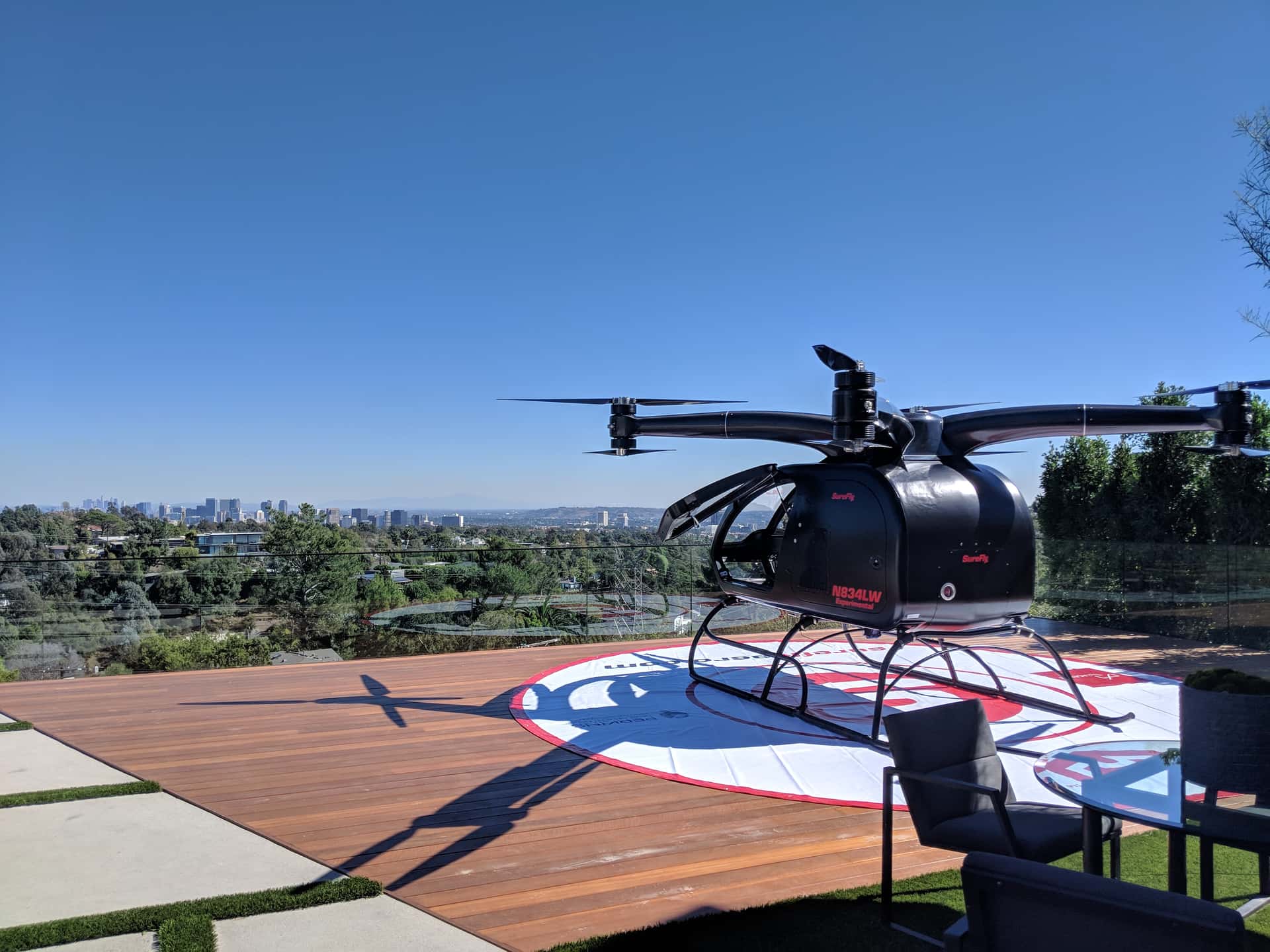
Governor Ron DeSantis said Monday that Florida will begin testing electric air taxis in Central Florida before the end of 2026, framing the state as a proving ground for aircraft designed to carry passengers between cities without using conventional runways. He made the announcement at SunTrax, the state-owned transportation testing facility in Auburndale, in Polk County, which already hosts autonomous vehicle testing from companies including Tesla and Waymo.
The aircraft in question are known as eVTOLs, short for electric vertical takeoff and landing. They lift off and land vertically like helicopters, then transition to winged flight for cruising, and they are designed to operate from compact ground facilities called vertiports rather than airports. The governor described the technology as a potential route to moving passengers between major Florida cities, and pointed to the Interstate 4 corridor between Tampa and Orlando as a natural early market.
The announcement is a statement of intent rather than a service launch. Testing at a closed facility is several regulatory steps removed from carrying paying passengers over populated areas, and the timeline for commercial operation depends on federal certification decisions that Florida does not control. What the state is offering is infrastructure, testing space and a regulatory posture designed to attract the industry.
What was announced
DeSantis said testing would begin in Central Florida by the end of the year, with SunTrax serving as a central venue. The facility, operated by the Florida Department of Transportation, occupies several hundred acres and includes a high-speed oval track and a large interior testing pad built specifically for emerging transportation technologies.
The governor connected the eVTOL work to the state's existing autonomous vehicle testing program, presenting both as parts of a single strategy: position Florida as the place where new transportation technology gets validated, and capture the associated engineering and manufacturing activity. He cited congestion relief and safety as the public benefits the state is pursuing.
Specific operators, aircraft models and flight schedules were not the focus of the remarks as reported. Neither was the question of who pays for vertiport construction, which is the infrastructure element that determines whether the technology becomes a scheduled service or stays a demonstration.
How eVTOLs actually work
An eVTOL uses distributed electric propulsion, meaning multiple electric motors driving multiple rotors or propellers rather than a single engine. On takeoff, those rotors point upward and the aircraft rises vertically. In forward flight, most designs either tilt the rotors forward or transition lift to a fixed wing, which is far more energy-efficient than hovering.
The engineering advantages over helicopters are meaningful. Distributed propulsion provides redundancy, since the loss of one motor does not necessarily mean the loss of the aircraft. Electric motors have far fewer moving parts than turbine engines, which reduces maintenance burden. And the noise profile is substantially lower, which is the single biggest factor in whether communities accept vertiports in urban areas.
The constraint is energy. Battery energy density remains far below that of jet fuel, which caps practical range. Most current designs target trips in the range of 25 to 100 miles, which is why the Tampa to Orlando corridor, roughly 85 miles, sits at the edge of what is plausible and why shorter hops such as airport to downtown transfers are the more likely first commercial applications.
The regulatory path
Nothing flies commercially without the Federal Aviation Administration. The agency has established a certification framework for what it calls powered-lift aircraft, a category that did not previously exist in a form suited to eVTOLs, and it published operational rules covering pilot training and requirements for this class of aircraft.
Certification is a multi-year process involving type certification for the aircraft design, production certification for the manufacturing process, and operational certification for the company flying them. Several manufacturers have been working through that pipeline for years. Testing at a state facility can generate data that supports certification, but it does not substitute for it.
Airspace integration is the other federal question. Introducing a meaningful volume of low-altitude passenger flights into airspace already used by general aviation, medical helicopters, law enforcement aircraft and, increasingly, drones requires traffic management systems that are still being developed. Florida cannot resolve that independently.
What it means for Floridians
In the near term, very little changes for the average resident. Testing at a closed facility in Polk County will not alter anyone's commute this year. The realistic horizon for commercial passenger service in Florida is measured in years, contingent on federal certification, and the first routes will almost certainly be premium-priced.
The more immediate effect is economic. Aerospace is already a substantial Florida industry, anchored by the Space Coast, defense contractors across the state and the aviation programs at Embry-Riddle Aeronautical University in Daytona Beach and Florida Institute of Technology in Melbourne. Hosting eVTOL testing plausibly generates engineering jobs, supplier relationships and training pipelines.
There is also a question of who benefits. Air taxi service, at least initially, is a product for business travelers and affluent consumers. Whether it eventually scales to something resembling mass transit depends on cost curves that have not yet been demonstrated. Floridians evaluating the announcement should hold both facts at once: the technology is real and progressing, and the near-term consumer relevance is limited.
Where this fits in Florida's transportation picture
Florida's core mobility problems are structural. The state has added population faster than it has added road capacity, and its development patterns are heavily automobile-dependent. The I-4 corridor, connecting Tampa, Lakeland, Orlando and Daytona Beach, is among the most congested stretches of highway in the Southeast and has been the subject of expansion projects for decades.
Air taxis do not address that at the volumes involved. A vehicle carrying four to six passengers, operating on a schedule constrained by battery charging and weather, moves a rounding error's worth of the traffic on I-4 on any given day. The honest framing is that eVTOLs are a premium point-to-point option, not a congestion solution.
Weather is a Florida-specific complication worth noting. Afternoon thunderstorms are a near-daily summer feature across the peninsula, and lightning, downdrafts and low visibility all constrain small aircraft operations. Any Florida air taxi service will need to plan around a reliability profile shaped by that pattern.
What SunTrax is
SunTrax occupies several hundred acres in Auburndale and was developed by the Florida Department of Transportation and Florida's Turnpike Enterprise specifically as a testing environment for emerging transportation technology. Its centerpiece is a 2.25-mile oval track surrounding a large interior pad built to support controlled testing scenarios.
The facility's original purpose was tolling technology, testing systems that read transponders and license plates at highway speeds. Its scope expanded to autonomous vehicle testing, which requires a closed environment where a system can be pushed to failure without endangering the public.
That closed-course model is what makes the site suitable for early eVTOL work. A manufacturer can conduct flight testing, evaluate ground handling and charging infrastructure, and gather performance data without the airspace coordination and community notification that testing over populated areas would require.
Florida's autonomous vehicle framework
The eVTOL announcement builds on a legal framework Florida established years ago for autonomous vehicles. The state enacted legislation permitting operation of autonomous vehicles on public roads without a human operator present, provided the vehicle meets insurance and equipment requirements, making Florida one of the more permissive jurisdictions in the country.
That posture is deliberate industrial policy. States compete for testing and deployment by offering regulatory clarity, and companies concentrate operations where the rules are settled. Florida's approach has attracted testing programs from multiple developers.
The tradeoff in permissive frameworks is that they place more weight on federal safety oversight and on company self-regulation. Aviation differs importantly here, because the Federal Aviation Administration's authority over aircraft certification and airspace is comprehensive in a way that vehicle regulation is not. A state cannot create a permissive path around federal aviation rules.
Who is building these aircraft
The eVTOL sector consists of a handful of well-capitalized developers pursuing broadly similar concepts with different technical approaches, alongside a longer tail of smaller entrants. Several have been in FAA certification processes for years, and several have conducted piloted transition flights, the maneuver in which an aircraft shifts from vertical lift to wing-borne flight.
Major aerospace and automotive companies have taken positions in the sector through investment or partnership, and airlines have placed conditional orders that are best understood as options rather than firm commitments. Conditional orders cost little and secure delivery position if certification succeeds.
Consolidation is the widely expected outcome. Certification is expensive, manufacturing at scale is harder than prototyping, and the market will not support the number of entrants currently pursuing it. Which companies survive that shakeout will determine a great deal about where the industry locates its operations.
What a vertiport requires
The infrastructure question is the one that most often determines whether an advanced air mobility program becomes a service or stays a demonstration. A vertiport needs a landing area sized for the aircraft, clear approach and departure paths, passenger facilities, and, critically, electrical capacity for charging.
Charging is the constraint people underestimate. An eVTOL fleet operating on a schedule requires rapid charging between flights, which means substantial electrical service and, in many cases, on-site battery storage to avoid overwhelming local distribution infrastructure during peak periods.
Siting is the other obstacle. Vertiports need to be near where people want to go, which means urban and suburban locations where land is expensive and where neighbors have standing to object through local land use processes. Noise, even at the reduced levels these aircraft produce, is the objection that surfaces most consistently.
What's next
The immediate milestone is whether testing actually begins at SunTrax before the end of the year, and which operators participate. Those details will say more about the seriousness of the program than the announcement itself does.
Beyond that, the questions to watch are vertiport siting, which requires local land use approvals and will generate community debate over noise, and the pace of federal certification for the manufacturers involved. Both are slower-moving than announcements.
Florida has made a recurring bet that being first to host emerging transportation technology produces durable economic advantages. That bet has paid off in some cases and not in others. The eVTOL program is early enough that its outcome is genuinely open.
Spotted an issue with this article?
Have something to say about this story?
Write a letter to the editor