FSU Students Are Far More Tolerant of Political Disagreement Than They Think Their Peers Are, Survey Finds
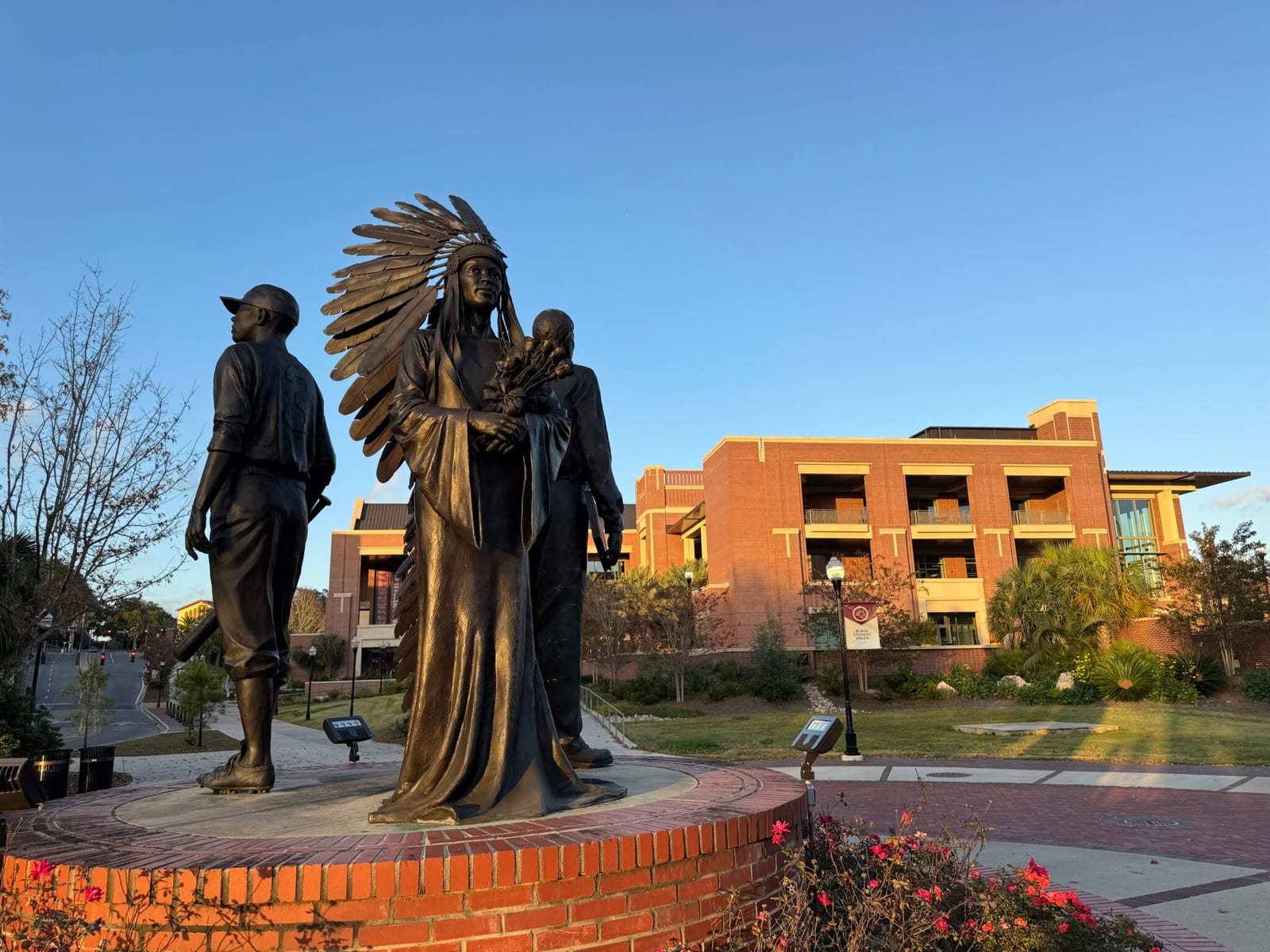
Florida State University students expect their classmates to be far less tolerant of opposing political views than those classmates say they are, according to a new survey by FSU's Institute for Governance and Civics. On average, students estimated that 52% of their peers would react negatively to someone expressing views they strongly opposed, but only 15% of the same students said they themselves were likely to react that way, a gap of 37 percentage points.
The report, titled "Political Disagreement at FSU: Student Attitudes, Peer Expectations, and Free Speech," was released in November and written by Zach Goldberg, Ryan Owens and James L. Woodworth. Owens directs the institute, which the Florida Legislature established at FSU in 2023. It is the institute's second annual survey of FSU undergraduates.
How the survey was done
The institute emailed invitations to 7,000 undergraduates drawn from a university-provided list designed to approximate the student body by class year, sex, race and ethnicity, and field of study. The online survey ran from Sept. 16 to Oct. 16, 2026. Of those invited, 683 answered at least one substantive question and 620 completed the survey, a completion rate of 8.9%. Participation was voluntary, and students who finished received a $5 electronic gift card.
Women were overrepresented among respondents (67.5%, compared with 58.2% of those invited), and seniors were underrepresented. The researchers weighted the results to match the invitation list on sex, race and ethnicity, and class year. Because respondents chose whether to take part, the findings describe those who answered rather than a random sample of every FSU undergraduate.
The perception gap
The headline result is a mismatch between what students expect from each other and what they report about themselves. Only 2% of respondents said they would be very likely to react negatively to a peer openly expressing views they strongly disagreed with, and 13% said somewhat likely, according to the report and Florida Phoenix coverage. Yet the same students guessed, on average, that roughly half of FSU would.
The same pattern appeared on dating. Respondents estimated that 41% of FSU students would be willing to date someone with opposing political views, even if they would prefer not to. Among the respondents themselves, 66% said they would be willing, a gap of 25 points.
The authors describe the gap as consistent with what psychologists call pluralistic ignorance, a shared misperception of what others think. Their concern is a self-reinforcing silence: students who expect hostility keep their views to themselves, and the less often a view is voiced, the easier it is for others who share it to assume they are alone. In a statement reported by the Florida Phoenix, Owens said students should take notice, because those who expect a negative reaction may hold back questions or alternative viewpoints even though the survey shows more room for open dialogue than they assume.
Echo chambers and tolerance
The 2026 survey added a question the first one lacked: how many of a student's close friends share their politics. Among respondents who knew enough to answer, 66% said most (42%) or all or almost all (24%) of their close friends shared their views. Liberal respondents were much more likely than moderates or conservatives to say that all or almost all of their close friends agreed with them: 38%, compared with 9% of moderates and 14% of conservatives.
Students in the most politically uniform friend groups were the least tolerant on several measures. After adjusting for ideology and demographics, an estimated 46% of them said they would be comfortable with a roommate holding opposing views, compared with 61% to 76% among students with more varied friendships. Just 10% were willing to date across political lines without reservation, compared with 27% to 37% in the other groups, and 25% said they would likely react negatively to a peer expressing disagreeable views, compared with 11% to 15% for everyone else.
The researchers caution that the relationship may run in either direction. Diverse friendships could make students more tolerant, or more tolerant students could be more likely to form diverse friendships, and the survey cannot tell which.
Overall comfort with a politically opposed roommate barely moved from last year: 61% in fall 2026, compared with 59% in fall 2025. The report found that a gap between men and women on that question appeared only among liberal respondents. Among liberals, 38% of women and 61% of men said they would be comfortable with such a roommate; among moderates and conservatives, men and women answered almost identically.
Free speech in principle and in practice
Students endorsed free expression in broad terms. Ninety-three percent agreed that expressing and hearing controversial views is an important part of the college experience, unchanged from 2025. Support for expressing unpopular views without fear of consequences from faculty, staff or university leadership rose from 89% to 93%, and support for doing so without fear of consequences from other students rose from 77% to 88%.
Support weakened when students faced specific situations. Asked whether a speaker should be disinvited if most FSU students opposed them, 32% agreed and 53% disagreed. Forty-four percent agreed that freedom of expression should sometimes be restricted when it conflicts with social harmony and inclusivity, while 38% disagreed. Forty-six percent supported the university restricting views that some students believe harm certain groups, compared with 35% opposed, and 56% said the university should consider the views to be expressed when deciding whether to approve a student group's event.
The gap between abstract and practical support was larger among liberals than conservatives. For example, 73% of conservatives opposed faculty restrictions on classroom speech that might upset some students, compared with 50% of liberals, and 55% of conservatives opposed university limits on speech some consider harmful to certain groups, compared with 26% of liberals. The Florida Phoenix also reported a partisan split on disinvitations, with Democrats leaning toward disinviting an opposed speaker and Republicans mostly against it.
Speech, harm and violence
For the first time on campus, the institute asked two questions it had previously posed only nationally. Sixty-seven percent of FSU respondents agreed that some forms of speech can be as damaging as physical violence, compared with 62% of U.S. adults overall and 54% of adults ages 18 to 29 in the institute's September 2025 national survey. But just 15% agreed that physical violence is sometimes justified to stop harmful public speech, slightly above the 11% of all adults and below the 19% of young adults nationally.
Liberal students agreed with both statements more often than conservatives: 82% compared with 52% on speech as harm, and 19% compared with 9% on violence. Students who scored lowest on the report's index of practical support for free speech were far more likely to say violence can be justified, 44% compared with 3% among those scoring highest, after adjusting for other factors.
Little change by class year
The survey found limited evidence that students grow more tolerant as they move through college. Seniors were somewhat more comfortable than first-year students with an opposing roommate (63% versus 56%), but the differences on tolerance and free speech were not statistically significant. Friendships showed a clearer pattern: 59% of seniors said most or all of their close friends shared their views, compared with 74% of first-year students. The authors note that following the same students over time would be needed to show whether college causes the change.
Why it matters in Florida
The findings land in a state where campus speech has been a recurring political issue, and where state leaders have argued that Florida's public universities lean too far in one direction. The survey's conclusion is narrower: at FSU, students appear more open to disagreement than their peers believe, and the perception itself may be what keeps some of them quiet.
The report recommends that campus discussions build on students' broad agreement about free speech in principle while working through the harder questions, including how universities should respond when students believe speech harms certain groups. The institute says it is trying to provide that space through its "Agree to Disagree" events and a new Pluralist Lab.
What's next
Because this is the second year of the survey, the institute can now track change over time, and the authors say following the same students across their college years would be the way to learn whether campus life itself shapes tolerance. The full report and a technical appendix are posted on the Institute for Governance and Civics website.
Spotted an issue with this article?
Have something to say about this story?
Write us a letterComments
No comments yet. Be the first to weigh in.
Related Coverage

GAO report: 57% of Florida kindergartners missed the readiness benchmark in 2024-25
3d ago
Some Classes Will Stay on Hillsborough College's Dale Mabry Campus During Rays Stadium Construction, Reversing Part of Off-Site Plan
3d ago
Broward Schools Fired 285 Teachers Over Certification Lapses This Year After a State Audit Found Nearly a Quarter Out of Compliance
4d ago

Vanderbilt's West Palm Beach Campus Aims to Keep Palm Beach County Talent at Home as 2029 Opening Nears
5d ago