Plan to Mine Sugar Land Next to the EAA Reservoir South of Lake Okeechobee Faces Skeptical Water Managers
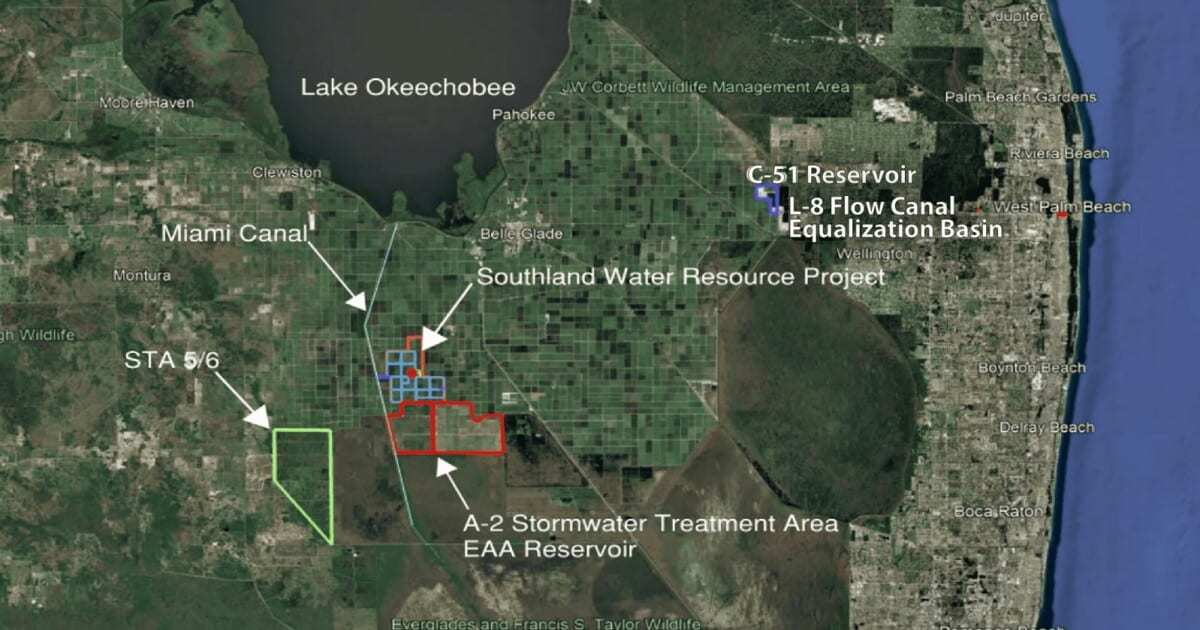
A private plan to blast, drain and mine thousands of acres of sugar land south of Lake Okeechobee, then turn the pits into a water reservoir, is running into growing skepticism from the South Florida Water Management District, the agency it most needs to win over. The contractor behind the Southland Water Resource Project has missed three deadlines to explain how it would mine limestone next to the $4 billion Everglades Agricultural Area Reservoir without damaging it, and the latest deadline is Dec. 1, according to reporting by The Florida Trib published Tuesday by WLRN.
The project would sit on 8,632 acres owned by U.S. Sugar and Florida Crystals in Palm Beach County. Its backers say it would add water storage for Everglades restoration. Environmental groups, and some state and federal officials, worry it is a rock mine dressed up as a restoration project, and that it could undercut the most important piece of restoration now under construction.
What is being proposed
The lead contractor, a Tennessee-based company called Phillips Heavy, proposes to mine several million tons of limestone from the site over 34 years and sell it as road and building material. The pits left behind would then be filled with water to form a reservoir. The company submitted the plan as an unsolicited proposal to the water management district on July 1, 2024, the same day a new state law took effect that streamlined approval of unsolicited proposals for public infrastructure, WLRN reported. The proposal posted by the district describes roughly 100,000 to 120,000 acre-feet of additional water storage.
Neither the U.S. Army Corps of Engineers nor the water management district asked for the reservoir, and it is not part of the Comprehensive Everglades Restoration Plan. Mining the rock could generate about $168.3 million a year in revenue, according to the Palm Beach Post.
The reservoir framing matters legally. Palm Beach County zoning bars mining in the Everglades Agricultural Area unless it supports public road construction, agriculture, or water management projects tied to ecosystem restoration, regional water supply or flood protection. Courts have upheld that rule and blocked earlier attempts to mine limestone on sugar land in the area.
Approvals won and still pending
The project has cleared some hurdles and still faces others. The current status of each, as reported by WLRN, is below.
| Agency | Action | Status |
|---|---|---|
| Palm Beach County | Land use and zoning approvals | Approved |
| Florida Department of Environmental Protection | Key state approval | Approved |
| Florida Department of Transportation | $5.9 million grant for a rail line to haul rock | Announced intent to award |
| South Florida Water Management District | Answers on the unsolicited proposal | Due Dec. 1 after three missed deadlines |
| South Florida Water Management District | Water use permit to pump 45.36 million gallons a day | Pending; board will vote |
| U.S. Army Corps of Engineers | Federal permit | Pending; no timeline given |
Palm Beach County commissioners approved the project unanimously in May 2025, according to published reports. The state environmental permit followed a February 2026 settlement of a legal challenge brought by Tropical Audubon Society; under the amended permit, mining beyond a first phase of 1,337 acres requires new permit applications and full environmental review, according to those reports.
Water managers lose patience
The district has been asking Phillips since April 2025 to explain how it would blast holes in the porous limestone bedrock without harming the neighboring reservoir or polluting the water. Each time the company missed a deadline, the district granted an extension.
In September, without answering those questions, Phillips filed a new application asking the district for permission to pump 45.36 million gallons of water a day at the site through 2039, lowering local water levels by as much as 10 feet to facilitate mining. At its Oct. 8 meeting, the district's governing board took the unusual step of claiming the right to vote on the permit publicly rather than leaving the decision to staff.
"Why would you apply for a permit when we don't know what the permit is for?" board chair Chauncy Goss said, according to the report. Board member Ron Bergeron, a businessman who once operated an Everglades rock mine, said he had received many calls from stakeholders with concerns. Board member Charlie Martinez said the project deserved extra scrutiny because too much work, time and money had gone into the neighboring reservoir to risk it.
The board has said it will wait for Phillips's technical details before voting, so no date is set. Phillips declined an interview, but senior vice president Matt Eidson said in an emailed statement that the project would boost South Florida's water storage and help Everglades restoration, and thanked the Department of Environmental Protection for recognizing its value.
The risk to the EAA Reservoir
The Southland site would lie less than 1,000 feet from the Everglades Agricultural Area Reservoir, the project often called the crown jewel of Everglades restoration. When it opens in 2029, it is designed to store 78 billion gallons of water south of Lake Okeechobee, water that can then be cleaned and sent south to the Everglades instead of being dumped east and west into the St. Lucie and Caloosahatchee estuaries.
In a July 2, 2025 letter to U.S. Rep. Brian Mast, the Army Corps' Col. Brandon L. Bowman wrote that the Corps has concerns about the project's impacts on Everglades restoration, including seepage. Pumping tens of millions of gallons a day to keep mining pits dry right beside a reservoir built on porous rock could pull water out of the reservoir and cause it to leak.
Steve Davis, chief science officer at the Everglades Foundation, said blasting could also crack the bedrock and worsen seepage, and that mining and crushing rock could release phosphorus, the nutrient that harms the naturally low-nutrient Everglades, along with chloride, sulfate and radium. Davis said many questions would have to be answered before the project could be called restoration.
Critics say the real need is filter marshes
Everglades advocates argue that deep storage is not the bottleneck. The bigger need, they say, is more stormwater treatment areas, the engineered wetlands where plants strip nutrients from farm and lake runoff. Water from reservoirs can only be sent into the Everglades if it meets strict phosphorus limits.
Matt DePaolis, policy director for the Sanibel-Captiva Conservation Foundation, said extra storage without cleanup capacity just means more polluted water. Chris Wittman, co-founder of Captains for Clean Water, said his group would support the companies donating or selling the land to the state for a filter marsh. Treatment marshes, however, need shallow wetlands, not deep pits, so they offer no justification for mining.
What happens to sugar land as soil runs out
The fight also reflects a long-term question about the Everglades Agricultural Area. The muck soils there have been wasting away since the land was drained for farming. At a University of Florida research station near Belle Glade, subsidence has erased about 6 feet of soil since 1924, and UF scientists have predicted nearly half of the area could have less than 8 inches of soil by 2050, making sugarcane difficult and costly to grow. Wittman said growers may be looking for the land's next use. Casey Darling Kniffin of Friends of the Everglades said that if farming stopped, restoration experts could bring the land back toward historic Everglades flow.
The politics
The board that is now scrutinizing the project may not be the one that decides it. Governor-elect Byron Donalds takes office Jan. 5 and could replace the governing board, as Ron DeSantis did after taking office in 2019. U.S. Sugar, Florida Crystals and Phillips gave $955,000 directly to Donalds' political committee this year, and the companies funded other committees that gave him more, according to the report.
What's next
The immediate test is Dec. 1, when Phillips is due to tell the water management district how it would mine the site without harming the EAA Reservoir. The district board's vote on the pumping permit will follow only after that information arrives, and the Army Corps' federal review remains open. With a new governor arriving in January, the makeup of the board that casts that vote could change.
Spotted an issue with this article?
Have something to say about this story?
Write us a letterComments
No comments yet. Be the first to weigh in.
Related Coverage
Conservation Groups Move to Sue Federal Government Over Long-Delayed Manatee Habitat Protections
5h ago

Sarasota Bay Dolphins May Swallow More Than 10,000 Microplastic Particles a Day Through the Fish They Eat, Study Finds
1d ago
Tampa Bay Water Gets $10 Million State Grant to Expand Its Surface Water Treatment Plant as Drought Restrictions Drag On
1d ago

Rising Fuel Costs Squeeze Citrus County Stone Crabbers as 2026-27 Season Gets Underway
2d ago