SpaceX Launches Classified NROL-95 Payload From Cape Canaveral Before Dawn
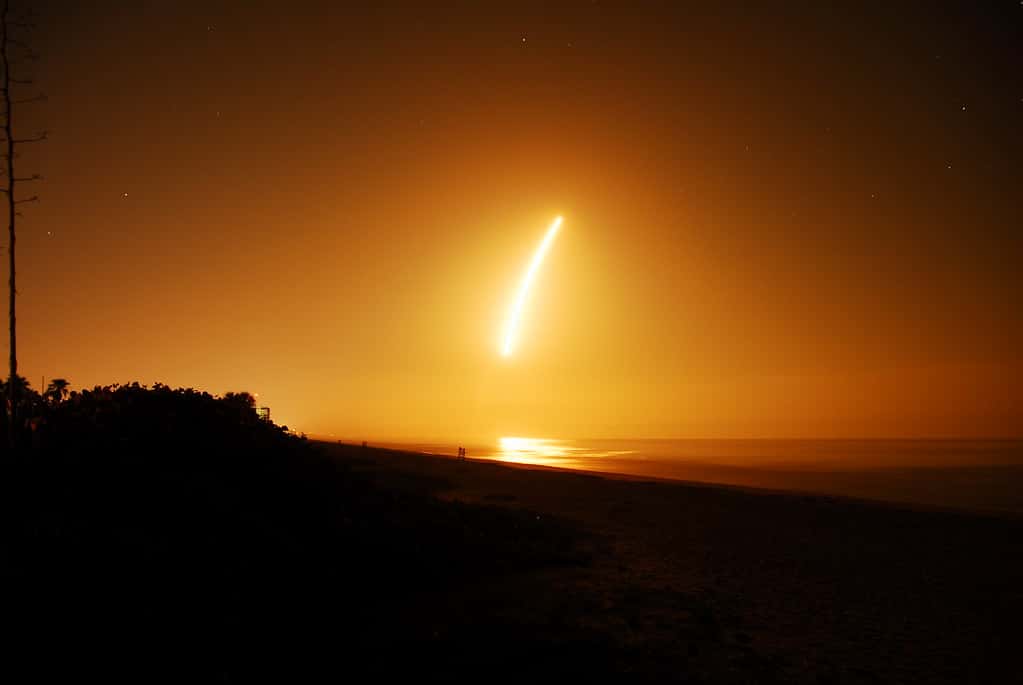
A SpaceX Falcon 9 rocket lifted off from Space Launch Complex 40 at Cape Canaveral Space Force Station at 3:10 a.m. Eastern on Thursday, carrying a classified payload for the National Reconnaissance Office on a mission designated NROL-95. The first stage returned to Earth for a landing at Cape Canaveral roughly eight and a half minutes after liftoff, and the National Reconnaissance Office subsequently confirmed that its payload had been deployed.
It was the seventh flight for that particular first stage booster, and the fourth National Reconnaissance Office launch of 2026. The other three NRO missions this year also flew aboard Falcon 9 rockets, but from Vandenberg Space Force Base in California rather than from Florida.
For Florida, the launch is one entry in a cadence that has made the Space Coast the busiest launch site in the world. For the intelligence community, it is a routine addition to a satellite architecture whose details remain classified.
What is known about the mission
The National Reconnaissance Office designs, builds, launches, and operates the United States government's reconnaissance satellites, supplying imagery and signals intelligence to the Department of Defense and the intelligence community. Its payloads are classified, and the agency discloses launch occurrence and success but not capability.
What is publicly observable about NROL-95 is limited to the launch profile. The liftoff time, the pad, the vehicle configuration, and the recovery method are all matters of public record because they occur in view of the Florida coast and are broadcast by SpaceX up to the point where coverage is cut for classified missions.
The return-to-launch-site landing at Cape Canaveral rather than a droneship recovery in the Atlantic indicates a mission profile with sufficient performance margin to allow the booster to reverse course and fly back. That generally implies a lighter payload or a lower-energy orbit than missions that require the booster to continue downrange.
Amateur satellite trackers typically observe and catalog objects in orbit following classified launches, and their findings circulate publicly. The government neither confirms nor comments on those observations.
Why Florida hosts these launches
Cape Canaveral's advantages are geographic and historical. Its latitude, roughly 28 degrees north, provides a rotational velocity boost for eastward launches, which reduces the propellant required to reach orbit. Its position on the Atlantic coast means launch trajectories carry vehicles over open water rather than over populated areas.
The infrastructure that accumulated around those advantages over seven decades is now the more decisive factor. Cape Canaveral Space Force Station and the adjacent Kennedy Space Center host multiple active launch complexes, processing facilities, range instrumentation, and a workforce concentrated in Brevard County.
That concentration has grown substantially with the rise of commercial launch. SpaceX operates from both Space Launch Complex 40 at Cape Canaveral and Launch Complex 39A at Kennedy Space Center, and United Launch Alliance, Blue Origin, and other providers maintain Florida operations.
The result is a launch tempo that would have been implausible a decade ago, with multiple missions per week during busy periods and a corresponding demand on range scheduling, airspace and maritime closures, and support infrastructure.
The Space Coast economy
Brevard County's economy is anchored by aerospace to a degree unusual among American metropolitan areas. Launch operations, satellite manufacturing, propulsion, and the supply chain supporting them employ tens of thousands of workers directly, with substantially more employment generated in construction, professional services, and hospitality.
The state has actively courted expansion. During a business development mission to the United Kingdom earlier this month, Governor Ron DeSantis announced at the Farnborough International Airshow that Relativity Space had committed to expanding operations on the Space Coast, with capital investment and job creation attached. The governor also presided over the signing of a memorandum of understanding between Space Florida and the United Kingdom Space Agency on international space collaboration.
Space Florida, the state's aerospace economic development authority, functions as the state's mechanism for infrastructure financing and site development in the sector. Its role has grown alongside the commercial launch industry.
Launch tourism has become its own economic category. Viewing locations along the Space Coast, in Titusville, Cocoa Beach, and Port Canaveral, draw visitors for high-profile missions, and hotel occupancy correlates with launch schedules.
What it means for Floridians
For Brevard County residents, launches are routine enough to be part of daily life, and the sonic booms produced by returning boosters are a recognized local phenomenon. Return-to-launch-site landings like the one on Thursday generate booms audible across a wide area of the Space Coast.
For the broader state, the launch industry represents one of Florida's highest-wage employment sectors and a significant driver of the technology workforce pipeline that feeds through Florida universities, including the University of Central Florida, Embry-Riddle Aeronautical University, and the Florida Institute of Technology.
Launch operations also intersect with other Florida interests. Range closures affect maritime traffic and fishing, and launch scheduling coordinates with commercial aviation through Federal Aviation Administration airspace management. Both are managed routinely but represent real coordination costs.
The national security dimension
The National Reconnaissance Office's satellite architecture supports military operations, treaty verification, and intelligence collection. Launch reliability is therefore a national security requirement rather than a commercial preference, and the certification process for national security launch vehicles is correspondingly rigorous.
SpaceX's Falcon 9 has flown national security missions for years under that certification, and the reuse of a booster on its seventh flight for a classified payload reflects the government's acceptance of flight-proven hardware, which was not always the case.
Launch capacity itself has become a strategic consideration, with the Department of Defense maintaining multiple certified providers to avoid dependence on any single vehicle. Cape Canaveral's ability to support high-tempo operations is central to that posture.
How reusability changed the Space Coast
The seventh flight of a single first stage booster would have been unthinkable a decade ago, when orbital rockets were expended after a single use. Reusability is the change that produced the current launch tempo, and Florida is where its effects are most visible.
The economics are straightforward. A booster that flies repeatedly amortizes its manufacturing cost across many missions, which lowers the price of access to orbit and increases the number of missions the market can support. Higher flight rates in turn justify investment in the ground infrastructure that supports them.
The operational consequences reach the surrounding community. Return-to-launch-site landings produce sonic booms audible across Brevard County and beyond, an effect that residents have largely normalized but that remains notable for visitors.
Booster recovery, refurbishment, and reflight also create sustained local employment in a way that expendable launch did not. Processing facilities operate continuously rather than in the discrete cycles associated with building a new vehicle for each mission.
The range and the airspace
Cape Canaveral operations depend on the Eastern Range, operated by Space Force, which provides tracking, telemetry, and flight safety services for launches from both Cape Canaveral Space Force Station and Kennedy Space Center.
Every launch requires closure of airspace and maritime areas downrange during the launch window. The Federal Aviation Administration issues notices and reroutes commercial air traffic, and the Coast Guard enforces maritime exclusion zones.
At the current flight rate, those closures occur frequently enough to represent a real coordination burden. Range modernization efforts have focused on reducing the time required to reconfigure between launches, which is what allows multiple missions in a single week.
Weather is the other constraint. Florida's summer convective pattern produces afternoon thunderstorms that violate launch weather criteria, which is a significant reason launches cluster in early morning and late evening windows during this part of the year.
What comes next on the Space Coast
Beyond routine Falcon 9 missions, Florida's launch infrastructure supports a widening set of vehicles and customers. United Launch Alliance operates from Cape Canaveral, Blue Origin has developed launch and manufacturing facilities in the area, and additional providers have pursued Florida sites.
Crewed missions to the International Space Station launch from Kennedy Space Center, and the facility remains the primary United States crewed launch site. Those missions draw the largest public audiences and the most substantial visitor traffic to the region.
Governor Ron DeSantis announced during a business development mission to the United Kingdom this month that Relativity Space had committed to expanding its Space Coast operations, and Space Florida signed a memorandum of understanding with the United Kingdom Space Agency on international collaboration. Both reflect a state strategy of treating aerospace as a target sector rather than an inherited industry.
Watching a launch from the Space Coast
Launch viewing has become a genuine tourism draw for Brevard County. Public viewing locations include beaches and parks in Titusville, Cocoa Beach, and along the Indian River, with visibility depending on the launch azimuth, time of day, and cloud cover.
Pre-dawn launches like the NROL-95 mission are among the most visually dramatic, since the vehicle's exhaust plume can be illuminated by sunlight at high altitude while the ground remains dark. Those conditions produce the effects that circulate widely afterward.
Launch times shift frequently. Weather, range availability, and technical holds can move a launch by hours or scrub it entirely, and visitors planning around a specific mission should expect schedule changes.
The Kennedy Space Center Visitor Complex offers ticketed viewing for many missions, and local tourism organizations publish guidance on public viewing locations and expected visibility.
What's next
The Space Coast launch schedule continues, with additional Falcon 9 missions, including Starlink deployments and commercial payloads, planned in the coming weeks. Launch schedules shift regularly based on weather, range availability, and vehicle readiness.
Florida's summer weather is a recurring constraint. Afternoon thunderstorm development across the peninsula frequently pushes launches to early morning or late evening windows, and the current pattern of drier air has been comparatively favorable.
Residents and visitors can track upcoming launches through published schedules, and viewing conditions vary by launch azimuth and time of day. The Florida Press will continue covering Space Coast launch activity.
Spotted an issue with this article?
Have something to say about this story?
Write a letter to the editor