DeSantis Says New Federal Tax Credit Will Pay for Tutoring, Therapy for Florida Public School Students
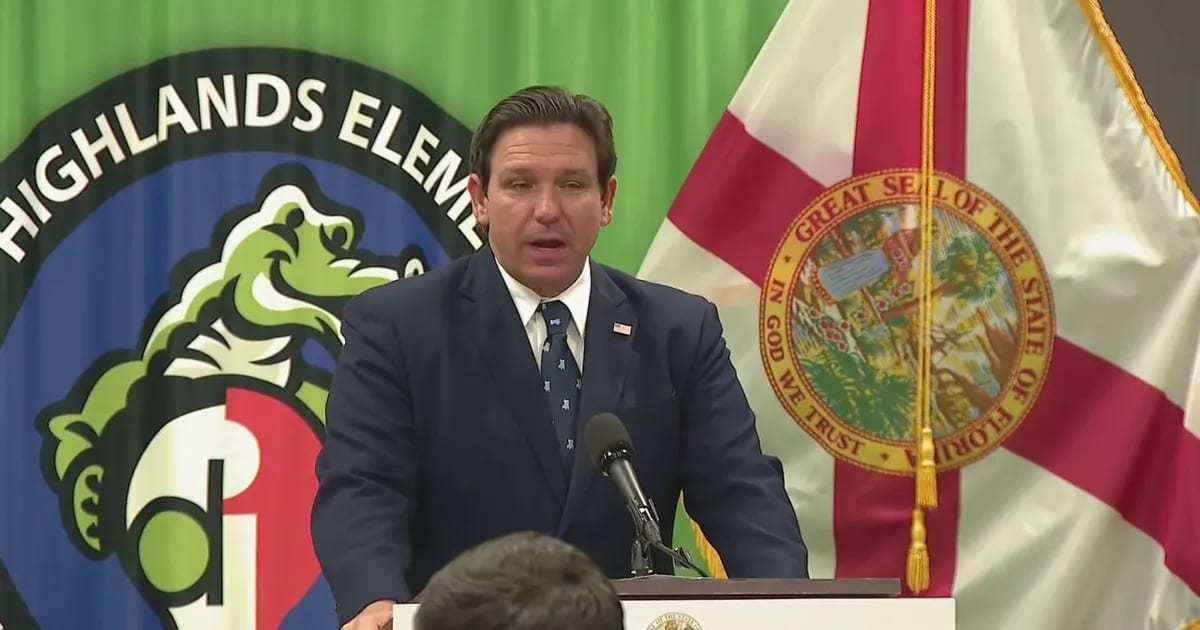
Gov. Ron DeSantis on Friday laid out how Florida will put the new federal Education Freedom Tax Credit to work when it takes effect Jan. 1, 2027, naming two scholarship organizations to run the program and pitching it as a way to pay for tutoring, therapy, mentoring and technical programs for students who stay in their neighborhood public schools. Speaking at Gulf Highlands Elementary School in Port Richey, the governor said the credit would reach far beyond private school families, according to FOX 13.
"This is going to have the biggest impact with kids that are in our school districts and public schools," DeSantis said, according to the station. He called the program "a great opportunity for students in Florida."
What was announced
The governor's office said Florida is launching the federal Education Freedom Tax Credit Scholarship Program and has designated two Scholarship Granting Organizations, or SGOs, to administer it: Step Up, Step Further, the federal-credit fund connected to Step Up For Students, and AAA, the nonprofit that already runs state scholarship programs in Florida as the AAA Scholarship Foundation.
Under the federal law, taxpayers do not get the credit for paying their own children's expenses. They get it for donating cash to an approved SGO, which then awards scholarships to eligible students. The governor's office said those scholarships can cover tuition, tutoring, special education services, books, instructional materials and other qualifying educational resources, and that the program is open to students in public, charter and private schools.
For public school families, the pitch is supplemental help rather than a change of schools. FOX 13 reported that the money can be used for enrichment such as tutoring, therapy, mentoring and technical programs that students attend off campus while remaining enrolled at their public school.
The governor's office also announced two early fundraising efforts:
- Step Up, Step Further said it has secured $5 million in private donations to support implementation.
- The Florida Chamber Foundation's Florida Prosperity Initiative aims to secure at least $250 million in employer commitments in 2027, with outreach focused on low-income public school students who qualify for free or reduced-price lunch.
Mark Wilson, president and CEO of the Florida Chamber of Commerce and its foundation, said in the release that "every 30,000 taxpayers who participate generates $50 million annually for kids." Education Commissioner Henry Mack said, "Educational freedom is ultimately about opportunity."
How the federal credit works
The credit was created by the federal tax and spending package that President Donald Trump signed in 2025, known as the One Big Beautiful Bill Act. A joint fact sheet from the U.S. Treasury and Department of Education lays out the mechanics:
- Amount: up to $1,700 per individual for qualified cash contributions to an SGO. Under Treasury's proposed rules, each spouse may claim up to $1,700 based on his or her own contributions, for up to $3,400 on a joint return. The governor's office likewise said married couples filing jointly can receive up to $3,400 if both spouses contribute.
- Dollar for dollar: it is a credit, not a deduction, so it reduces federal income tax owed directly. Donors do not need to itemize.
- Nonrefundable: the credit can cut a donor's federal tax bill to zero but will not produce a refund beyond that. Unused credit can be carried forward for up to five years.
- No double benefit: a donor cannot also take a charitable deduction for the part of a gift used for the credit, and any state tax credit for the same gift reduces the federal amount.
- Timing: contributions made on or after Jan. 1, 2027, qualify and are claimed on 2027 federal returns, generally filed in 2028.
Donors must tell the SGO at the time of the gift that it is intended for the credit, and they cannot earmark a donation for a particular child. The SGO must send each donor a written acknowledgment by Jan. 31 of the following year.
Which students qualify
Federal rules set the eligibility line. A student must be eligible to enroll in a public elementary or secondary school and come from a household whose prior-year income is no more than 300% of the area's median gross income, adjusted for family size. Treasury estimates that about 95% of American children live in households under that limit, though eligibility does not guarantee a scholarship. Awards depend on how much money each SGO raises.
SGOs must spend at least 90% of contributions on scholarships, keep credit-eligible donations in separate accounts and serve at least 10 students who do not all attend the same school. Scholarship amounts are set by the SGO and cannot exceed the expenses they cover.
The Florida context
Florida signed up early. DeSantis announced on Jan. 28, 2026, that the state would opt in to the federal credit, saying at the time that it would let Florida families supplement their existing scholarships. The federal program requires each state to elect in and submit a list of approved SGOs; for 2027, Treasury says states must file an advance election by Jan. 1, 2027, and their SGO lists by Feb. 15, 2027.
Florida already operates the country's largest private school choice system. It adopted universal eligibility for state education savings accounts in 2023, and the governor's office says about 1.4 million Florida students are enrolled in some form of school choice, including private schools, charter schools, virtual programs and homeschooling. Step Up For Students and AAA are the two nonprofits that administer Florida's existing state scholarships, which is why the state turned to them again.
What is new is the emphasis on students in traditional district schools. State scholarships have mostly been used to leave public schools. The federal credit's rules explicitly allow scholarships for tutoring and similar services for students who remain in public school, and DeSantis framed Friday's announcement around that group.
What it means for Florida families
For families, the practical questions are when scholarship applications open and how much money will be available. Neither the governor's office nor FOX 13 reported application dates or award amounts, and the state's SGOs are expected to release those details as donations come in during 2027.
For taxpayers, the credit offers a way to direct up to $1,700 of federal income tax, or up to $3,400 for a couple who each give, to K-12 scholarships. Because the credit is nonrefundable, it is useful only to people who owe federal income tax. Treasury and the IRS issued proposed regulations in October, and final rules could still change some details.
What's next
The program starts Jan. 1, when donors can begin giving to Step Up, Step Further and AAA for the credit. Florida must file its federal election and its SGO list with the IRS early in 2027, and the Florida Chamber Foundation will begin its push for $250 million in employer-driven commitments. Families interested in tutoring or other services through the program should watch for application announcements from the two scholarship organizations.
Spotted an issue with this article?
Have something to say about this story?
Write us a letterComments
No comments yet. Be the first to weigh in.
Related Coverage

UF Jacksonville Wins Final Design Approval for First New Downtown Building in LaVilla
19h ago
Miami-Dade School Board Weighs Proof of Citizenship Requirement for Dual Enrollment Students
1d ago
Bradenton's Saint Stephen's Episcopal School Disputes Attorney General Uthmeier's Expulsion and Tuition Claims
3d ago
Florida School Board Members Say State Pressure Is Silencing Them, Researchers Report
3d ago