NASA and SpaceX Set October 1 for the Next Crew Launch From Cape Canaveral
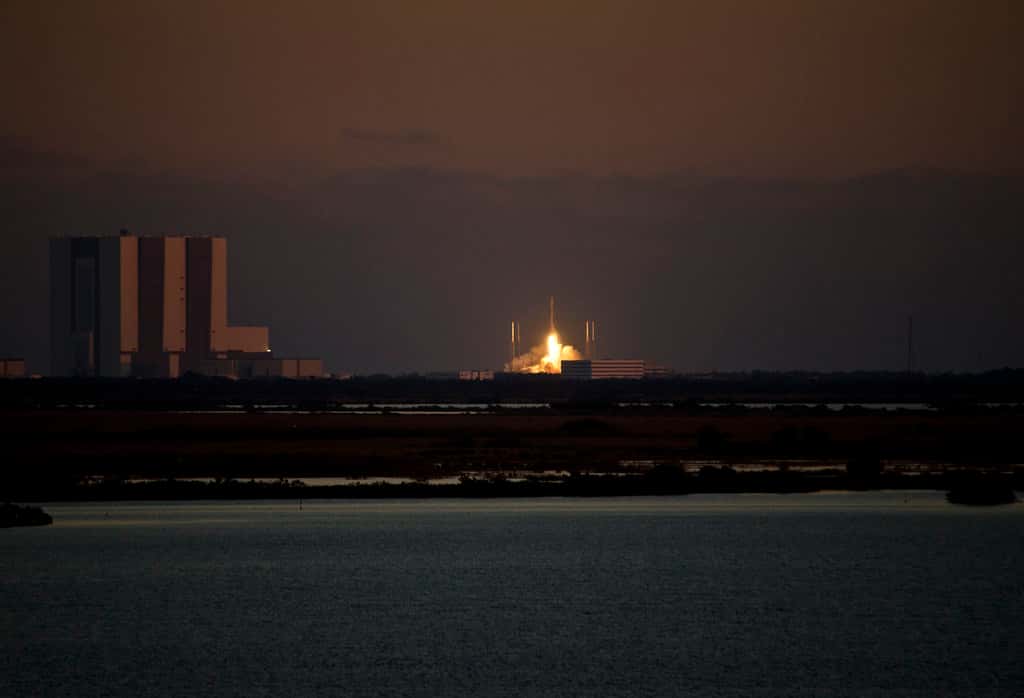
NASA and SpaceX are targeting 11:10 a.m. Eastern on Thursday, October 1, as the earliest launch opportunity for the Crew-13 mission to the International Space Station, lifting off from Space Launch Complex 40 at Cape Canaveral Space Force Station.
The agencies moved into final prelaunch preparations this week. On September 22, the four crew members posed for a portrait in their pressure suits during a preflight training session, one of the standard milestones in the weeks before a crewed launch.
The crew consists of NASA astronauts Jessica Watkins and Luke Delaney, Canadian Space Agency astronaut Joshua Kutryk and Roscosmos cosmonaut Sergey Teteryatnikov, an international complement typical of station rotation missions.
What the mission does
Crew rotation flights deliver the astronauts who live and work aboard the International Space Station for months at a time, and they return the crew members whose increment has ended.
The station has been continuously occupied since 2000, an unbroken record that depends on these rotations occurring reliably. Each flight carries not just people but also cargo, experiments and supplies.
Station crews conduct research across materials science, biology, human physiology, Earth observation and technology demonstration, much of which requires the sustained microgravity environment that cannot be replicated on the ground.
The international composition of the crew reflects the station's partnership structure, which includes NASA, Roscosmos, the European Space Agency, the Japan Aerospace Exploration Agency and the Canadian Space Agency.
Why Florida is the launch site
Cape Canaveral's advantages are geographic and historical. Its latitude provides a velocity boost from Earth's rotation, and launching eastward over the Atlantic means expended stages and any failure debris fall into open ocean rather than over populated areas.
The federal investment in the Space Coast dates to the 1950s, and the accumulated infrastructure of launch pads, processing facilities, tracking systems and range operations represents decades of construction that would be enormously expensive to replicate elsewhere.
Space Launch Complex 40, where Crew-13 will lift off, is a Cape Canaveral Space Force Station pad that SpaceX has used extensively and modified to support crewed missions in addition to satellite launches.
Kennedy Space Center's Launch Complex 39A, adjacent to the Space Force station, has also supported crewed Dragon flights, giving the program two available pads.
What it means for the Space Coast
Brevard County's economy is built substantially on launch activity. Launch cadence from the Space Coast has increased dramatically over the past decade as commercial providers added missions alongside government flights.
That growth has driven employment, population increase and residential construction across Brevard, reversing the decline the region experienced after the Space Shuttle program ended in 2011.
Crewed launches generate particular economic activity. They draw substantially larger crowds than routine satellite missions, filling hotels along the beaches and bringing visitors to viewing areas in Titusville, Cocoa Beach and Port Canaveral.
Kennedy Space Center Visitor Complex sells launch viewing packages that sell out for high-profile missions, adding tourism revenue to the direct aerospace employment.
The launch window mechanics
Launches to the International Space Station have instantaneous or near-instantaneous windows. The spacecraft must lift off at the precise moment that puts it into a trajectory intersecting the station's orbital plane, and a delay of even seconds can require scrubbing to the next opportunity.
That is why crewed station launches are scheduled to the minute and why they scrub relatively frequently. Weather, technical issues or range conflicts that would be manageable for a satellite launch with a longer window force a delay here.
Florida weather is the most common cause. Launch commit criteria address lightning, cumulus clouds, precipitation, wind and conditions along the ascent corridor and at abort landing sites in the Atlantic.
September and early October fall within a period when Florida afternoon convection is common, though a late-morning launch time reduces exposure to the worst of the daily thunderstorm cycle.
The commercial crew program
Crew-13 flies under NASA's Commercial Crew Program, which contracts with private companies to transport astronauts rather than having NASA operate the vehicles directly.
The program was created after the Space Shuttle retirement left the United States dependent on Russian Soyuz vehicles for station access, a dependency that lasted nearly a decade.
SpaceX's Dragon has flown the majority of commercial crew missions to date. Boeing's Starliner was developed under the same program and has had a considerably more difficult path to operational status.
The arrangement has been cited as a model for how NASA might procure other services, and it has been controversial among those who argue it transfers too much control to private operators.
Florida's broader space sector
The Space Coast now supports a range of operators beyond SpaceX. United Launch Alliance flies from Cape Canaveral, Blue Origin has established facilities in the area, and smaller providers have sought range access.
Space Florida, the state's aerospace development agency, works to attract companies to the state with infrastructure investment and financing tools, treating aerospace as a target industry alongside tourism and agriculture.
NASA's Artemis program also operates from Kennedy Space Center. Artemis II launched on April 1 of this year, carrying four astronauts around the Moon on a nearly ten-day flight that splashed down in the Pacific on April 10, the first crewed lunar mission in more than 50 years.
Hardware for Artemis III, which is intended to land astronauts on the lunar surface, has been arriving at Kennedy Space Center for processing.
How to watch
NASA provides live coverage of crewed launches through its broadcast channels, typically beginning several hours before liftoff with crew suit-up, transport to the pad and ingress.
Public viewing areas along the Indian River in Titusville, along the beaches in Cape Canaveral and Cocoa Beach, and at designated Kennedy Space Center locations offer direct views, with traffic and parking becoming significant considerations for high-profile launches.
Residents across Central Florida can often see the ascent from considerable distance, and the sonic signature of a launch carries well inland on clear days.
What Dragon does
The Crew Dragon spacecraft carries up to four astronauts to low Earth orbit and remains docked to the station throughout the crew's increment, serving as a lifeboat available for emergency return at any time.
The vehicle launches atop a Falcon 9 rocket, whose first stage returns to a landing after separation, either on a droneship in the Atlantic or at a landing zone on the Cape. That reusability has been central to reducing launch costs.
Dragon's return involves a deorbit burn, atmospheric reentry protected by a heat shield, and a parachute-assisted splashdown off the Florida coast or in the Gulf.
Recovery vessels stationed near the splashdown zone retrieve the capsule and crew, typically within an hour of water impact.
The station's remaining years
The International Space Station is operating in what is understood to be the final phase of its service life. Partner agencies have discussed a controlled deorbit at the end of the decade, with commercial stations intended to succeed it.
That transition shapes the significance of missions like Crew-13. Each remaining increment carries research that will need a successor platform, and the pace of commercial station development will determine whether continuous human presence in orbit persists.
NASA has contracted with several companies developing commercial destinations, and those vehicles would also launch from Florida, extending the Space Coast's role well past the station's retirement.
The launch cadence and its effects
The Space Coast now supports a launch rate that would have been inconceivable during the Shuttle era, with missions occurring weekly and sometimes more often across multiple pads and providers.
That cadence has consequences for the surrounding area. Road closures, airspace restrictions and marine exclusion zones accompany each launch, and coordination among the Space Force range, the Federal Aviation Administration and local authorities has become a continuous operation.
Residents of Brevard County have adapted, and launch viewing has become routine rather than exceptional for much of the local population.
Crewed missions remain the exception. They draw crowds, media attention and visitor spending at levels routine satellite launches do not approach.
Research aboard the station
The experiments that fly with crew rotation missions cover a broad range. Microgravity allows researchers to study protein crystallization, fluid behavior, combustion and materials formation without the interference of gravity-driven convection and sedimentation.
Human physiology research examines bone density loss, muscle atrophy, fluid redistribution, vision changes and immune function, all of which inform planning for longer missions to the Moon and Mars.
Florida institutions participate in station research, with university laboratories across the state contributing experiments and analyzing returned samples.
Weather as the recurring variable
Launch weather officers assess conditions against a detailed set of criteria covering the pad, the ascent corridor and potential abort landing areas downrange in the Atlantic.
The criteria include limits on lightning within a specified distance, restrictions on flying through certain cloud types that carry electrical charge, and thresholds for surface wind and upper-level wind shear.
Abort landing conditions matter for crewed flights in a way they do not for satellite launches. Sea state along the ascent corridor must be within limits that would allow safe recovery if the crew had to abort during ascent.
That additional requirement is part of why crewed missions scrub more frequently than uncrewed ones from the same pad.
What's next
The October 1 date is the earliest opportunity rather than a commitment. Launch readiness reviews in the days before will confirm whether the vehicle, spacecraft, station and range are all ready.
If the launch scrubs, backup opportunities generally follow within days, subject to orbital mechanics and range availability.
Once launched, Dragon takes roughly a day to rendezvous and dock with the station, after which the arriving crew begins a handover period with the crew they are replacing.
Spotted an issue with this article?
Have something to say about this story?
Write a letter to the editor