Pinellas Seeks $24.2 Million Federal Grant to Replace 1962 San Martin Boulevard Bridge Over Riviera Bay
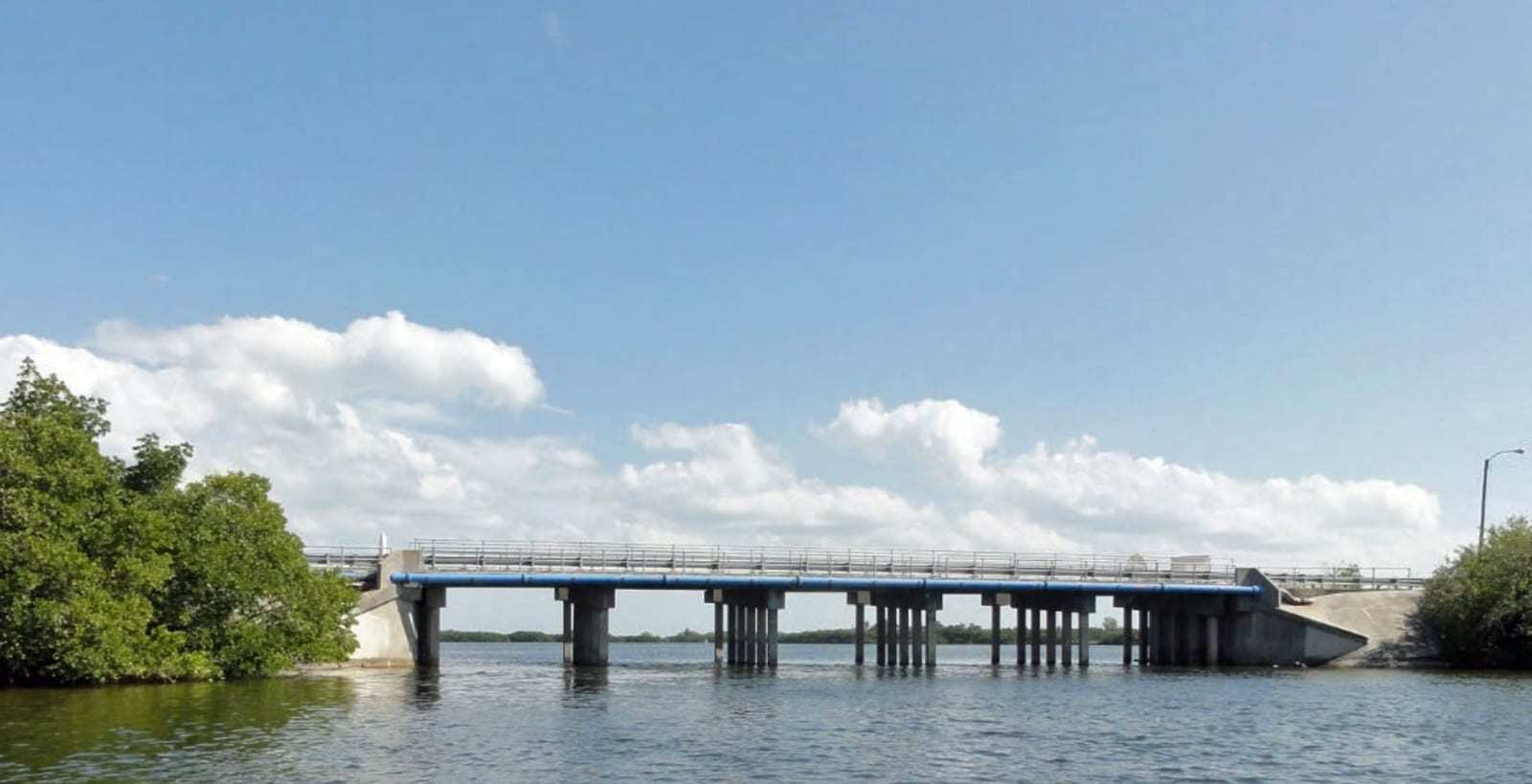
Pinellas County is asking Washington for $24.2 million to replace the San Martin Boulevard Bridge, a 64-year-old, two-lane span over Riviera Bay in northeast St. Petersburg that engineers have flagged as scour-critical and that a load test 25 years ago said would stay serviceable only until about 2032. County commissioners voted unanimously on Tuesday to ratify the county's application for a federal PROTECT grant, according to reporting by the St. Pete Catalyst published by WUSF.
Construction of the replacement is estimated at $31.4 million. If the Federal Highway Administration awards the grant, federal money would cover 80% of construction, and the county would put in about $6.3 million from Penny for Pinellas, the voter-approved local sales tax that pays for much of the county's capital work. Pinellas has already secured an $850,000 federal earmark for the project.
A small bridge with an outsized job
The San Martin Boulevard Bridge, built in 1962, carries about 3,700 vehicles a day between Tallahassee Drive and Weedon Drive. Its traffic count is modest, but its role is not. The bridge is one of two access routes to Duke Energy's Bartow power plant, and it serves more than 1,400 homes. If the bridge had to close, drivers would face a detour of about 4.2 miles, according to the county's figures as reported by the Catalyst.
The span also sits in a vulnerable spot. The county's project page places it within a storm surge area in Evacuation Zone A, and Riviera Bay was one of the neighborhoods where Hurricane Helene pushed water into homes and streets in September 2024. The current bridge has no bike lanes or sidewalks, and the county says it no longer meets current design standards or Americans with Disabilities Act requirements.
Engineers classify the structure as scour-critical, meaning moving water could erode the soil around its foundations enough to threaten its stability. The 2001 load test that put its serviceable life at roughly 2032 left the county with a firm deadline, and county engineers concluded that widening or rehabilitating the existing bridge is not feasible.
What would replace it
The new bridge will be built just east of the existing one with a similar overall design, which lets the county keep San Martin Boulevard open while construction is staged around the old span. According to the county's project page, the proposed cross-section includes:
- Two 11-foot travel lanes
- Two 7-foot buffered bike lanes
- A 6-foot sidewalk
- A 12-foot shared-use path that will help close a gap in the Pinellas Trail Loop
The new structure will also sit higher and open a wider waterway. Vertical clearance for boats would rise from 10.5 feet to 17.8 feet, and the navigation channel would be three times as wide as the current one. Engineers designed the bridge for 4.8 feet of projected sea-level rise over its 75-year service life, a standard that reflects how often low-lying Pinellas neighborhoods have flooded in recent storms.
The city of St. Petersburg has already done part of the groundwork. Last December, the city approved $7.14 million in related utility contracts to relocate water and wastewater pipes attached to the bridge. Those lines serve about 30,000 residents, so moving them before the old bridge comes down protects service well beyond the immediate neighborhood.
How the project got here
The replacement has been in planning for a decade. The county presented rehabilitation and replacement options at a public workshop in 2016, selected a preferred concept at a virtual public meeting in November 2021, and finished its Project Development and Environment study in April 2022. That study followed the federal National Environmental Policy Act process, which is what makes the project eligible for federal dollars such as the PROTECT grant.
The key milestones, drawn from the county's project page and the Catalyst's reporting, are below.
| Date | Milestone |
|---|---|
| 1962 | San Martin Boulevard Bridge built |
| 2001 | Load test projects service life to about 2032 |
| 2016 | Public alternatives workshop |
| November 2021 | Preferred alternative selected |
| April 2022 | Environmental study completed |
| May 2023 | Design begins |
| December 2025 | City approves $7.14 million utility contracts |
| November 2026 | Commissioners ratify $24.2 million grant application |
| Spring 2027 | Design expected to be complete |
| Late 2027 to summer 2030 | Scheduled construction |
An aging inventory across Pinellas
San Martin is one example of a wider problem. A 2022 city assessment found that 74 of St. Petersburg's 138 bridges had exceeded their recommended design life. Evan Morey, the city's transportation director, estimated at the time that St. Petersburg needed $12.6 million a year to keep up with its aging bridges, according to the Catalyst.
Countywide, the 2026 National Bridge Inventory lists 441 structures in Pinellas County. Of those, 280 are rated in good condition, 154 in fair condition and seven in poor condition.
The county is working on other spans at the same time. Commissioners also awarded a $7.6 million construction contract to replace the Ridgemoor Boulevard Bridge over Brooker Creek in East Lake, a project paid for through Penny for Pinellas and a state transportation grant.
The budget backdrop
The grant request comes as local governments in Florida brace for tighter budgets. Pinellas County's fiscal 2027 budget cut transportation infrastructure funding by $1.5 million, and local governments have linked declining property tax revenue to the passage of Amendment 3, according to the Catalyst. Penny for Pinellas is a sales tax rather than a property tax, so Amendment 3 does not directly reduce the money the county plans to use for its local share of the San Martin project.
That makes the federal share all the more important. PROTECT, short for Promoting Resilient Operations for Transformative, Efficient, and Cost-saving Transportation, is a federal program created under the 2021 infrastructure law to help states and local governments make roads and bridges more resilient to flooding, storms and other natural hazards. A bridge in a surge zone, designed for several feet of sea-level rise and serving a power plant, fits squarely within that purpose.
What residents should expect
For the roughly 1,400 households that rely on the bridge, the staged design is the most important detail. Because the new span will rise alongside the old one, the county does not plan a full closure of San Martin Boulevard during construction. Once complete, residents would gain a dedicated place to walk and bike across Riviera Bay for the first time, along with a link in the regional trail network.
Boaters would also benefit. The higher clearance and wider channel would make it easier for larger vessels to pass between Riviera Bay and Tampa Bay.
What's next
The Federal Highway Administration will decide whether to fund the county's request. Design work is expected to wrap up in spring 2027, and construction is scheduled to begin in late 2027 and run through summer 2030, ahead of the roughly 2032 limit set by the old load test. If the grant does not come through, the county would need to find another way to cover the federal share of the $31.4 million cost. The county's project manager, Dana Parkinson of Pinellas County Public Works, is listed as the contact for residents with questions.
Spotted an issue with this article?
Have something to say about this story?
Write us a letterComments
No comments yet. Be the first to weigh in.
Related Coverage

Manatee County Leads the Nation in New Home Permits as Roads, Deputies and Schools Struggle to Keep Up
1h ago
JTA Asks Public What Should Replace the Shuttered Jacksonville Skyway, With Options Up to $565 Million
2h ago

Carnival Orders a New Class of Smaller LNG Cruise Ships for 2033 and 2035, Opening More Doors at Florida Ports
4h ago

Former JEA CEO Vickie Cavey's Pension Calculated at $451,688 a Year, Pending Board Vote
1d ago