Messi Scores Again but Inter Miami Settles for 2-2 Draw

Lionel Messi scored his MLS-leading 19th goal of the season on Saturday night, but Inter Miami could not hold the lead, conceding to Nashville SC a minute into stoppage time and settling for a 2-2 draw against the Eastern Conference leaders. The result kept Nashville nine points clear of second-place Miami with the regular season winding toward its conclusion.
Sam Surridge scored twice for Nashville, opening the scoring in the fourth minute and delivering the equalizer in stoppage time. His performance extended Nashville's unbeaten run against Miami to four meetings this season.
For Inter Miami, the draw represents a familiar frustration: a match in which Messi delivered and the team did not close it out.
How the match unfolded
Nashville struck early through Surridge in the fourth minute, a start that forced Miami to chase the game from the outset. Conceding inside the opening five minutes changes the shape of a match, pulling a team out of its intended structure before it has established rhythm.
Miami drew level in the 19th minute in fortunate circumstances, with Nashville defender Reed Baker-Whiting turning the ball into his own net from a corner kick. Own goals are the least satisfying route to an equalizer but count the same in the table.
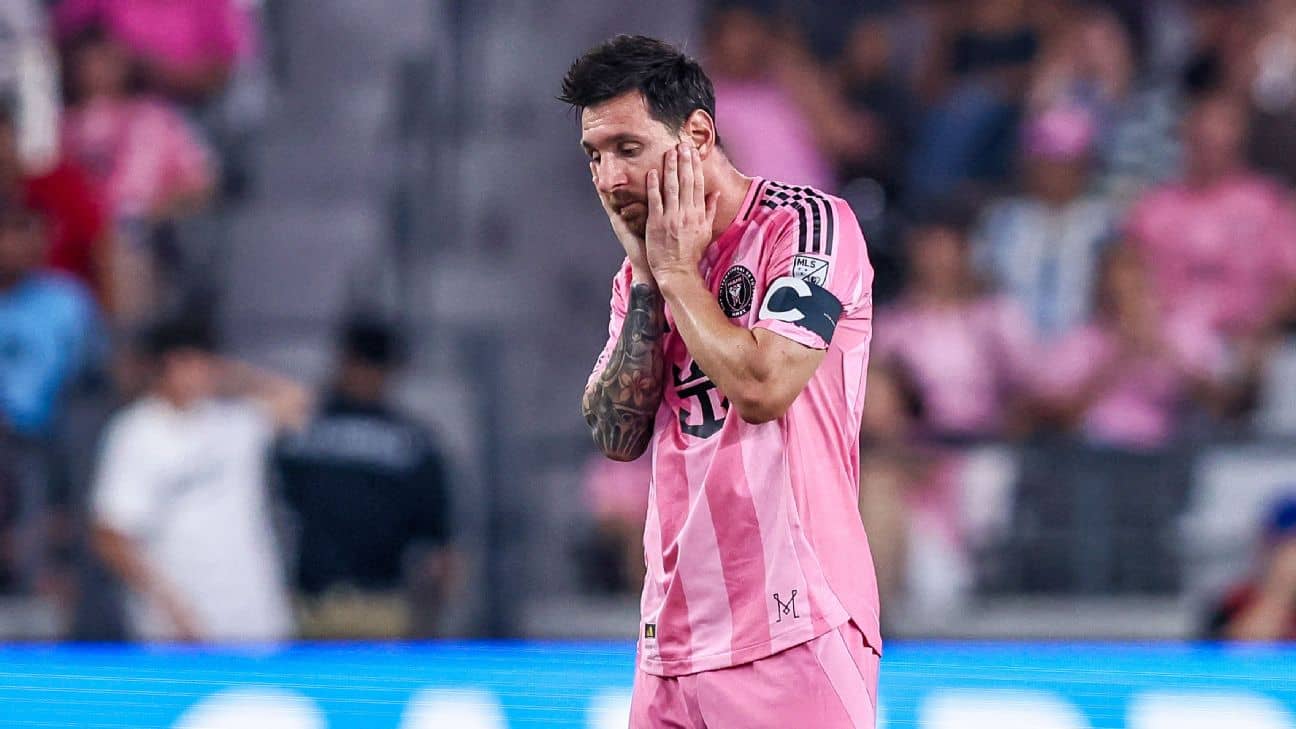
The decisive Messi moment came in the 62nd minute, a left-footed finish that put Inter Miami ahead 2-1 and appeared to set up a result that would close the gap on the conference leaders.
Surridge's second arrived a minute into added time, the latest possible moment to deny Miami the win. Stoppage time goals carry a psychological weight beyond their statistical value, and conceding one after leading for nearly half an hour compounds the disappointment.
Messi's season
Nineteen goals leads MLS, and the milestone attached to Saturday's finish carried additional weight: reporting around the match noted it as his 99th goal for Inter Miami across all competitions.
Messi's production continues to justify the transformation his arrival brought to the league. His signing reshaped MLS commercially, driving television audiences, attendance and international attention to a degree no previous signing approached.
What Saturday illustrated is the limitation of individual brilliance in a team sport. Messi created the lead. The team did not protect it. That pattern has recurred for Inter Miami across the season, and it explains the nine-point gap to Nashville more than any deficiency in the attacking third.
The Nashville problem
Four meetings this season without a Miami win against Nashville is a pattern rather than a coincidence. Nashville has found a structural approach that limits what Inter Miami does well, and repeated failure to solve it raises tactical questions ahead of the postseason.
Surridge has been central to that success. Scoring twice in a single match against Miami, including a stoppage time equalizer, represents the kind of individual performance that decides tight games between evenly matched sides.
The nine-point gap with limited fixtures remaining makes the Supporters' Shield race in the Eastern Conference effectively settled. Miami's attention turns to seeding for the MLS Cup playoffs, where the format gives lower seeds genuine paths to advance.
What it means for South Florida
Inter Miami has become a significant presence in the South Florida sports landscape since Messi's arrival, drawing crowds and attention that the club did not command in its earlier seasons.
The club's move to its new stadium has changed the matchday experience and expanded capacity, and Messi's presence has kept demand consistently high. Ticket prices for Inter Miami matches have run well above typical MLS levels throughout his tenure.
The broader effect on soccer in South Florida has been substantial. Youth participation, viewing culture and the region's standing as a soccer market have all been strengthened, and with the 2026 World Cup having brought matches to the region, the sport's position in Florida has advanced considerably.
What the draw means competitively
A point away to the conference leaders is not a poor result in isolation. The disappointment stems from the manner in which it arrived, with Miami holding a lead into stoppage time.
In a compressed table, single points accumulate into seeding differences that determine home field advantage in the playoffs. Home matches in MLS postseason play carry meaningful advantage, and Miami's seeding will determine how many it hosts.
The club's squad construction, built around veteran talent with substantial career mileage, has raised questions about fitness across a full season. Late-match concessions can reflect fatigue as much as tactical error, and managing workloads into the postseason is a live consideration.
What the MLS playoff format allows
Major League Soccer's postseason structure gives lower seeds genuine paths to advance, which softens the practical consequence of Miami's nine-point deficit to Nashville.
The format includes a first round played as a best-of-three series, followed by single-elimination rounds. That structure rewards regular season performance through home field advantage without making it decisive.
Home field matters in MLS more than in some leagues, given the travel distances involved and the atmosphere home supporters generate. A team hosting more matches has a measurable advantage, but not one that determines outcomes.
For Inter Miami, the calculation is therefore about maximizing seeding within a structure where the top seed is out of reach. Every remaining point affects where the club enters the bracket.
Managing a veteran squad
Inter Miami's roster construction has centered on experienced players with substantial career mileage, an approach that delivers quality and commercial value while raising questions about durability across a long season.
MLS schedules combine league play with cup competitions and, for clubs qualifying, continental fixtures. The resulting congestion tests squad depth, and clubs relying heavily on a small group of key players face accumulating fatigue.
Late-match concessions can be a symptom. A side that defends well for 85 minutes and concedes in stoppage time may be showing physical rather than tactical limits.
Rotation is the standard remedy, but rotating away the players who generate the club's attacking threat carries its own cost, particularly in matches with seeding implications.
Soccer's position in Florida
The sport's standing in Florida has changed substantially over the past decade. Inter Miami and Orlando City give the state two MLS clubs, Orlando Pride competes in the NWSL, and the region hosted matches during the 2026 World Cup.
Florida's demographics support the sport's growth, with large populations from countries where soccer is the dominant sport and a youth participation base that has expanded steadily.
The commercial infrastructure has followed. Broadcast arrangements, sponsorship and facility investment have all increased, and the state now regularly hosts international friendlies and tournament matches drawing large crowds.
Whether that growth persists after Messi's playing career concludes is the question the league faces, and one Inter Miami will confront directly.
The 100-goal mark
Reaching a century of goals for a club is a benchmark that few players achieve anywhere, and Messi is approaching it in a relatively compressed period since joining Inter Miami.
His MLS-leading 19 goals this season places him at the top of the league's scoring chart, a position he has occupied or contended for throughout his time in the competition.
Goal-scoring records in MLS carry an asterisk that applies to any league with expansion and schedule changes over time, but the rate at which Messi has produced is unambiguous regardless of how the historical comparisons are drawn.
The milestone will arrive in a match that carries competitive stakes, given Miami's position in the seeding race, which means the club will not be able to manage it as a ceremonial occasion.
What the club has built
Inter Miami's transformation since Messi's arrival extends well beyond results on the field. Attendance, broadcast audience, sponsorship revenue and international profile all increased sharply, and the club became one of the most recognized names in American professional sports.
That commercial success funded infrastructure investment, including facilities and a stadium project that gives the club a permanent home with capacity matched to demand.
The competitive record has been more mixed. The club has won trophies during this period, but has also fallen short in competitions where its roster quality suggested it should advance, and Saturday's draw fit that pattern.
The organizational challenge is converting commercial strength into sustained competitive success, and building a squad that remains strong as its current core ages.
Nashville's season
The opponent's position matters for context. Nashville has led the Eastern Conference for much of the season and arrived at Saturday's match having gone unbeaten against Miami in their previous three meetings.
Surridge's two goals continued a productive campaign, and his performance in matches against Miami specifically has been a recurring feature of the season series.
A nine-point cushion at this stage of the schedule is substantial, and Nashville's position at the top of the conference reflects consistency across the full season rather than a late surge.
For Miami, the inability to solve this particular opponent across four attempts raises questions the coaching staff would prefer to answer before a potential postseason meeting.
What supporters saw
Matches of this kind produce a specific kind of disappointment for supporters, in which a moment of brilliance is followed by a collapse of the result it created.
Messi's 62nd-minute finish was the sort of individual moment that the club's attendance and viewership are built around, and the stoppage-time equalizer erased its competitive value within half an hour.
The draw still returns a point, and in a table where seeding is decided by narrow margins, points accumulated on the road against the conference leader are not worthless.
What's next
Inter Miami has a limited number of regular season fixtures remaining to improve its seeding before the MLS Cup playoffs begin. Every remaining match carries weight in that calculation.
The immediate tactical priority is game management, specifically the ability to close out matches in which the club holds a lead. That is a coachable problem, and addressing it before the postseason would substantially improve Miami's prospects.
Messi's pursuit of his 100th Inter Miami goal will draw attention in the club's next outing, adding a milestone storyline to fixtures that already carry competitive stakes.
Spotted an issue with this article?
Have something to say about this story?
Write us a letterComments
No comments yet. Be the first to weigh in.
Related Coverage
Messi Sets Up De Paul as Inter Miami Beats NYCFC 2-0 and Clinches an MLS Cup Playoff Berth
18h ago

Giannis Antetokounmpo Posts 20, 15 and 9 as Heat Beat Nets 144-128 in Final Home Preseason Game
19h ago
Florida Gators at No. 7 Texas: Aaron Philo Questionable, Vernell Brown III Could Return as Sumrall's Team Tries to Stop a Two-Game Skid
21h ago

Buccaneers Host Aaron Rodgers and the Steelers Sunday as Jalon Daniels Lines Up for a Third Start and Trump Drops Plans to Attend
1d ago