NASA Launches Roman Space Telescope From Kennedy Space Center on Falcon Heavy
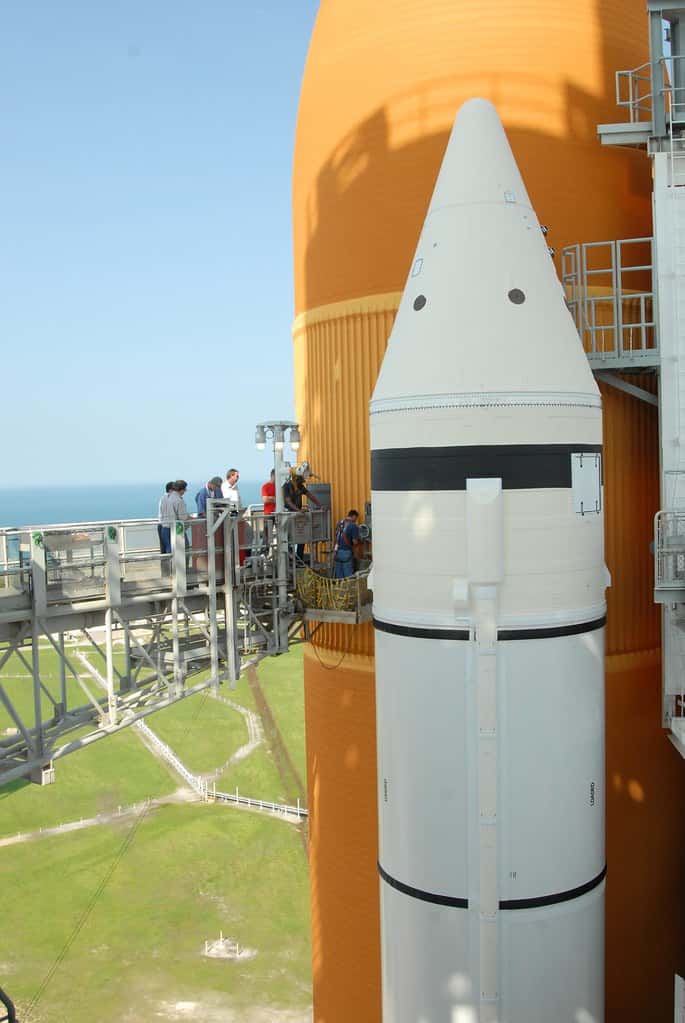
NASA's Nancy Grace Roman Space Telescope lifted off from Launch Complex 39A at Kennedy Space Center at 7:26 a.m. Eastern on Sunday, August 30, riding a SpaceX Falcon Heavy on the first leg of a journey to a gravitational balance point roughly a million miles from Earth. The observatory separated from the rocket's second stage on schedule at 7:57 a.m., 31 minutes after liftoff.
The launch marks the departure of one of NASA's flagship astrophysics missions from Florida's Space Coast, and it is the kind of event that distinguishes Brevard County from every other stretch of American coastline. The Falcon Heavy's 27 Merlin engines generated more than 5 million pounds of thrust at liftoff, with a center core and two side boosters carrying a second stage that lofted the observatory.
Launch Complex 39A carries its own history. The pad sent Apollo missions to the Moon and later supported the Space Shuttle program before SpaceX leased it in 2014, and it now handles Falcon 9 and Falcon Heavy flights. Sunday's departure added a flagship astrophysics mission to a manifest that already spans six decades of American spaceflight.
What Roman is built to do
The Roman Space Telescope is designed to investigate dark energy and dark matter, conduct a statistical census of planetary systems, and support a broad range of additional astrophysics research. Those are three distinct scientific programs sharing one instrument.
Dark energy is the name given to whatever is driving the accelerating expansion of the universe, and it accounts for the large majority of the universe's total energy content while remaining fundamentally unexplained. Roman is intended to measure the expansion history with enough precision to distinguish among competing explanations, which requires surveying enormous numbers of galaxies rather than studying individual objects in depth.
The exoplanet program uses a different technique. Rather than watching for the small dimming that occurs when a planet crosses in front of its star, Roman will use gravitational microlensing, in which a foreground object's gravity briefly magnifies the light of a background star. That method is sensitive to planets at wide separations from their host stars, a population that transit surveys largely miss.
The mission also has a planned survey structure that distinguishes it from observatories operating primarily on proposals from individual researchers. A substantial portion of Roman's observing time is dedicated to defined core surveys, with the resulting data released broadly to the scientific community. That model produces datasets that support research questions nobody anticipated when the mission was designed, which has historically been where survey astronomy delivers its largest returns.
The wide field that makes it different
Roman's defining characteristic relative to the James Webb Space Telescope is field of view. Webb is built to look at small patches of sky in extraordinary detail. Roman is built to survey very large areas at high resolution, capturing in a single exposure what would require many pointings from a narrower instrument.
That difference determines what each telescope is good for. Statistical cosmology requires large samples, because measuring the expansion history means characterizing the distribution of enormous numbers of galaxies rather than examining a few closely. A wide field is not a compromise for that work. It is the requirement.
The observatory was previously known as the Wide Field Infrared Survey Telescope, or WFIRST, and was later renamed for Nancy Grace Roman, the NASA astronomer whose advocacy was central to the creation of the Hubble Space Telescope. Roman is often described as NASA's first chief astronomer.
Falcon Heavy flights are comparatively rare, which is part of why this launch drew the attention it did on the Space Coast. Most payloads fit on a Falcon 9, and the heavy configuration is reserved for missions requiring greater performance, typically because of mass, destination, or both. Sending an observatory to a point a million miles away falls into that category.
Why this matters to Florida
Florida's Space Coast is the departure point for the substantial majority of American orbital launches, and the industry built around Kennedy Space Center and Cape Canaveral Space Force Station is one of the state's most distinctive economic assets.
The employment picture extends well beyond launch day. Kennedy Space Center supports engineering, payload processing, range operations, and facility maintenance year-round, and the surrounding commercial space sector in Brevard County has grown substantially as launch cadence has increased. SpaceX alone had conducted 100 orbital missions in 2026 as of late August.
Launch tourism is a smaller but real component. Major launches draw visitors to Brevard County beaches, causeways, and viewing sites, filling hotels and restaurants on days that would otherwise be ordinary. A Falcon Heavy launch, which occurs far less frequently than routine Falcon 9 flights, draws a larger crowd than most.
The strategic value to Florida is that the launch industry has diversified an economy that historically leaned on tourism and agriculture. Brevard County's combination of aerospace and cruise homeporting at Port Canaveral gives the region an economic profile unlike anywhere else in the state.
Microlensing also has a scientific advantage worth explaining, since it is unfamiliar compared to the transit method that produced most known exoplanets. Because the technique relies on gravity rather than on light from the planet or the star, it can detect worlds at distances from their host stars comparable to Jupiter's orbit in our own system, and in some cases planets not bound to any star at all. That population is essentially invisible to other methods.
The federal dimension
Roman is a NASA flagship mission, funded through federal appropriations and executed with SpaceX as the launch provider. That structure is now standard for NASA science missions, and it reflects a fundamental shift over the past 15 years from government-operated launch systems to commercial procurement.
The arrangement has generally lowered launch costs and increased cadence, which has direct consequences for how many science missions NASA can fly within a given budget. It has also concentrated a large share of American launch capability in a small number of commercial providers, a dependency that has drawn scrutiny in Washington.
Florida's congressional delegation has a persistent institutional interest in NASA funding for straightforward reasons. Appropriations decisions made in Washington translate into employment and contract activity on the Space Coast, and members representing the region have historically worked across party lines on space policy.
President Donald Trump called into the post-launch press conference, reflecting the political attention that flagship science launches attract. Space policy has remained one of the less partisan areas of federal activity, in part because the constituencies for it are geographically concentrated in states like Florida, Texas, and Alabama rather than sorted by party.
The supporting industry has clustered accordingly. Payload processing facilities, propellant handling, launch range instrumentation, and a substantial engineering workforce all exist in Brevard County because launches happen there, and the growth in commercial launch cadence over the past decade has expanded that base considerably. Space Florida, the state's aerospace development authority, exists specifically to recruit and support that sector.
Where Roman goes now
After separation, the observatory was set to deploy its solar panels and prepare for a mid-course correction burn on its way to the second Earth-Sun Lagrange point, known as L2, roughly a million miles from Earth on the side opposite the Sun.
L2 is the preferred parking spot for infrared observatories, and the reason is thermal. At that location a spacecraft can keep the Earth, Sun, and Moon all on the same side, allowing a sunshield to block their heat and light while the instruments face outward into deep space. Infrared detectors must be extremely cold to work, and heat from nearby bright objects is the enemy.
The transit takes weeks, followed by a commissioning period during which the observatory is checked out, its instruments calibrated, and its optics aligned. Science operations begin only after commissioning is complete, which means the first substantive results are still some months away.
Appropriations pressure is a persistent feature of NASA science missions, and flagship observatories are the most exposed because their costs are large and visible. Programs of this scale routinely face proposed reductions or cancellation during budget cycles, and the ones that survive generally do so because of sustained congressional support from delegations with a direct stake. Florida's delegation is among those.
What's next
The near-term milestones are the mid-course correction burn, arrival at L2, and the commissioning campaign. NASA has concluded its launch coverage, and mission updates will now come through the Roman project's regular channels rather than through launch broadcasts.
For the Space Coast, the launch cadence continues. SpaceX has maintained a high tempo of Falcon 9 flights from both Cape Canaveral and Kennedy, and other providers including United Launch Alliance and Blue Origin operate from the same coastline. Florida's launch schedule is now dense enough that individual missions rarely disrupt local routines.
The scientific payoff from Roman will arrive over years rather than months. Survey missions accumulate value as their data sets grow, and the cosmology results that justify the mission require observations spanning much of its planned operational life. What launched from Florida on Sunday morning is the beginning of a long program.
Commissioning is also the period during which a mission is most vulnerable. Deployments have to work, instruments have to reach operating temperature, and optical alignment has to be achieved with no possibility of a repair mission at that distance. Every flagship observatory has passed through that window, and the ones that emerged successfully did so because the engineering was validated on the ground years earlier.
Floridians who want to watch future launches have more opportunities than at any point in the program's history. Launch cadence from the Space Coast now runs to well over a hundred flights a year across providers, viewing is possible from public beaches and causeways in Brevard County, and schedules are published in advance, though weather and technical delays remain routine.
Spotted an issue with this article?
Have something to say about this story?
Write us a letterComments
No comments yet. Be the first to weigh in.
Related Coverage
Alligator Alcatraz Is Closed, but Florida Is Still Chasing More Than $500 Million in Federal Reimbursement
2h ago

Florida Voters Face Few New Rules on Nov. 3 as Other GOP States Roll Out Citizenship and ID Laws
1d ago

Florida Leads the Nation in ICE Detainer Arrests as Local Police Take a Growing Role, New Data Show
1d ago
Federal Government Again Asks Miami Judge to Toss Lawsuit by Nearly 1,000 Cubans With I-220A Papers
1d ago