Santa Fe College's diesel technician program prepares first graduates as Florida faces a shortage of heavy-truck mechanics
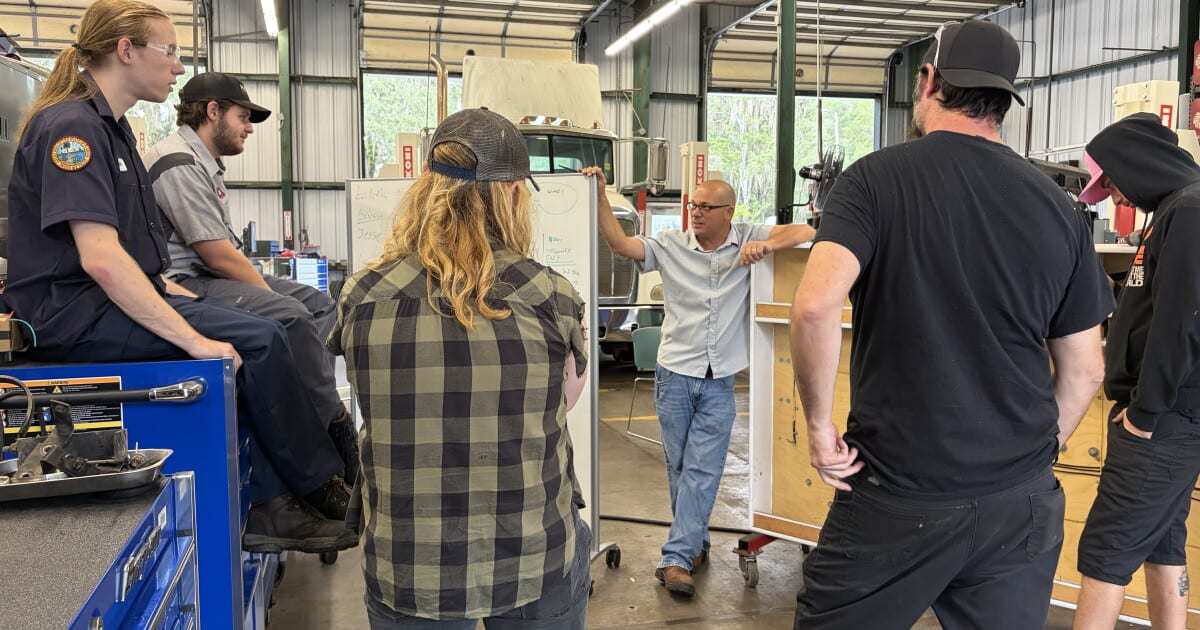
Santa Fe College's diesel technician program in Gainesville is preparing to graduate its first class next summer, part of a local push to train workers for a trade that Alachua County officials say Florida badly needs. The program started in 2025 with five students, added seven more in August and aims to have room for 20 new students in 2027. An Alachua County economic development official estimates Florida will need almost 25,000 certified heavy diesel mechanics over the next eight years.
The program was profiled by WUFT reporter Dalton Sallengs in a story published by WUSF, which described students splitting their time between textbook lessons and hands-on work on brake systems and full-size diesel trucks.
A program built around a county fleet shop
The diesel system technician track is part of Santa Fe College's systems technician career certification program and grew out of a partnership among the college, Alachua County and CareerSource North Central Florida, the regional workforce board. Students spend four days a week during the semester in a working fleet shop, and the first cohort is expected to finish with 1,800 hours of classroom time and hands-on experience.
When the program was announced in 2025, The Gainesville Sun reported that it would be housed at the Alachua County Public Works site off U.S. 441, cost students about $5,600 to complete and train them to diagnose, repair and maintain medium and heavy trucks. Applicants must be at least 18 and hold a valid Florida driver's license. Program director Morris told the Sun at the time that people seemed excited about the program and that it was a good time to get into the field. The Sun also reported that the program was designed in part to supply workers for a U.S. Army Reserve equipment site planned on the former Alachua County fairgrounds in east Gainesville, as well as for the wider truck repair industry. Alachua County has committed $36 million to that Army Reserve site, which Mainstreet Daily News reported is the largest economic development investment in the Gainesville Community Reinvestment Area district. The college and county held a ribbon-cutting for the diesel program on Aug. 11, 2025, at the county's fleet operations facility north of Gainesville, where students train alongside the county's own diesel mechanics.
A veteran mechanic at the front of the room
The program's founding instructor is Beau Morris, hired as an assistant professor of diesel programs. Morris is a graduate of Santa Fe's automotive program who spent 12 years as a dealership technician and 20 years as a fleet technician for the city and county, according to WUFT. Leading a classroom is new for him. Santa Fe marketing manager Maria Gebhardt told WUFT that Morris was hired after applying online.
Morris told WUFT the goal is to give students a broad base across many diesel topics so they can specialize later. Courses include diesel engine technician fundamentals and diesel brakes technician, and each class session ends with a five-question quiz to check understanding. During one shop exercise described by WUFT, Morris told a student to bring a spare battery because no one was sure whether the installed one was charged. "Hope is not a strategy," he said. The battery turned out to be dead.
He described the approaching first graduation as bittersweet and said his main job is preparing students for careers as diesel technicians.
Who is enrolling
The students WUFT profiled are career changers. Jesse Huntoon, 41, of Newberry, previously worked in construction and wanted a higher-paying job. Lilith Boulet-Musselwhite, 28, a second-year student from Melrose, had briefly done preventive maintenance at a truck stop before enrolling. Her advice to new students, according to WUFT, was not to worry about what they do not yet know.
The statewide need
Sean McLendon, Alachua County's economic development manager, told WUFT that Florida will need almost 25,000 heavy diesel mechanics with certifications over the next eight years, and he described the work as high-skill and high-wage.
Federal figures show the scale of the field. Diesel service technicians and mechanics earned a national median wage of $61,770 a year, or $29.70 an hour, in May 2025, according to the U.S. Bureau of Labor Statistics Occupational Outlook Handbook. The bureau counted about 316,000 such jobs nationally in 2025, projected employment growth of 4 percent from 2025 to 2035 and estimated about 24,400 openings a year, many of them to replace workers who retire or change careers.
Florida's own projections point to faster growth. Employment of bus and truck mechanics and diesel engine specialists in Florida is projected to rise from 13,680 in 2024 to 14,980 in 2034, an increase of about 10 percent, according to state trend data published through the U.S. Labor Department's O*NET database. Those figures count total jobs, not openings. McLendon's estimate of nearly 25,000 is a count of mechanics needed over eight years, which includes replacement hiring; workers retiring or leaving the trade create far more openings than net job growth alone, which is why the two numbers differ so sharply.
Pay in the state tracks the national average. A Santa Fe advising specialist told The Gainesville Sun in 2025 that Florida salaries for diesel mechanics reflect the national figure, and the Sun reported that entry-level graduates could earn close to $60,000 a year.
How people get into the trade
BLS notes that employers often prefer applicants with postsecondary diesel training, that industry certification may be required and that a commercial driver's license may be needed to test-drive buses and large trucks. Programs like Santa Fe's are meant to shorten the path into those jobs for people who might otherwise learn only on the job.
What's next
The first five students are expected to graduate next summer with their 1,800 hours completed. Santa Fe plans to keep expanding, with a goal of capacity for 20 new students in 2027, and the county is counting on the program to help staff the Army Reserve equipment site and local fleet shops. Whether that pipeline can keep pace with a statewide need measured in the tens of thousands will depend on how quickly the college and similar programs elsewhere in Florida can grow.
Sources
Spotted an issue with this article?
Have something to say about this story?
Write us a letterComments
No comments yet. Be the first to weigh in.
Related Coverage
Miami-Dade Tax Collector returns nearly $9 million in unused fees to county public schools
2h ago
FSU Students Are Far More Tolerant of Political Disagreement Than They Think Their Peers Are, Survey Finds
1d ago

GAO report: 57% of Florida kindergartners missed the readiness benchmark in 2024-25
4d ago

Some Classes Will Stay on Hillsborough College's Dale Mabry Campus During Rays Stadium Construction, Reversing Part of Off-Site Plan
5d ago