Dolphins Begin 2026 Rebuild with Malik Willis at QB, Mourn Loss of Legend Manny Fernandez
A Franchise at a Crossroads
The Miami Dolphins enter the 2026 NFL season in the midst of a sweeping organizational rebuild, one that has reshaped the roster top to bottom following another disappointing year. Front office and coaching staff decisions made over the offseason have cleared out many of the players associated with the team's recent identity, leaving a younger and less experienced group tasked with establishing a new foundation for one of the most storied franchises in professional football. For South Florida fans who have witnessed multiple cycles of promise and disappointment in recent years, the 2026 rebuild carries both hope and uncertainty in roughly equal measure.
The scale of the personnel changes is difficult to overstate. Gone are most of the high-profile veterans who defined the Dolphins' roster in recent seasons. In their place, the organization has committed to a younger core built around draft picks and lower-cost free agent additions, with the explicit understanding that 2026 is likely to be a developmental year rather than a genuine championship contender. Team officials have framed the approach as necessary to establish long-term organizational health rather than to chase short-term results that would require trading away future assets.
The offseason changes also extended to the structure of the roster's financial commitments. By moving on from the contracts that had constrained the team's salary cap flexibility, the Dolphins created room to invest in the specific positions and player types that the coaching staff believes fit their evolving vision for how the team should operate. That vision will be tested against the reality of a competitive AFC East division that includes the Buffalo Bills, New York Jets, and New England Patriots, all of whom have their own roster plans heading into the season.
Malik Willis: The New Face at Quarterback
The most consequential personnel decision of the Dolphins' offseason was the elevation of Malik Willis to starting quarterback. Willis enters the 2026 season as the highest-paid player on the Miami roster, a marker of how fully the organization has committed to him as its signal-caller. The former Tennessee quarterback, who was selected in the third round of the 2022 NFL Draft by the Tennessee Titans, spent several seasons developing behind veteran starters before emerging as a starter in his own right. His path to the top of the Miami depth chart reflects both his own growth as a player and the Dolphins' willingness to bet on his upside.
Willis brings a dual-threat skill set that the Dolphins' offensive coaching staff believes can be used creatively to create problems for opposing defenses. His ability to extend plays with his legs adds a dimension that Miami's offense lacked in recent years when the team was built primarily around a drop-back passing game. The challenge for Willis will be translating those athletic gifts into consistent pocket performance, including decision-making under pressure, accuracy on intermediate and deep routes, and managing a game clock in a variety of situations. Coaching staff have expressed confidence in his development, though they have also acknowledged that a learning curve is expected.
The supporting cast around Willis is less certain than the Dolphins would prefer at this stage of the offseason. De'Von Achane, the dynamic running back who emerged as one of the most explosive offensive weapons in the NFL in his first two seasons, is dealing with an injury that has limited his availability during offseason workouts. Offensive lineman Austin Jackson is also managing an offseason injury concern, creating uncertainty at a position where the Dolphins already had questions about depth. The availability of both players for the start of training camp and the preseason will be closely watched by coaches and fans alike.
A Preseason Schedule That Begins in Washington
The NFL released the 2026 preseason schedule in mid-May, and the Dolphins will open their exhibition slate on August 14 against the Washington Commanders. The game will be played at Northwest Stadium in Washington, giving the Dolphins and their new-look roster an early road test before they return to South Florida for home preseason games. Preseason games are typically used to evaluate backup players and young talent, but for a team with a new starting quarterback, the exhibition schedule takes on added significance as an opportunity to assess Willis's comfort level in game situations.
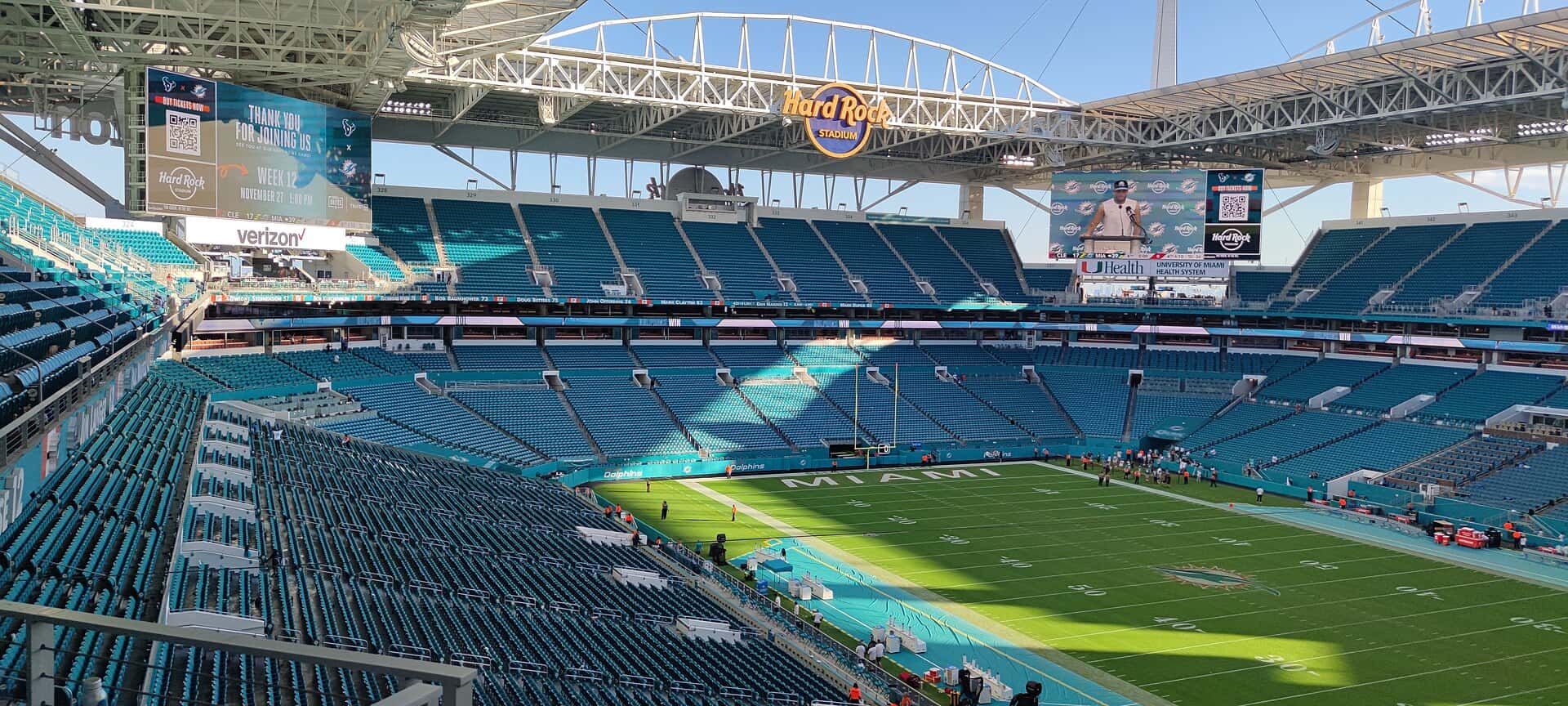
Following the road opener, the Dolphins will return to Hard Rock Stadium in Miami Gardens to host two home preseason games. The New York Giants are scheduled to visit for one preseason matchup, with the Atlanta Falcons also on the home exhibition schedule. Hard Rock Stadium, which has undergone a series of renovations over the years to improve its facilities and fan experience, serves as the hub of South Florida professional football and remains one of the most recognizable venues in the NFL. Home preseason games also allow the Dolphins to gauge local fan enthusiasm heading into the regular season, a useful barometer given the franchise's recent struggles to sustain deep playoff runs that keep engagement high.
The regular season schedule, also released in May 2026, will reveal the full scope of Miami's 2026 challenges and opportunities. Divisional matchups against Buffalo, New York, and New England will be the baseline tests, while nonconference opponents and any prime-time scheduling decisions by the league will shape the national profile of the Dolphins' season. Teams in active rebuilds sometimes find themselves scheduled into fewer prime-time windows, which affects both exposure and revenue, but the Dolphins' large and passionate fan base means the franchise typically maintains a degree of national interest regardless of recent results.
The Passing of Manny Fernandez
Overshadowing the Dolphins' preparations for 2026 is the loss of one of the franchise's most celebrated figures. Manny Fernandez, the defensive tackle who was a cornerstone of the legendary Miami Dolphins teams of the early 1970s, passed away at age 79. The news drew an outpouring of tributes from the NFL community, from former teammates and opponents, and from the South Florida fans who grew up watching him play. Fernandez represented an era of Dolphins football that remains unmatched in the franchise's history and, by some measures, in NFL history.
Fernandez played for the Miami Dolphins from 1968 through 1976, spending his entire professional career with the organization. He was selected in the 10th round of the 1967 AFL Draft and developed into one of the most disruptive interior defensive players of his generation. Standing at 6 feet 2 inches and playing at roughly 245 pounds, Fernandez used quickness, leverage, and football intelligence to compensate for a size disadvantage relative to the offensive linemen he faced nightly. His ability to penetrate the backfield and disrupt running plays was central to a Miami defense that ranked among the best in professional football during the height of the franchise's dynasty period.
The 1972 Perfect Season and Fernandez's Role
Manny Fernandez's name is permanently associated with one of the most remarkable achievements in professional sports history: the 1972 Miami Dolphins' undefeated season and Super Bowl championship. The 1972 Dolphins finished their regular season 14-0 and then won two playoff games and Super Bowl VII to complete a perfect 17-0 campaign, the only undefeated season in NFL history. That accomplishment has endured as a touchstone of sporting excellence, and the surviving members of the 1972 roster have been celebrated annually in a tradition that the franchise and its fans have maintained for decades.
Fernandez's contribution to the undefeated season was immense, and yet it took place in the shadow of teammates who were more publicly recognized at the time. At Super Bowl VII against the Washington Redskins, Fernandez recorded 17 individual tackles, a performance of singular dominance in the most important game of the year. Despite that output, the Super Bowl Most Valuable Player award went to safety Jake Scott rather than to Fernandez, a decision that has been revisited by football historians and analysts who argue that Fernandez's game was at least as worthy of individual recognition. His consistent excellence within the Dolphins' defensive system was a reflection of the team's collective approach, one that valued execution and reliability over individual flash.
The No-Name Defense, as the 1972 Dolphins' defensive unit was known, embodied a philosophy that minimized individual publicity in favor of team cohesion. Head coach Don Shula constructed a roster of players who excelled within their assignments and trusted that the collective result would speak for itself. Fernandez was the physical embodiment of that ethos, a player whose impact was most fully appreciated by those who watched closely and understood the game's interior mechanics. Among football historians and former players who faced the 1972 Miami defense, his reputation has always been that of a dominant player who was never fully recognized by the wider public.
Tributes From the Dolphins Organization and NFL Community
The Miami Dolphins organization issued a formal statement mourning Fernandez's death and honoring his contributions to the franchise. Current team ownership, coaching staff, and front office leadership expressed condolences to the Fernandez family and committed to honoring his memory as part of the organization's celebration of its championship history. Former teammates from the 1972 and 1973 Dolphins championship teams offered personal remembrances, with many describing Fernandez as a player whose preparation and dedication set the standard for the entire defensive unit.
Former Dolphins players and coaches who have remained publicly connected to the franchise expressed their grief on social media and in interviews with local and national sports media. Several emphasized Fernandez's character off the field as much as his ability on it, describing him as a team-first player whose commitment to the Dolphins extended well beyond his playing days. He remained a visible and beloved figure at franchise events and alumni gatherings for decades after his retirement, keeping him connected to the fan base that had watched him play during the team's greatest period.
NFL alumni organizations and the Pro Football Hall of Fame community also acknowledged Fernandez's passing. The question of whether Fernandez deserved Hall of Fame recognition was a recurring debate among his former teammates and supporters, who argued that his statistical profile and historical significance warranted selection. He was never inducted during his lifetime, a fact that his former teammates and advocates have long viewed as an oversight. In the wake of his passing, calls for posthumous recognition have renewed, with former Dolphins players and historians making the case that Fernandez's career merits Hall of Fame consideration through the senior committee process.
Connecting Past and Present: What Fernandez's Legacy Means for the 2026 Dolphins
The timing of Fernandez's passing, coinciding with the Dolphins' entry into a significant rebuilding phase, has given rise to reflection among South Florida fans about the distance between the franchise's present and its championship past. The 1972 team's perfect season and the back-to-back Super Bowl victories of 1972 and 1973 established a standard that no subsequent Miami team has come close to matching, and the franchise has spent much of the intervening five decades searching for the combination of coaching, quarterback play, and team-wide talent that could produce another championship run.
That history provides both inspiration and context for what the current front office is attempting with the 2026 rebuild. Franchise officials have pointed to the organizational culture that Don Shula established as a model for the values they want to instill in the current roster: accountability, discipline, preparation, and a team-first approach that subordinates individual interests to collective success. Whether those values can be cultivated quickly enough to produce meaningful results in 2026 remains an open question, but the organizational aspiration is clearly connected to the franchise's championship heritage.
For fans attending games at Hard Rock Stadium this season, the memory of Manny Fernandez and the 1972 champions will be present alongside the anticipation of watching a new generation of Dolphins players begin their own journey. The franchise has plans to honor Fernandez during the 2026 season, with specific tribute activities to be announced as the schedule progresses. His number and legacy are woven into the history that greets visitors to the stadium, a reminder that the franchise's greatest moments were built by players who defined excellence on and off the field.
Outlook for the 2026 Season
Realistic expectations for the 2026 Miami Dolphins are tempered by the scope of the roster changes and the uncertainty surrounding key positions. Willis's development as a starter is the central variable, and the degree to which he improves from week to week will likely determine whether the season is viewed as a productive rebuild or a difficult one. The offensive line situation, with Jackson dealing with an injury, adds another layer of uncertainty to how effectively the team can protect its new quarterback and establish a consistent running game with Achane, assuming he recovers from his own offseason ailment.
Defensively, the Dolphins retain some building blocks from recent seasons, and the coaching staff has emphasized that defensive improvement will be essential to keeping games competitive while the offense develops under Willis. Special teams, an area that has fluctuated in quality for Miami in recent years, will also be a focus during training camp and the preseason as new contributors compete for roster spots. Head coach and front office leadership have communicated a patient approach to the rebuilding timeline, signaling that player development and organizational culture are the priorities for 2026 rather than a specific win total.
South Florida's football community will be watching closely as the season unfolds, with the hope that the decisions made this offseason will produce a team that is genuinely competitive within two to three years. The legacy of Manny Fernandez and the 1972 Dolphins serves as a reminder of what the franchise has achieved at its best, and the current leadership has expressed a commitment to honoring that legacy by building a team that eventually competes at the highest level. For now, Hard Rock Stadium will host a work in progress, with the outcome of the rebuilding project still very much to be determined.
Spotted an issue with this article?
Have something to say about this story?
Write us a letterComments
No comments yet. Be the first to weigh in.
Related Coverage
Panthers open home schedule against Wild without Barkov and Marchand
8h ago
Rays await Guardians or White Sox in ALCS after sweeping Yankees; Game 1 Monday at Tropicana Field
1d ago
John Carlson scores twice, Dennis Hildeby makes 34 saves as Lightning hold off Wild 3-2
1d ago
Winless Dolphins host Bengals at Hard Rock Stadium seeking first win under Jeff Hafley
2d ago