SpaceX Targets Tuesday Dawn Launch From Cape Canaveral With Final Solar Arrays for the Space Station
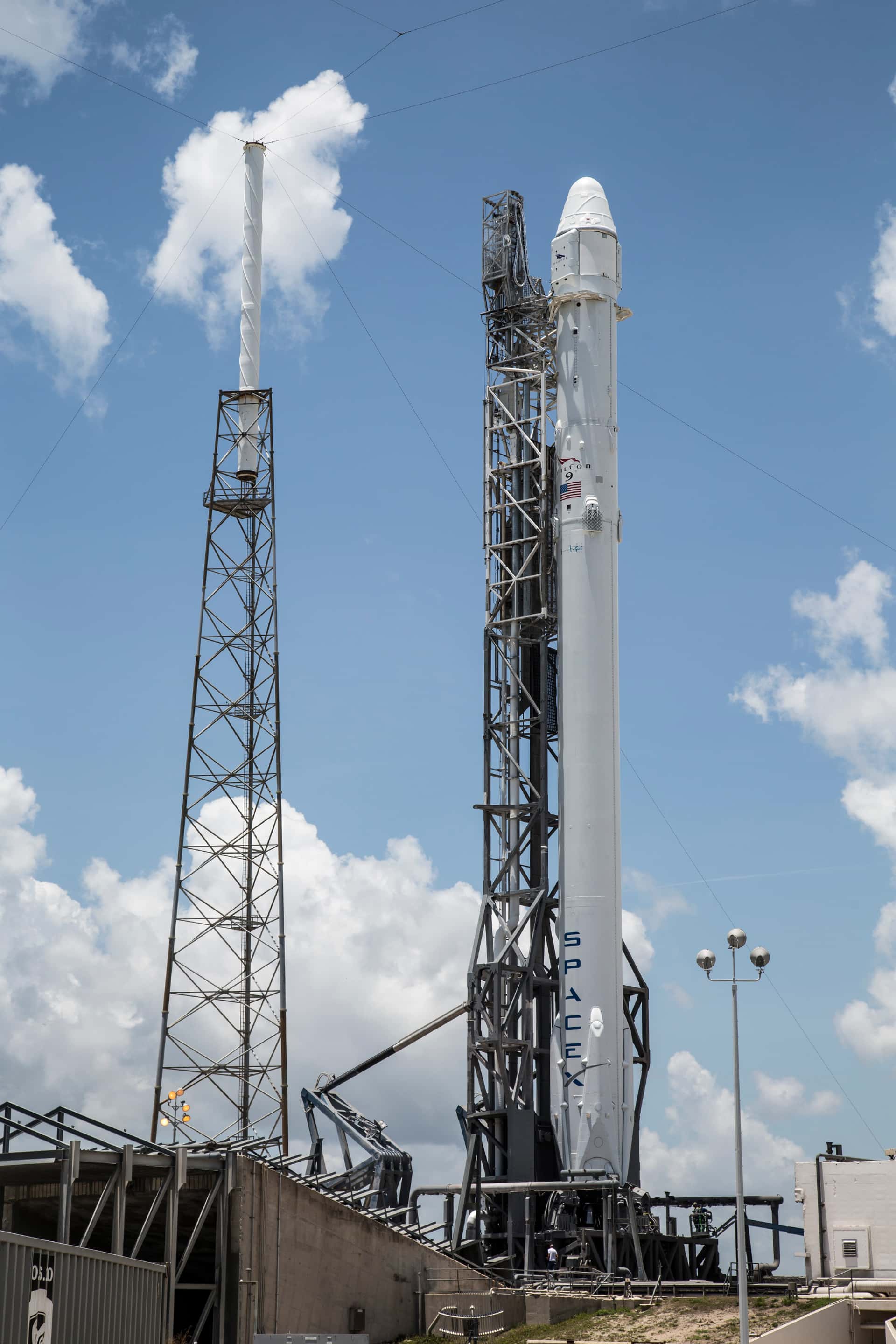
A SpaceX Falcon 9 rocket is scheduled to lift off from Cape Canaveral at dawn Tuesday carrying the last set of new solar arrays NASA plans to install on the International Space Station. The equipment will power the orbiting laboratory for the rest of its working life, through its planned deorbit.
NASA and SpaceX are targeting 6:33 a.m. EDT Tuesday, Oct. 13, for liftoff from Space Launch Complex 40 at Cape Canaveral Space Force Station. The flight is SpaceX's 35th commercial resupply services mission for NASA, known as CRS-35. The Dragon cargo spacecraft will carry more than 6,300 pounds of supplies, science experiments and hardware. It is scheduled to dock on its own around 11 a.m. Thursday, Oct. 15, at the space-facing port of the station's Harmony module.
The launch comes days after the Crew-12 astronauts, who launched from Florida in February, returned to Earth, and shortly after NASA formally invited companies to propose the commercial stations meant to replace the ISS.
Launch day details
NASA's live coverage begins at 6:15 a.m. Tuesday, and the agency will post countdown updates on its International Space Station blog starting no earlier than 6 a.m. Arrival coverage begins at 9:15 a.m. Thursday ahead of the 11 a.m. docking. Members of the public can register to attend the launch virtually through NASA's virtual guest program.
Launch times and dates are subject to change based on weather, range availability and the condition of the rocket and spacecraft. On the Space Coast, a Falcon 9 liftoff from SLC-40 is visible across Brevard County and often well beyond in clear, predawn conditions.
The key mission milestones, as scheduled by NASA, are listed below.
| Milestone | Date and time (EDT) | Location |
|---|---|---|
| Launch coverage begins | Tuesday, Oct. 13, 6:15 a.m. | NASA online platforms |
| Liftoff | Tuesday, Oct. 13, 6:33 a.m. | SLC-40, Cape Canaveral Space Force Station |
| Arrival coverage begins | Thursday, Oct. 15, 9:15 a.m. | NASA online platforms |
| Docking | Thursday, Oct. 15, about 11 a.m. | Harmony module, space-facing port |
| Undocking and splashdown | Mid-November | Pacific Ocean off California |
The last of the new solar arrays
The largest item on the manifest is the final pair of International Space Station Roll-Out Solar Arrays, called IROSAs. NASA has been adding these arrays to the station in stages, mounting them over the station's aging original solar wings to boost power.
NASA said installing this last pair completes the upgrade of the station's power system. That power will support critical operations through the end of the program, including the station's safe and controlled deorbit. The arrays are installed on the station's truss during spacewalks.
The flight also carries hardware for NASA's Moon program. A Collapsible Contingency Urinal and supporting equipment will fly as a demonstration and test unit for the Artemis III mission. That is the next crewed Artemis flight, and its rocket boosters are already stacked inside the Vehicle Assembly Building at Kennedy Space Center.
A large foam clamshell will fly up empty. It will be used to bring home the robotic arm joint that failed on Canadarm2 and was replaced during a June 30 spacewalk. Engineers will analyze the joint on the ground. Other equipment includes a toilet dose pump, a toilet pretreat quality sensor and a robotic tool for maintaining external equipment.
Science headed to orbit
Dragon will also deliver several research projects that NASA says could have medical and industrial uses on Earth:
- LambdaVision-1 will test building artificial retinas one thin layer at a time in microgravity, where reduced settling may produce more uniform layers. Researchers hope the implants could one day help restore vision for patients with retinal diseases that are currently incurable.
- Stellar Spheroids will study how microgravity affects the growth of 3D human heart tissue models, including whether it improves the formation of blood vessel networks. The goal is more realistic tissue models for disease research and larger-scale drug testing.
- ELF-Unconventional Glass 2 will observe how glass made from non-traditional elements forms in microgravity. The samples could lead to stronger, more durable materials for spacecraft and habitats.
- MINDS will study brain organoids, built from cells taken from multiple people, to better understand inflammation tied to Alzheimer's, Parkinson's and multiple sclerosis.
NASA astronaut Anil Menon and Canadian Space Agency astronaut Joshua Kutryk will monitor Dragon's approach from inside the station. The spacecraft will stay about a month. When it returns in mid-November, it will carry back the failed Canadarm2 joint, a spacesuit for refurbishment, a pump assembly from the station's urine processor and a filtration unit from the water processor. It will splash down in the Pacific Ocean off California.
A busy week for the station program
CRS-35 caps a week of activity for the station program. On Oct. 8, NASA's SpaceX Crew-12 mission splashed down in the Pacific off Los Angeles after 237 days in orbit. That crew included NASA astronauts Jessica Meir and Jack Hathaway, European Space Agency astronaut Sophie Adenot and Roscosmos cosmonaut Andrey Fedyaev. They launched Feb. 13 and traveled more than 100 million miles. On Oct. 9, the station's robotic arm released a Northrop Grumman Cygnus XL cargo spacecraft, clearing room at the orbiting complex.
The same day, NASA released its final request for proposals for commercial space stations meant to keep Americans in low Earth orbit after the ISS retires. Proposals are due Dec. 8, with contract awards expected in spring 2027. NASA plans to select two or more companies for early development, then hold a competition for final design, testing and certification.
"NASA is committed to maintaining a sustained American presence in low Earth orbit long after the International Space Station retires," NASA Administrator Jared Isaacman said. He added that the agency wants "credible plans, strong technical execution, and companies prepared to invest in destinations that can serve NASA while developing additional customers and markets of their own."
For Florida, the transition matters. SpaceX's crew and cargo flights to the station launch from the Space Coast, and the companies competing to build its successors will need regular launches to keep their outposts staffed and supplied.
What's next
If Tuesday's attempt is scrubbed, NASA and SpaceX will announce a new target. NASA's coverage will be available on its website and the NASA+ streaming service, and photos will be posted shortly after liftoff. After docking Thursday, the station crew will begin unloading the cargo, and the new solar arrays will await installation on future spacewalks. The Crew-12 astronauts will discuss their mission at a news conference at Johnson Space Center in Houston at 3:30 p.m. EDT on Oct. 15.
Spotted an issue with this article?
Have something to say about this story?
Write us a letterComments
No comments yet. Be the first to weigh in.
Related Coverage

Justice Department Restarts Federal 7-OH Ban Using the Same Limits Florida Adopted in June
2h ago

FHA Home Loans to Non-Permanent Residents Collapse in Orlando, Lakeland and Miami After HUD Rule Change
3h ago

Federal Appeals Court Upholds Florida Bar's Higher Fees for Experienced Out-of-State Lawyers
4h ago

ATF Ends Registration for Suppressors and Short-Barreled Rifles, Leaving Florida's Federal-Linked Gun Law in Limbo
5h ago