DeSantis Says Florida License Plate Readers Are Out of Control
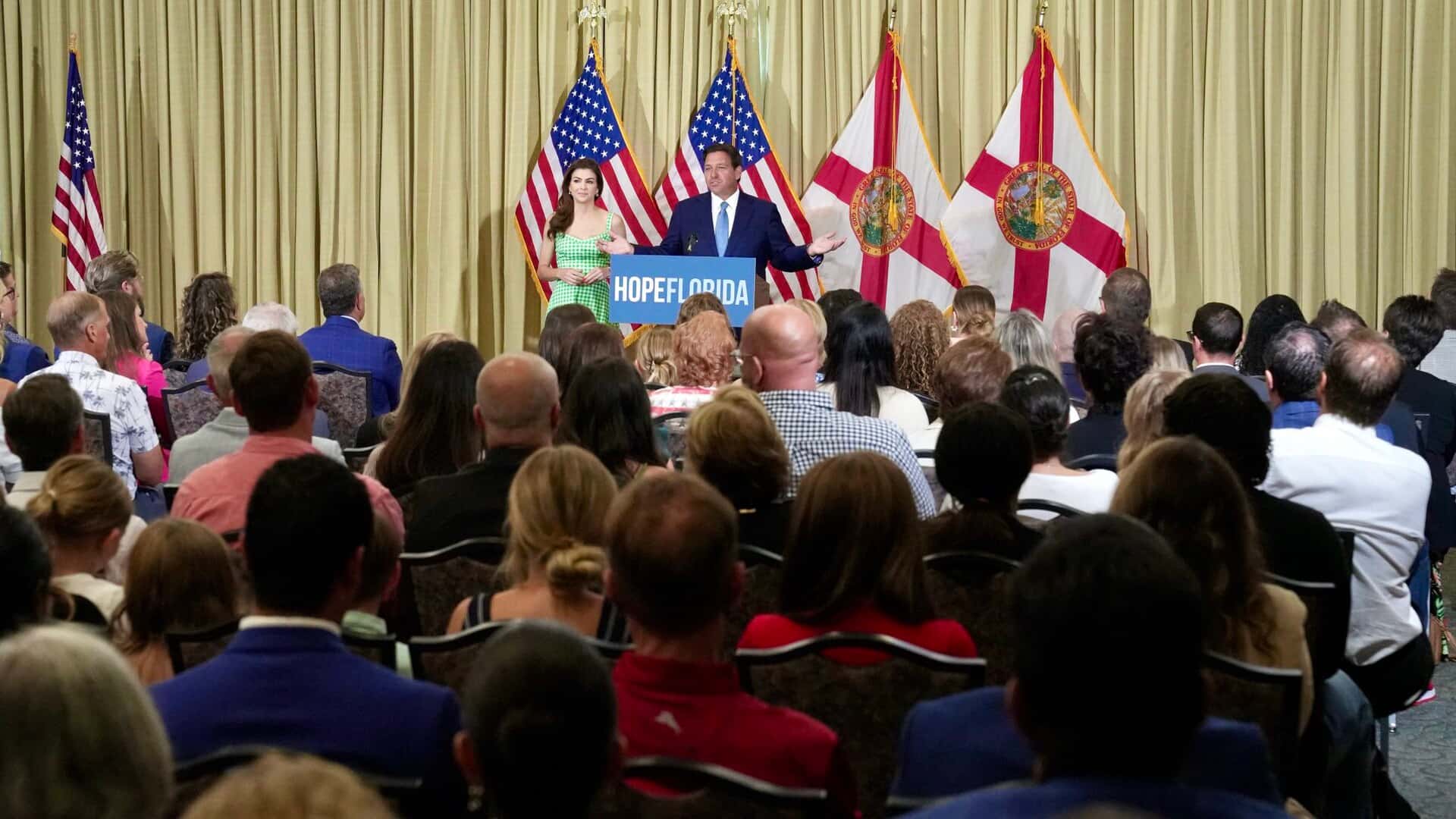
Gov. Ron DeSantis said Wednesday that the spread of automated license plate readers across Florida has gotten out of control, and he called on the Legislature to write new limits on how law enforcement agencies collect, store and search the data those cameras produce. Speaking at a press event at Florida International University in Miami, the governor warned that a technology sold to local governments as a crime-fighting tool has quietly grown into something closer to a statewide surveillance network, and he said Floridians deserve statutory protections that do not currently exist.
The remarks land at a moment when the cameras, most of them manufactured by the Georgia company Flock Safety, have become one of the most contested pieces of public infrastructure in Florida. Counties and municipalities have installed them on arterial roads, at neighborhood entrances and along highway corridors, generally through contracts approved at routine commission meetings with little public debate. According to a tally cited by WUFT, there are now roughly 7,500 license plate readers operating in the state.
DeSantis is a Republican governor in his final year in office, and his criticism of a technology broadly popular with sheriffs and police chiefs cuts against the usual partisan alignment on policing questions. That makes the intervention significant. A governor's endorsement of new restrictions gives cover to legislators in both parties who have introduced privacy bills in past sessions without getting them to the floor.
What the governor said
DeSantis argued that automated plate readers have drifted well beyond the purpose Floridians were told they would serve. Cameras that began as toll collection and stolen vehicle tools now feed searchable databases that can reconstruct where a given car has been over weeks or months, he said, and that capability exists without a warrant requirement or a clear statutory ceiling on how long records are kept.
The governor described the current situation as out of control and warned of the state drifting toward a surveillance state, according to accounts of his remarks from multiple Florida outlets. He also pointed to a specific abuse risk: officers with database access using it for personal reasons rather than legitimate investigations. That concern is not hypothetical in Florida, and the governor cited recent cases to make the point.
DeSantis suggested lawmakers look at New Hampshire, which sharply restricts the installation of these cameras along public roads, as a possible model. He did not commit to specific bill language or announce an executive action, and no formal proposal accompanied the remarks. What he offered was a direction for the 2027 legislative session and a signal that he would engage on the issue.
How the cameras spread across the state
Automated license plate readers work by photographing every vehicle that passes, converting the plate to text and logging the time and location. Individually, a single reading is unremarkable and is roughly equivalent to an officer noting a plate by hand. The privacy question arises from aggregation. Once hundreds of cameras across a metropolitan area feed a shared database, a search can produce a detailed movement history for a vehicle whose owner is not suspected of anything.
Florida agencies have adopted the systems quickly, in part because the vendor model is inexpensive on a per-camera basis and in part because the cameras have produced results in stolen vehicle and violent crime cases. Sheriff's offices in large counties have publicized recoveries and arrests that began with a plate hit. That track record is the core of the argument for keeping the systems in place, and it is why any legislative effort to restrict them will meet resistance from law enforcement associations.
What has not kept pace is the legal framework. Florida statute does not comprehensively govern retention periods, audit requirements, interagency sharing or the standard an officer must meet before running a query. Much of that is set by individual agency policy and by contract terms with the vendor. The result is a patchwork in which a driver's data may be handled one way in one county and differently across a county line.
Two officer arrests sharpened the debate
The governor's comments follow two arrests this month that gave the abuse argument concrete form. In mid-August, a Haines City police officer was arrested after his own department reported that he had used license plate reader data to track his estranged wife. About a week later, a Sarasota police officer was arrested on allegations of running a specific vehicle through the system more than three hundred times without an investigative reason.
Both officers are accused rather than convicted, and both cases remain pending. But the pattern they describe is the one privacy advocates have warned about for years: the risk is not primarily that agencies will conduct mass dragnets, but that a small number of individuals with credentials will misuse a powerful tool against people they know. Because the searches leave logs, the cases also demonstrate that misuse is detectable when someone bothers to audit.
That last point is central to what reform might look like. Mandatory audit trails, periodic independent review of query logs and criminal penalties for non-investigative searches are among the least controversial guardrails available, because they restrict abuse without taking the tool away from investigators working legitimate cases.
Local governments are already pushing back
Some Florida jurisdictions are not waiting for Tallahassee. On the same day the governor spoke, Manatee County commissioners rejected a proposal to deploy Flock license plate cameras, a decision that drew immediate attention because it came from a county board rather than from an advocacy group.
Local rejections matter for a technology that spreads contract by contract. Vendors build coverage by signing municipalities in sequence, and the value of the network to each participant rises as neighboring jurisdictions join. A county that declines creates a gap, and it also gives elected officials elsewhere a precedent to point to when constituents raise objections at a public comment period.
At the same time, the fragmentation cuts the other way. If limits are set only at the local level, Floridians will face very different privacy protections depending on where they live and drive, and data collected in a permissive jurisdiction can still be shared with agencies in a restrictive one. That is the strongest practical argument for a statewide statute rather than a collection of county policies.
What it means for Floridians
For most drivers, nothing changes immediately. The cameras remain in place, the databases remain searchable and agencies continue to operate under their existing policies. The governor's remarks do not carry the force of law.
The practical significance is that Floridians now have a clearer picture of what is being collected. Anyone who drives a regular commute in a covered area should assume that the movements of their vehicle are being logged and retained for some period, and that the record is accessible to officers across multiple agencies. Residents who want to know their local rules can ask their city or county for the agency policy governing retention and query standards, which is generally a public record.
For homeowners associations and neighborhood groups, many of which have contracted for cameras independently, the debate raises a separate question about private deployments feeding into law enforcement databases. Those arrangements sit in an even less settled area of Florida law, and they are likely to draw attention if the Legislature takes the issue up.
What the data actually captures
Understanding the privacy argument requires understanding what a plate reader records and what it does not. The cameras do not identify drivers, listen to conversations or track phones. They photograph a vehicle, extract the plate characters, and log a timestamp and a location. Many systems also capture what the industry calls vehicle fingerprint attributes: color, make, body style, roof racks, bumper stickers and visible damage.
That last category is what allows searches on vehicles whose plates were not readable, and it is also what makes the databases more powerful than the plate-only description suggests. An investigator can search for a white pickup with a ladder rack in a defined area during a defined window without knowing the plate at all.
The retention period converts these individual observations into a movement history. A record held for a few days supports investigation of a specific recent crime. A record held for a year supports reconstructing where a person went, when, and how often, over a period long enough to reveal medical appointments, religious attendance, political meetings and personal relationships. That distinction, more than the cameras themselves, is what most proposed legislation targets.
The law enforcement case for the technology
Florida sheriffs and police chiefs have defended the systems with specific results. Plate readers have contributed to recovering stolen vehicles, locating cars connected to shootings, tracking suspects across jurisdictional lines and finding vehicles associated with missing persons and abduction alerts. In cases where a witness recalls only a partial plate or a vehicle description, the databases can turn an unusable lead into a workable one.
Agencies also point out that the cameras observe public roads, where courts have generally held that drivers have a reduced expectation of privacy in the movement of a vehicle bearing a state-issued plate. The legal argument for the status quo rests substantially on that principle, though it has been complicated by court decisions recognizing that prolonged aggregate tracking raises different questions than a single observation.
The result is that the debate is less about whether police should be able to use plate readers at all and more about the conditions under which they do. Very few participants in the Florida discussion, including the governor, have called for eliminating the technology outright.
What's next
The Florida Legislature next convenes in regular session in 2027, which sets the practical timeline for any statutory change. Privacy bills addressing plate readers have been filed in previous sessions without advancing, and the governor's public support changes the political math for the coming cycle. Whether it changes the outcome depends heavily on how law enforcement associations engage and whether a bill is drafted narrowly enough to preserve investigative use.
The likely shape of a compromise is visible in the debate already: fixed retention limits measured in weeks rather than years, a documented investigative purpose required for each query, mandatory logging and audits, restrictions on sharing with agencies outside Florida, and penalties for misuse. Each of those can be adopted without banning the cameras, which is a politically difficult step in a state where sheriffs carry substantial weight.
DeSantis leaves office in January 2027, and his successor will inherit whatever the Legislature does or fails to do. That timing means the issue will almost certainly surface in the governor's race and in legislative campaigns this fall. For now, the cameras keep running, and the rules governing them remain largely a matter of agency discretion.
Spotted an issue with this article?
Have something to say about this story?
Write us a letterComments
No comments yet. Be the first to weigh in.
Related Coverage

Miami Voters to Decide $450 Million Police and Fire Bond as City Carries Heavy Debts and Pension Bills
23h ago

Martin County's MARTY Buses Stop Cold After Operator Walks Away From Contract, Stranding Riders on the Treasure Coast
1d ago
Florida now requires REAL ID or a passport with I-94 to register a vehicle, leaving some immigrants unable to qualify
1d ago
Broward Mayor Launches Probe of Sheriff Gregory Tony's Spending as County Budget Feud Escalates
1d ago