Florida's Job Market Cools as Federal Payrolls Shrink and Orlando Pulls Ahead
Florida's labor market has spent 2026 in an unfamiliar position. After years in which the state routinely outpaced national job growth, Florida recorded five consecutive months of annual job losses from November 2025 through April 2026 before returning to small increases in April, May and June, according to the Florida Chamber of Commerce's mid-year economic report. The state's average unemployment rate year to date has surpassed 4 percent, a threshold Florida spent most of the post-pandemic period comfortably below.
The composition of the losses is as significant as the total. Government employment led the decline, with the state shedding roughly 12,300 federal positions and 1,600 state positions over the past year. Financial activities lost about 11,500 jobs, construction about 8,700, trade, transportation and utilities about 7,900, manufacturing about 4,500, and leisure and hospitality about 3,000.
What Florida is experiencing does not look like a layoff wave. Nationally, weekly applications for unemployment benefits have remained near historic lows, slipping to roughly 203,000 in late August, and analysts have generally described the current period as one of slow hiring rather than rapid job destruction. Florida's rising unemployment rate is consistent with that reading: people entering or reentering the labor force are taking longer to find work, rather than large numbers of employed people being cut loose.
Where the federal job losses hit
The loss of 12,300 federal positions is the single largest sectoral decline in the state, and its geography is concentrated. Florida hosts a substantial federal footprint that includes military installations, Veterans Affairs medical centers, Social Security and IRS processing operations, federal courts, and the civilian workforce supporting NASA operations on the Space Coast.
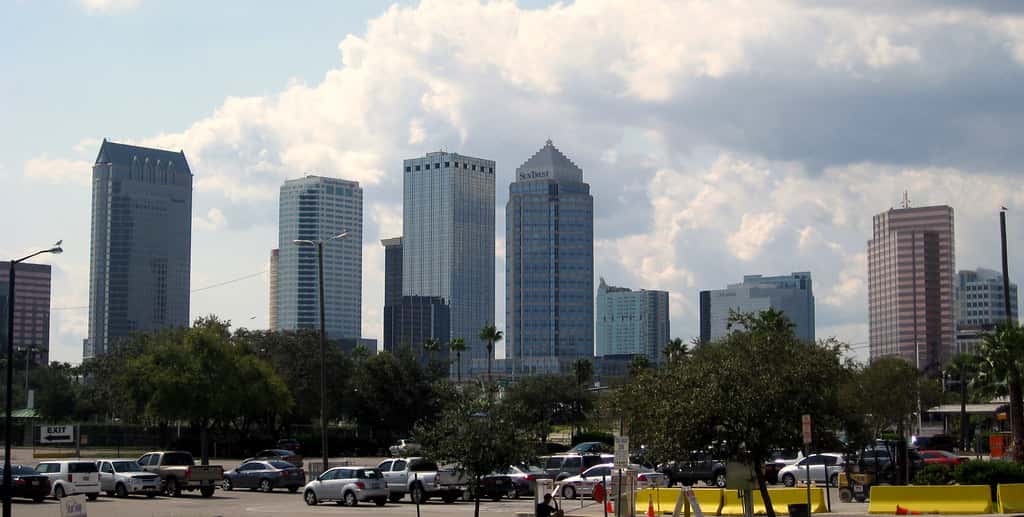
Tampa is home to MacDill Air Force Base and to the headquarters of U.S. Central Command and U.S. Special Operations Command, which together anchor a large civilian and contractor workforce. The Jacksonville area supports Naval Air Station Jacksonville and Naval Station Mayport. The Panhandle hosts Eglin Air Force Base, Tyndall Air Force Base and Naval Air Station Pensacola. Brevard County's economy is tied to Kennedy Space Center and Patrick Space Force Base.
Federal civilian jobs typically pay above the median wage in the metropolitan areas where they sit, which means their loss removes more purchasing power per position than the raw count suggests. They also tend to be stable, benefit-carrying positions that households build long-term financial plans around, including mortgages.
The distinction between federal civilian employment and federal contracting matters for reading the data. Payroll surveys count contractor employees under the contractor's industry classification, not under government, so reductions in federal contract spending show up in professional services or manufacturing rather than in the government line. The 12,300 figure captures direct federal employment only.
The private-sector picture
The 11,500-job decline in financial activities is notable in a state that has spent a decade courting financial firms relocating from higher-cost jurisdictions. That sector includes banking, insurance carriers and agencies, securities and investment firms, and real estate. Both the insurance and real estate components are sensitive to conditions specific to Florida, and both have gone through significant restructuring.
Construction's 8,700-job decline follows a long expansion. Florida's construction employment grew substantially through the residential boom and through post-hurricane rebuilding, and a pullback was widely expected as the pipeline of multifamily projects begun during the low-rate period reached completion. Multifamily starts fell sharply once financing costs rose, and the effect on employment shows up roughly two years later as existing projects finish.
Trade, transportation and utilities lost about 7,900 jobs. That category covers retail, wholesale, warehousing, trucking and port operations, and it is closely tied to consumer spending and goods volumes. Florida's ports and distribution centers handle both domestic freight and international trade, which makes the category responsive to tariff policy and to global shipping conditions.
Leisure and hospitality lost about 3,000 jobs, a comparatively small decline in Florida's largest private employment category. That sector employs well over a million Floridians across hotels, restaurants, theme parks and attractions, and a decline of that size represents a fraction of a percent rather than a contraction.
Orlando as the outlier
Central Florida has moved in the opposite direction from the state as a whole. Orlando's payrolls grew 1.4 percent year over year at midyear 2026, compared with 0.3 percent nationally, and the metropolitan area added roughly 20,600 jobs in the twelve months ending in June, leading Florida metropolitan areas.
The region's growth rests on several pillars. Tourism and hospitality remain the largest, anchored by Walt Disney World Resort, Universal Orlando Resort and SeaWorld Orlando, and Universal's recent capital investment cycle has added both construction and permanent operating positions. Health care has expanded steadily with population growth. The Lake Nona medical and life sciences cluster and the simulation and training industry around the University of Central Florida have added higher-wage technical positions.
The state's investment in emerging transportation technology also runs through Central Florida. The SunTrax facility in Polk County, along the Interstate 4 corridor, tests connected and autonomous vehicles and is expanding to support electric vertical takeoff and landing aircraft testing, with workforce partnerships involving Embry-Riddle Aeronautical University and Polk State College.
Whether Orlando's outperformance persists depends substantially on consumer discretionary spending, since tourism demand is among the first categories households cut when finances tighten. Theme park attendance and hotel occupancy data through the fall will be the leading indicators.
Why the unemployment rate is rising
The Florida Chamber's analysis attributes much of the increase in unemployment to a slowdown in hiring rather than to widespread layoffs, and points to young workers as a significant driver of the rate increase. That pattern is consistent with what economists call a low-hire, low-fire labor market, in which employers hold onto existing staff but slow or freeze new hiring.
Young workers are disproportionately affected by that dynamic because they are disproportionately job seekers rather than job holders. Recent graduates entering the labor market, students seeking part-time work and workers early in their careers looking to move all depend on hiring activity, and when openings shrink, they accumulate in the unemployed count faster than established workers do.
Florida's continued population growth adds people to the labor force every month, which mechanically raises the unemployment rate when job creation does not keep pace. A state absorbing large numbers of new working-age residents needs to create jobs simply to hold its unemployment rate steady, and Florida's job creation this year has fallen short of that pace.
The state's unemployment rate remains within the range economists generally associate with a functioning labor market rather than a recession. Crossing 4 percent is notable relative to Florida's own recent history, not relative to long-run norms.
What it means for Floridians
For job seekers, the practical implication is a longer search. In a slow-hiring market, the number of applications required per offer rises and time-to-hire lengthens, and job seekers should plan financially for a longer gap than recent years would have suggested. CareerSource Florida operates regional workforce boards across the state that provide job search assistance, training referrals and reemployment services.
For employed workers, the low layoff rate is genuine reassurance, but it comes with reduced leverage. Wage growth tends to slow when workers cannot credibly threaten to leave, and voluntary quits fall in markets like this one. Workers considering a move should weigh the reduced availability of alternatives.
For households in federal-employment-heavy communities, particularly around military installations and the Space Coast, the concentrated nature of federal reductions warrants specific attention. Local economies built around a single large employer feel changes there more acutely than statewide averages suggest.
For homebuyers and sellers, labor market conditions feed into the housing picture that has otherwise been improving, with eleven consecutive months of year-over-year sales gains reported by Florida Realtors. Employment stability is a mortgage underwriting factor, and a softer job market tightens credit at the margin.
Wages, cost of living and the squeeze
Florida's minimum wage has been rising on a schedule set by a constitutional amendment approved by voters in 2020, which stepped the wage upward annually toward a $15 target with subsequent adjustments tied to inflation. The increases have raised the floor for the state's large service workforce.
Whether those gains have kept pace with costs is a separate question. Housing costs in particular have risen faster than wages in most Florida metropolitan areas over the past decade, and insurance and property tax increases have compounded the effect for homeowners while flowing through to renters as landlords pass along costs.
Florida has no state income tax, which raises take-home pay relative to states that do and which is consistently cited in explanations of the state's in-migration. The tradeoff is a revenue structure that leans on sales taxes and on tourism, making state finances sensitive to consumer spending.
For workers weighing a move within Florida, the cost differences across metropolitan areas are substantial. Housing costs in Miami-Dade and Monroe counties run well above those in the Panhandle or in interior counties, and a nominally higher salary in South Florida does not necessarily translate into higher real income.
What's next
Florida Commerce publishes monthly state and metropolitan area employment data, and the releases through the fall will show whether the small gains recorded in the spring have continued or whether the state has slipped back into year-over-year declines.
The Federal Open Market Committee meets September 15 and 16, and labor market data is a primary input into that decision. Forecasters have disagreed sharply this year about the direction of the next move, and the outcome will affect borrowing costs across Florida's construction, real estate and consumer sectors.
Federal budget decisions will determine whether the federal employment decline continues. Agency staffing levels follow appropriations, and Florida's congressional delegation has direct involvement in appropriations affecting military installations and NASA operations in the state.
The tourism season that begins in the fall and runs through the winter will test whether Central Florida's outperformance holds. Theme park attendance, hotel occupancy and airport passenger volumes are the metrics that will answer that question before the payroll data does.
Spotted an issue with this article?
Have something to say about this story?
Write a letter to the editorComments
No comments yet. Be the first to weigh in.
Related Coverage

Florida Home Insurance Rates Keep Falling as Regulators Approve New Cuts and South Florida Policyholders See the Biggest Relief
1d ago
Brightline Chapter 11 Explained: What the Railroad's Bankruptcy Means for Florida Riders and Orlando Service
1d ago

Florida Regulators Approve Four More Homeowners Insurance Rate Cuts Affecting 62,000 Policies
2d ago

Brightline Parent Companies File for Chapter 11 as Florida Trains Keep Running
4d ago