NASA's Roman Space Telescope Arrives at Kennedy Space Center for Falcon Heavy Launch From Florida
NASA's Nancy Grace Roman Space Telescope, one of the agency's flagship science missions, has arrived at Kennedy Space Center in Florida to begin preparations for launch aboard a SpaceX Falcon Heavy rocket. The arrival marks another major milestone for Florida's Space Coast, the launch hub from which the powerful observatory will begin its journey to search for distant, potentially Earth like worlds and to probe some of the deepest questions in astronomy.
The Roman telescope is designed to survey vast areas of the sky with remarkable speed and detail, and its launch from Florida reinforces the Space Coast's central role in American spaceflight. As the next high profile science mission to lift off from the region, the telescope brings renewed attention to the cluster of launch facilities, jobs and economic activity that have made Florida's east coast one of the busiest spaceports on the planet.
A powerful new observatory
The Nancy Grace Roman Space Telescope arrived in Florida to begin the careful process of preparing for launch from Kennedy Space Center. The observatory is built to scan enormous swaths of the sky, with a field of view far larger than that of earlier space telescopes, allowing it to survey the cosmos far more quickly than its predecessors.
The telescope's primary mirror is comparable in size to that of the Hubble Space Telescope, but its instruments are designed to capture a much wider area in each observation. This combination of resolution and breadth enables Roman to conduct sweeping surveys that would take far longer with a narrower instrument, making it a powerful tool for studying the structure and evolution of the universe.
Among its scientific goals, the telescope is designed to search for Earth like exoplanets, planets orbiting other stars that might share characteristics with our own world. It will also investigate fundamental questions about the cosmos, contributing to research on the nature of dark energy and the large scale structure of the universe. The mission represents a significant addition to NASA's fleet of space based observatories.
Launching from Florida's Space Coast
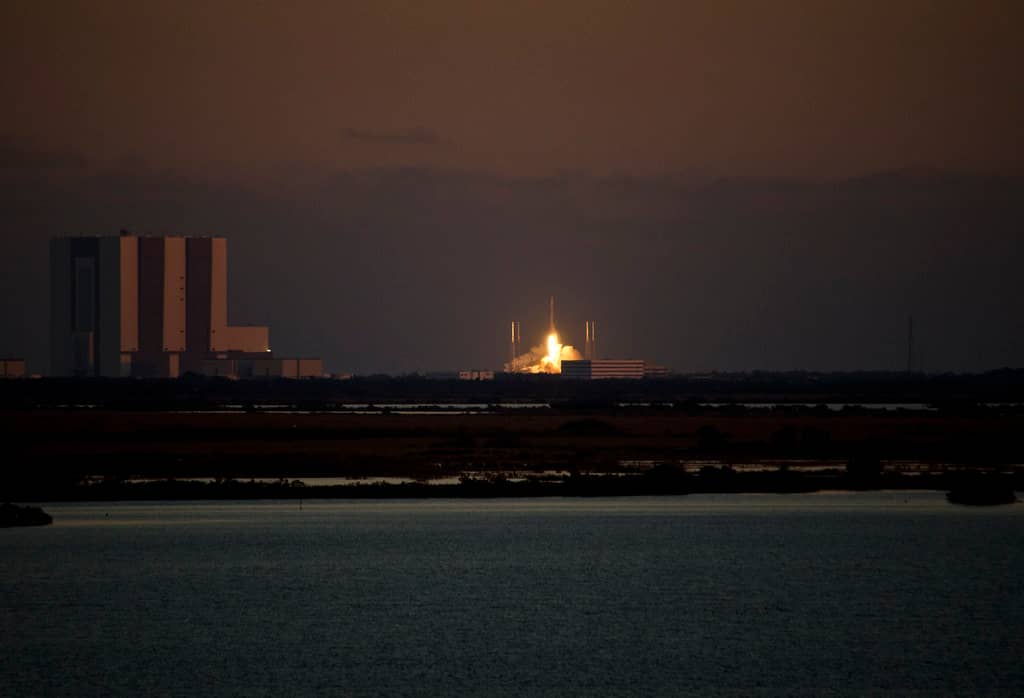
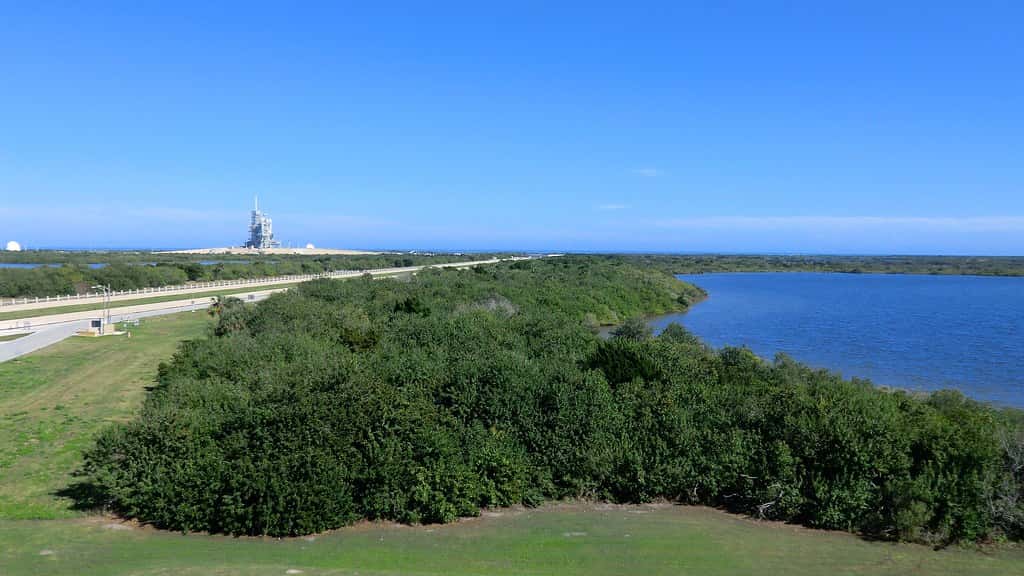
The telescope is slated to launch aboard a SpaceX Falcon Heavy rocket from Launch Complex 39A at Kennedy Space Center, the historic pad that has hosted some of the most significant launches in American spaceflight history. The Falcon Heavy, one of the most powerful rockets in operation, is suited to carrying heavy and valuable payloads like the Roman observatory.
The arrival of the telescope at Kennedy initiates a period of launch preparation, during which the spacecraft is processed, tested and integrated with its rocket. These preparations are meticulous and time consuming, reflecting the value and complexity of a flagship science mission and the importance of ensuring everything is ready before launch.
Florida's Space Coast has become the epicenter of a launch boom, hosting an extraordinary cadence of missions from both NASA and commercial operators. The region's facilities at Kennedy Space Center and the neighboring Cape Canaveral Space Force Station support everything from satellite deployments to crewed missions, and high profile science launches like Roman add to that busy schedule.
The Florida angle
The Space Coast is a major economic engine for Florida, supporting thousands of jobs in aerospace, engineering, manufacturing and related fields. The steady flow of launches sustains a workforce and an industry that have become integral to the region's identity and to the state's economy, and each major mission reinforces Florida's standing as a leader in spaceflight.
Brevard County and the surrounding Space Coast communities benefit directly from the launch industry through employment, business activity and tourism. Rocket launches draw spectators and visitors, and the presence of NASA and commercial space companies anchors a high technology sector that contributes to the state's broader economic diversification beyond tourism and agriculture.
The Roman telescope's launch from Florida also connects the state to cutting edge science with global significance. The discoveries the observatory may enable, from finding distant worlds to advancing the understanding of the universe, will originate from a mission that begins on Florida soil, a point of pride for the Space Coast and the state.
What it means for the region
For the Space Coast, the arrival of a flagship NASA science mission underscores the region's continued importance in an era when commercial spaceflight has dramatically increased launch activity. While companies like SpaceX conduct frequent commercial launches, marquee science missions like Roman highlight the enduring role of NASA and the scientific dimension of the region's space industry.
The launch preparations bring activity and attention to Kennedy Space Center, reinforcing the facility's status as a premier launch site. The processing and integration of a complex observatory require specialized expertise and facilities, the kind of capability that has made the Space Coast a hub for the most demanding missions.
For residents and space enthusiasts, the upcoming launch represents another opportunity to witness a significant moment in spaceflight from Florida's shores. The Space Coast's launches have become a defining feature of life in the region, and a flagship science mission adds a special dimension to the steady drumbeat of activity at the spaceport.
The science Roman will pursue
The Roman Space Telescope is named for Nancy Grace Roman, a pioneering NASA astronomer often regarded as the mother of the Hubble Space Telescope for her foundational role in advancing space based astronomy. The observatory bearing her name is designed to carry that legacy forward, conducting wide surveys of the sky that will address some of the most significant questions in modern astronomy.
One of the telescope's central goals is the study of dark energy, the mysterious force thought to be driving the accelerating expansion of the universe. By surveying enormous numbers of galaxies across vast stretches of cosmic time, Roman aims to help scientists understand the nature of this phenomenon, which remains one of the deepest puzzles in physics. The observatory's wide field of view makes it uniquely suited to such large scale surveys.
The telescope will also search for exoplanets, including worlds that might resemble Earth, using techniques that complement those of other observatories. Its ability to scan large areas of the sky quickly allows it to detect planets through methods that benefit from broad surveys, expanding the catalog of known worlds beyond our solar system. Together, these scientific objectives position Roman as a flagship mission with the potential to reshape our understanding of the cosmos.
The Space Coast's enduring legacy
The launch of the Roman telescope from Kennedy Space Center adds to a storied history of spaceflight on Florida's Space Coast. Launch Complex 39A, the pad slated to host the mission, has been the site of some of the most significant launches in American history, from the missions that carried astronauts toward the Moon to the space shuttle program and, more recently, commercial crew flights. The continuity of that history gives the region a unique place in the story of space exploration.
The Space Coast has reinvented itself across eras of spaceflight, transitioning from the government dominated programs of earlier decades to the current era of frequent commercial launches alongside flagship NASA missions. That adaptability has kept Florida at the center of American spaceflight even as the industry has transformed, and the launch of a major science mission like Roman reflects the enduring importance of the region's facilities and expertise.
For the communities of the Space Coast, each major mission reinforces a sense of identity tied to space exploration and sustains an economy built around it. The region's workforce, facilities and infrastructure represent a national asset, and the steady cadence of launches, from commercial satellites to scientific observatories, ensures that Florida remains America's gateway to space for the foreseeable future.
What's next
With the telescope at Kennedy Space Center, the mission team will proceed through the sequence of preparations leading toward launch, including testing, fueling and integration with the Falcon Heavy. Each step is carefully managed to ensure the observatory is ready for its journey to space and its years of planned operation.
Once launched, the Roman Space Telescope will travel to its operational location far from Earth, where it will begin its surveys of the sky. The science it produces is expected to contribute to astronomy for years, building on the legacy of space based observatories and opening new windows on the universe.
For now, the arrival of the Roman telescope at Kennedy Space Center marks the beginning of the final phase before launch, and another chapter in Florida's storied role as America's gateway to space. The Space Coast continues to launch the missions that expand human knowledge, and the Roman observatory is poised to add to that record from its perch on Florida's Atlantic shore.
The mission also illustrates the evolving partnership between NASA and commercial launch providers. By relying on a SpaceX Falcon Heavy to carry a flagship science payload, NASA leverages the capabilities and cost efficiencies of the commercial sector while focusing its own resources on the science and instruments. This model has become increasingly common, and the Space Coast, with its mix of government and commercial facilities, is uniquely positioned to support it.
For Florida, the steady flow of high profile missions reinforces the value of continued investment in the infrastructure, education and workforce that sustain the space industry. The expertise required to process and launch a spacecraft like Roman represents a specialized capability built up over decades, and maintaining it ensures the state remains competitive as the global space economy grows and as new missions are planned.
As anticipation builds toward launch, the Roman Space Telescope embodies the dual character of Florida's space industry: a place where cutting edge science meets the practical work of getting payloads to orbit. The discoveries the observatory may enable will resonate far beyond the state, but they will begin on Florida soil, a fitting role for a region that has launched so much of humanity's exploration of space and that continues to do so today.
Spotted an issue with this article?
Have something to say about this story?
Write a letter to the editor