DeSantis Declares September Florida Preparedness Month, and the Timing Is Better Than It Looks

Governor Ron DeSantis has declared September as Florida Preparedness Month, urging residents to confirm their evacuation zone, build a disaster plan and assemble an emergency supply kit. The designation lands during the statistical peak of the Atlantic hurricane season and in a year when the basin has produced five named storms but no hurricanes, a combination that makes the message both easy to ignore and unusually worth heeding.
What the designation calls for
The proclamation asks Floridians to take three specific actions: know their evacuation zone, put together a written disaster plan, and stock an emergency kit. Those three items are the core of what state and county emergency managers have found actually determines how households fare during a storm, as distinct from generalized awareness.
The timing is deliberate. September 10 is the climatological peak of Atlantic hurricane activity, the date on which, averaged across decades of records, the basin is most likely to have an active tropical cyclone. The month also opens a stretch running through October that has historically produced Florida's most damaging landfalls.
Preparedness designations exist in most coastal states, but Florida's carries more operational weight because of the state's exposure. Every one of Florida's 67 counties has some hurricane risk, and 35 of them have coastline.
Evacuation zones are not flood zones
The single most common point of confusion in Florida hurricane preparedness is the difference between an evacuation zone and a flood zone. They are different designations, created by different agencies, for different purposes, and a property can be in one and not the other.
Evacuation zones, labeled A through F in most Florida counties, are based on storm surge vulnerability. They answer the question of whether ocean water pushed inland by a hurricane is likely to reach a location. County emergency management agencies assign them, and evacuation orders are issued by zone rather than county-wide.
Flood zones come from FEMA's flood insurance rate maps and reflect the likelihood of flooding from rainfall and riverine sources as well as coastal flooding. They determine whether a mortgage lender requires flood insurance. A home well outside a surge evacuation zone can sit in a flood zone, and a home in Zone A can be outside a mapped high-risk flood area.
Residents can find their evacuation zone through their county emergency management website or through the state's Know Your Zone tool. That lookup takes about a minute and is the single highest-value preparedness action for a household that has not done it.
What a real disaster plan contains
Emergency managers describe an effective household plan as answering a specific set of questions before a storm forms. Where will the household go if an evacuation order covers its zone? Evacuation in Florida generally means going tens of miles inland rather than hundreds, and the most common destination is a friend or relative's home outside the surge zone.
Who is the out-of-state contact everyone will check in with? Local phone networks become congested during and after a storm, and a single out-of-area contact who can relay status among family members is a standard element of emergency planning.
What happens to pets, medications and important documents? Not all shelters accept pets, and pet-friendly shelters must be identified in advance. Prescription medications should be filled ahead of a storm rather than during one. Insurance policies, identification and property records should be photographed and stored somewhere accessible without power.
Households with members who have medical needs requiring electricity should register with their county's special needs registry. That registration is what allows emergency management to plan transportation and shelter placement, and it must be done in advance.
Supplies are now tax-free year-round
Florida has replaced its annual disaster preparedness sales tax holidays with a permanent year-round sales tax exemption on emergency supplies. Batteries, generators, smoke and carbon monoxide detectors, weather radios, tarps, coolers and related items can be purchased tax-free at any time rather than only during designated windows.
The policy change removes the artificial urgency that the old holidays created and the corresponding shortage of goods that occurred when everyone shopped in the same two-week period. It also means a household can maintain and refresh a kit through the year rather than assembling it all at once.
Standard guidance calls for at least seven days of water at one gallon per person per day, seven days of nonperishable food, a manual can opener, flashlights, batteries, a battery or hand-crank weather radio, a first aid kit, cash in small bills, and full fuel tanks. Cash matters because card readers do not work without power or connectivity.
The complacency problem
Emergency managers consistently identify two high-risk groups: residents who have never been through a hurricane, and residents who have been through one that did not affect them badly. Florida's population growth means the first group is large and grows every year, with hundreds of thousands of new residents arriving annually.
The second group is subtler. Someone who evacuated for a storm that turned and produced only rain in their area is measurably less likely to evacuate the next time. That pattern is well documented in evacuation research and is a persistent challenge for officials issuing orders.
The 2026 season adds a third dimension. A year in which the Atlantic has not produced a single hurricane through the first week of September makes preparedness feel abstract. Emergency management guidance treats a quiet season as a reason to prepare rather than a reason to relax, because a season's storm count says nothing about whether one storm reaches Florida.
What counties do and what residents do
County emergency management agencies handle evacuation orders, shelter openings, and post-storm response coordination. The Florida Division of Emergency Management coordinates at the state level and manages the state emergency operations center. Neither can substitute for household-level preparation.
Evacuation orders are issued by county and by zone, and they are the authoritative instruction. Residents should identify now which county official channel they will follow during a storm, whether that is a county emergency management social media account, a local broadcast station or an alert system they have signed up for.
Shelters are a last resort rather than a destination of choice. They provide safety from wind and surge, not comfort, and general population shelters have limited supplies. Residents who can stay with someone inland are advised to do that instead.
Insurance is part of preparedness
Emergency managers increasingly frame insurance review as a preparedness action rather than a financial one, because the aftermath of a storm is determined as much by coverage as by physical damage. Homeowners are advised to read their declarations page before the season rather than after a loss.
The items that matter most are the hurricane deductible, which in Florida is typically expressed as a percentage of the dwelling coverage rather than a flat dollar amount, and whether the policy provides replacement cost or actual cash value on the roof. Those two provisions determine most of the out-of-pocket exposure after a wind event.
Flood coverage is separate and is not included in a homeowners policy. Policies purchased through the National Flood Insurance Program carry a 30-day waiting period before coverage takes effect, and the program's authorization is itself scheduled to expire at the end of September pending congressional action.
Documentation is the other pre-storm step. Photographing every room, the exterior, the roof and major possessions creates the record that supports a claim, and storing those images in cloud storage rather than on a device that may be lost is what makes them useful afterward.
What the last decade taught Florida
Florida's recent storm history is the reason preparedness messaging carries weight that it would not in a state with less exposure. Hurricane Michael struck the Panhandle in 2018 as a Category 5, effectively erasing parts of Mexico Beach and damaging Tyndall Air Force Base severely enough to require years of reconstruction.
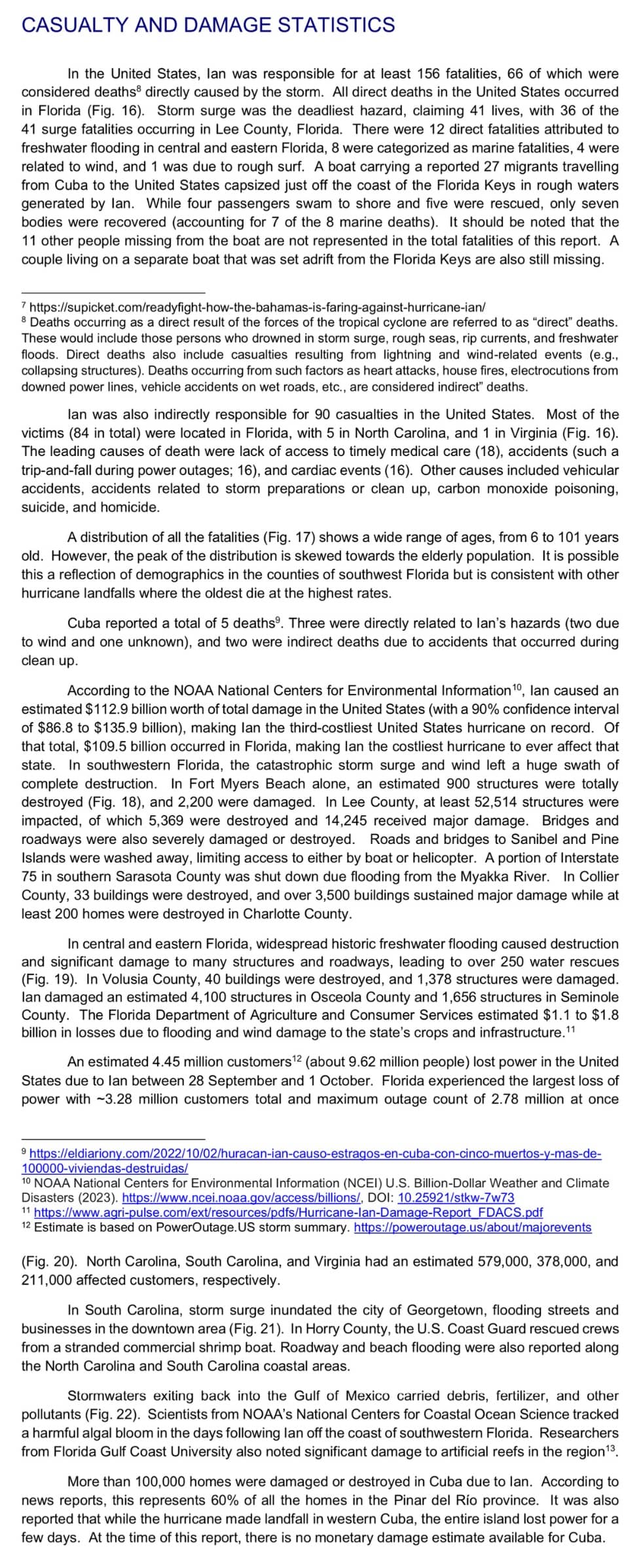
Hurricane Ian came ashore in Southwest Florida in September 2022 with a storm surge that reached well over ten feet in parts of Lee County, causing the deadliest hurricane in Florida since 1935. Most of those deaths were from drowning in the surge zone, and a substantial share were people who had not evacuated.
Hurricane Idalia struck the Big Bend in 2023, and Helene and Milton both affected the state in 2024, with Milton crossing the peninsula and generating a tornado outbreak well away from its center. Each of those storms produced a distinct hazard profile, and none of them looked like the others.
The pattern emergency managers draw from that decade is that Florida's storm risk is not confined to one region or one type of impact. The Panhandle, the Big Bend, Southwest Florida and the peninsula have all taken direct hits within a seven-year window, and the hazards ranged from catastrophic wind to storm surge to inland flooding to tornadoes.
That variability is why the state's guidance emphasizes zone-specific evacuation and household planning rather than a single set of instructions. A plan built around wind risk is not sufficient for a household in a surge zone, and a plan built around surge does not address the inland flooding that Ian produced hundreds of miles from where it made landfall.
What's next
The Atlantic season runs through November 30, and roughly a third of a typical season's activity occurs after the September 10 peak. Late-season development tends to favor the western Caribbean and the Gulf, which are the regions with the shortest travel distance to Florida and therefore the shortest warning timelines.
Preparedness Month runs through September, but the actions it asks for have no expiration. An evacuation zone lookup completed in September remains valid, a plan written now works in October, and a kit stocked at tax-free prices lasts until it is needed.
For households that do nothing else, emergency managers say the evacuation zone lookup is the one action that matters most. Everything else follows from knowing whether an order applies to your address.
Spotted an issue with this article?
Have something to say about this story?
Write us a letterComments
No comments yet. Be the first to weigh in.
Related Coverage

Storm-Force Low Off Southeast Coast Has 40% Chance to Turn Subtropical as Florida Coast Faces Tidal Flooding, Rough Surf
2d ago
Strong fall cold front brings Florida Saturday rain, cooler air and dangerous surf this weekend
5d ago
Hurricane Center Gives Atlantic Low Near Cabo Verde a 20% Chance as Florida Gets a Break After Isaias
Oct 12

Tallahassee and the Big Bend Escape Isaias' Worst, With Downed Trees, Brief Outages and Rising Rivers to Watch
Oct 9