Everglades Farmers Report a 65 Percent Cut in Phosphorus Runoff
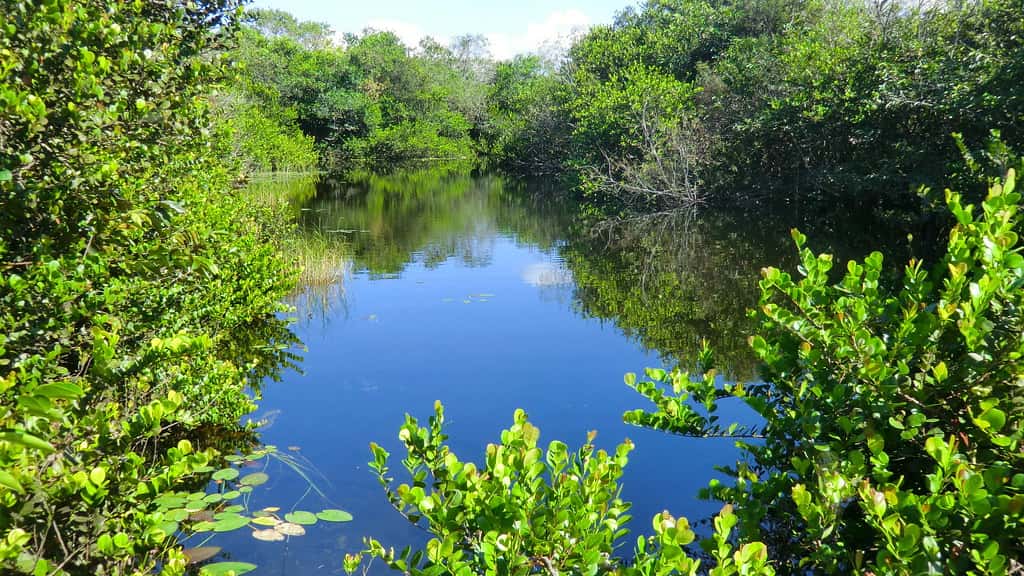
Farmers in the Everglades Agricultural Area reduced phosphorus loads in field runoff by 65 percent during Water Year 2026, nearly three times the 25 percent reduction required under the Everglades Forever Act, according to data presented to the South Florida Water Management District Governing Board in West Palm Beach.
The figures show water arriving on the farms from Lake Okeechobee carrying 164 parts per billion of phosphorus and leaving at 91 parts per billion. Water running out of the agricultural area was nearly twice as clean as the water running in.
Growers have exceeded the state benchmark every year since 1996, averaging a 57 percent annual reduction across three decades and keeping a cumulative 5,111 metric tons of phosphorus out of the Everglades over the life of the program.
Why phosphorus is the measurement that matters
The Everglades evolved as an oligotrophic system, meaning it is naturally extremely low in nutrients. The sawgrass marshes that define the historic ecosystem are adapted to phosphorus concentrations in the single digits of parts per billion, which is exceptionally low by the standards of most wetland systems.
That adaptation is precisely what makes the system vulnerable. When phosphorus levels rise, cattail displaces sawgrass. Cattail grows densely, forms monocultures, and produces habitat that supports far less biological diversity than the sawgrass and slough mosaic it replaces. The change in vegetation cascades through the food web, altering conditions for wading birds, fish and the invertebrates they depend on.
Periphyton, the algal mats that form the base of the Everglades food web and that are highly sensitive to nutrient levels, is affected first. Its decline precedes the visible vegetation shift.
Because the ecosystem responds to phosphorus at concentrations that would be considered negligible elsewhere, restoration standards are correspondingly strict, and small numerical changes carry biological significance.
How the reductions are achieved
The reductions come through Best Management Practices, a regulatory framework requiring growers in the basin to implement specified measures and to monitor results.
The practices are unglamorous and cumulatively effective. Precision fertilizer application matches nutrient inputs to crop requirements and timing, reducing the surplus available to run off. Water management on farms controls the timing and volume of discharges, including holding water on fields during periods when runoff would carry the highest nutrient loads.
Sediment control matters because phosphorus binds to soil particles, which means erosion control directly reduces phosphorus transport. Canal maintenance and cleaning remove accumulated sediment before it moves downstream.
Growers pay an agricultural privilege tax that helps fund the broader cleanup program, and compliance is tied to permits. The structure combines regulatory requirement, monitoring and financial contribution.
The stormwater treatment areas
Farm-level reductions are one component of a larger system. Water leaving the agricultural area flows into constructed wetlands known as Stormwater Treatment Areas, which the South Florida Water Management District operates across tens of thousands of acres.
These are engineered systems that use biological processes to remove phosphorus. Water moves slowly through wetland vegetation, and plants and periphyton take up phosphorus, which is then sequestered in accumulating soil. The treated water continues into the Everglades Protection Area at concentrations far below what entered.
The combination of on-farm reductions and treatment wetlands is what allows water to reach the Everglades at concentrations approaching the target. Neither component alone would be sufficient.
The treatment areas require ongoing management, including vegetation control and periodic maintenance, and their performance varies with weather. Extreme rainfall can push volumes beyond design capacity, and drought affects the biological processes doing the work.
The disagreement over progress
The farming figures sit alongside a more critical assessment published earlier this year. A report covered in April found that pollution persists in the Everglades despite a restoration effort spanning four decades.
Both accounts can be accurate, because they measure different things. The 65 percent figure describes phosphorus loads leaving farm fields relative to a historical baseline. The critical assessments describe conditions in the Everglades itself, including areas where phosphorus concentrations still exceed the ecological standard and where cattail has already displaced sawgrass.
Legacy phosphorus is a large part of the gap. Decades of accumulated nutrients are stored in soils and sediments throughout the system, and that reservoir continues releasing phosphorus into the water column regardless of what enters from upstream today. Even if inflows were eliminated entirely, the legacy load would take many years to work through.
Agriculture is also not the only source. Urban runoff, septic systems, atmospheric deposition and the Lake Okeechobee watershed north of the agricultural area all contribute. The 164 parts per billion entering the farms from the lake indicates that upstream sources matter substantially.
How this fits into Everglades restoration
Water quality is one element of a restoration effort that also addresses water quantity, timing and distribution. The Comprehensive Everglades Restoration Plan, authorized by Congress in 2000, is among the largest ecosystem restoration undertakings ever attempted.
The core problem is that the historic Everglades functioned as a shallow sheet of water moving slowly south from Lake Okeechobee across the peninsula to Florida Bay. Twentieth century drainage and flood control projects fragmented that flow with canals, levees and water control structures to enable agriculture and urban development.
Restoration involves storing water, treating it and delivering it south in volumes and patterns closer to natural conditions. Major components including reservoir construction and the raising of portions of the Tamiami Trail to allow water to flow beneath it are at various stages.
Water quality standards constrain the entire effort, because water cannot be delivered south unless it meets the required phosphorus concentration. Progress on treatment is therefore a prerequisite for progress on flow.
What it means for Floridians
Everglades health connects to Florida life in ways that extend beyond conservation. The system recharges the Biscayne Aquifer, which supplies drinking water to millions of South Florida residents. Freshwater flow to Florida Bay affects salinity, which affects seagrass, which affects the fisheries that support commercial and recreational activity in the Keys.
Nutrient management upstream also relates to the algal bloom events that have periodically affected Florida coasts, including blooms in the Caloosahatchee and St. Lucie estuaries following Lake Okeechobee discharges. Those events have closed beaches, harmed marine life and affected coastal tourism economies.
Water storage capacity affects flood management as well. In a state facing intense rainfall events, the ability to hold and route water has consequences for communities well beyond the ecosystem.
The agricultural area itself
The Everglades Agricultural Area occupies roughly 700,000 acres south of Lake Okeechobee, on land that was historically part of the northern Everglades before drainage projects in the early twentieth century converted it to farmland.
The soil is muck, an organic material formed over thousands of years from decomposing wetland vegetation. It is exceptionally fertile, which is why the area supports intensive agriculture, and it is also unstable once drained. Exposure to air causes oxidation, and the ground surface has subsided substantially since drainage began, a process that continues.
Sugarcane is the dominant crop, alongside vegetables, rice and sod. The industry is a significant employer in Palm Beach, Hendry and Glades counties, particularly around communities including Belle Glade, Clewiston and Pahokee, where agriculture is the economic foundation.
That economic reality is part of why Everglades policy has been contested for decades. Restoration objectives and the livelihoods of communities in the agricultural area have frequently been framed as opposing interests, though the Best Management Practices program represents an attempt to address water quality without eliminating farming.
Measuring water years rather than calendar years
Water quality data in South Florida is reported by water year rather than calendar year, a convention that reflects the region's distinct wet and dry seasons. The water year runs from May through April, which places the entire wet season within a single reporting period.
That framing matters for interpreting results. Rainfall drives runoff, and a wet year moves more water and more phosphorus than a dry one. Comparing results across years therefore requires accounting for hydrologic conditions, and load reductions are calculated against a baseline adjusted for rainfall to make the comparison meaningful.
The 65 percent figure for Water Year 2026 is such an adjusted calculation rather than a raw comparison, which is what makes the three-decade average of 57 percent a meaningful trend line rather than a series of unrelated annual numbers.
How the program is enforced
The Best Management Practices requirement is not voluntary, and understanding the enforcement structure explains why compliance has been consistent.
Growers in the basin operate under permits issued by the South Florida Water Management District that require implementation of approved practices and participation in a monitoring program. Water leaving farms is sampled and analyzed, and the resulting data is what produces the annual load calculations reported to the governing board.
Compliance is assessed at the basin level as well as at individual farms. If the basin as a whole fails to meet the required reduction, growers face additional obligations, which creates a collective incentive alongside individual permit requirements.
The agricultural privilege tax provides funding for the broader cleanup effort, including construction and operation of the treatment wetlands. That structure means growers contribute financially to the downstream treatment their runoff requires, in addition to reducing loads at the source.
What's next
Annual monitoring continues, with results reported to the South Florida Water Management District Governing Board each water year. Those figures will show whether the 65 percent reduction is sustained or whether it reflects favorable conditions in a particular year, since rainfall patterns influence results.
Restoration construction projects proceed on their own schedules, funded through a combination of federal and state appropriations. Reservoir and treatment capacity coming online will affect how much water can be stored, treated and delivered south.
The long-term measure is not the reduction percentage but the condition of the ecosystem: whether sawgrass holds against cattail, whether wading bird populations recover, and whether water reaching Florida Bay arrives in the volumes and at the times the system evolved to receive.
Spotted an issue with this article?
Have something to say about this story?
Write us a letterComments
No comments yet. Be the first to weigh in.
Related Coverage
Florida's New Stormwater Pollution Credit Rules Draw Fire From Environmentalists and Industry Alike
1d ago
Lead pellets from shot iguanas linked to first known crocodile poisoning death in Florida
3d ago

DeSantis and Cabinet protect more than 10,770 acres, from Putnam County woods to Martin County ranches
Oct 4

Record King Tides and Heavy Rain Swamp South Florida Streets as Water Managers Warn the Season Peaks Oct. 27
Oct 2