Federal Inspectors Document Overcrowding and Detention Standard Violations at South Florida Immigration Sites
A report released this month by the Department of Homeland Security's Office of Inspector General documented widespread violations of detention standards, severe overcrowding and what the office characterized as punitive practices across immigration detention sites in South Florida, including the state operated facility in the Everglades commonly referred to as Alligator Alcatraz.
Inspector general reports of this kind are the product of unannounced or scheduled inspections in which auditors review conditions against the detention standards that govern facilities holding immigration detainees, and they carry recommendations that agencies are expected to respond to formally.
The findings arrive while the Everglades facility remains the subject of litigation on multiple fronts. A federal appeals court allowed the site to continue operating while an environmental case proceeds, and a separate federal court order required U.S. Immigration and Customs Enforcement to provide detainees there with access to legal counsel.
The facility's legal posture has been unusual throughout. The appeals panel vacated an injunction that had ordered operations to wind down, holding that the state run site was not under federal control and therefore not subject to the federal environmental review requirement the challengers invoked.
What the inspector general found
The report describes overcrowding, meaning population levels exceeding designed capacity, which affects sleeping arrangements, access to sanitation, medical care delivery and the ability of staff to maintain safety.
It also describes violations of detention standards, the written requirements covering areas including medical screening, access to legal materials, recreation, dietary provision, grievance processes and the conditions under which detainees may be segregated from the general population.
The characterization of practices as punitive is significant in the detention context. Immigration detention is civil rather than criminal, which means it is legally justified as a means of ensuring appearance at proceedings rather than as punishment. Practices that function punitively raise distinct legal questions.
The office's reports typically include agency responses, and the standard process involves the inspected agency accepting, partially accepting or disputing each recommendation with a corrective action timeline.
The Everglades facility
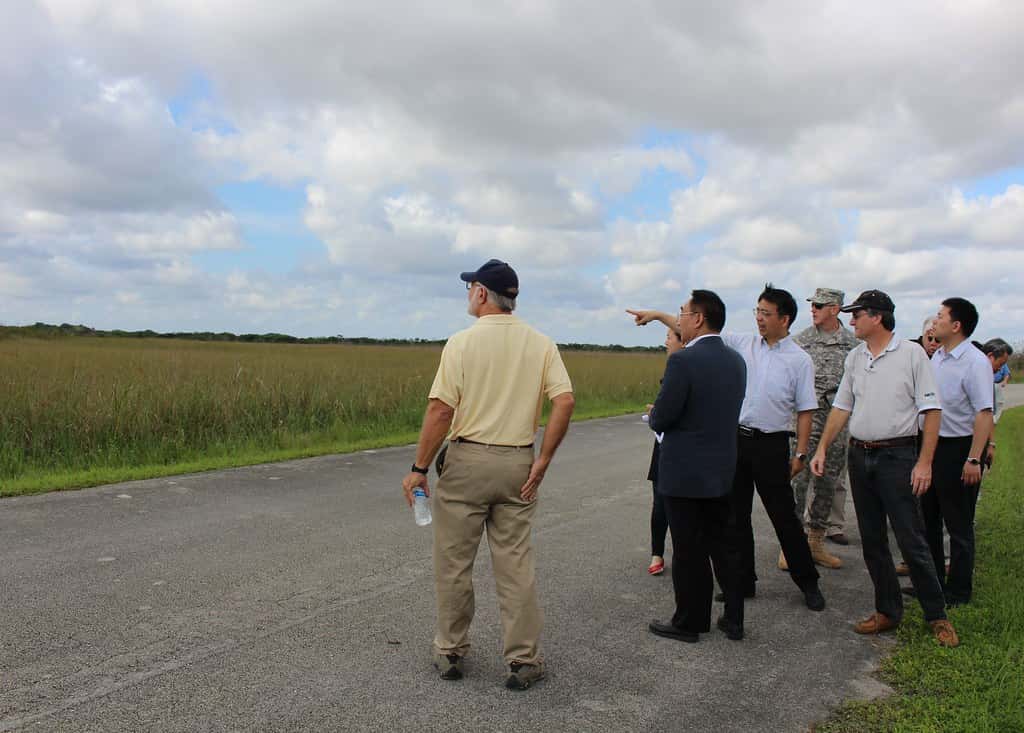
The site was established by the state of Florida on a remote airstrip in the Everglades and became nationally prominent almost immediately, both for its location and for the rhetoric surrounding its creation.
Its legal status has been contested from the outset. Environmental groups argued that because state officials indicated they might seek federal reimbursement for operating costs, the facility should be subject to the National Environmental Policy Act, which requires environmental review of major federal actions.
A district court agreed and ordered a wind down. A three judge panel in Miami vacated that injunction, concluding that the facility was not under federal control for purposes of the statute, which allowed operations to continue while the underlying case proceeds in the lower court.
Separately, the American Civil Liberties Union of Florida obtained a federal court order requiring that detainees at the facility be given access to legal counsel, addressing a distinct constitutional and statutory question from the environmental litigation.
Why this matters in Florida
Florida has one of the largest immigrant populations in the country, with communities from Cuba, Haiti, Venezuela, Nicaragua, Colombia and across Latin America and the Caribbean concentrated in South Florida and distributed throughout the state.
Detention conditions therefore touch families directly. A detainee in a South Florida facility frequently has relatives, employers and attorneys in the same metropolitan area, which makes access to counsel and to visitation practically meaningful rather than abstract.
Florida's political configuration adds complexity. Immigration enforcement enjoys support in parts of the state while specific enforcement actions against particular national origin groups, notably Venezuelans and Cubans, have generated opposition within communities that otherwise support enforcement.
The state's decision to build and operate detention capacity itself, rather than relying on federal facilities, is a significant expansion of state involvement in an area historically handled by the federal government.
The legal framework
Immigration detention standards derive from a combination of statute, agency policy and court settlements. ICE maintains performance based national detention standards that govern facilities holding its detainees, and contracts with county jails and private operators incorporate those standards.
Enforcement of the standards is largely internal, through inspections and contract oversight, which is why inspector general reporting matters. External enforcement comes through litigation, and courts have intervened in detention conditions cases repeatedly over the past two decades.
Where a facility is operated by a state rather than by the federal government or a federal contractor, the application of federal standards becomes legally murkier, which is one of the questions the Everglades litigation is surfacing.
Constitutional floors apply regardless. Civil detainees are entitled under the Due Process Clause to conditions that are not punitive and to adequate medical care, a standard courts have applied in immigration detention cases.
The response so far
Agencies typically respond to inspector general findings with corrective action plans, and the office tracks whether recommendations are implemented. Reports remain open until the office determines that each recommendation has been resolved.
State officials have defended the Everglades facility's operation and have characterized criticism as politically motivated. The governor's office has spoken about the site's future in public comments, and the state has continued to fund and staff it.
Advocacy organizations including the ACLU of Florida, the Center for Biological Diversity and immigrant rights groups have continued litigation and documentation efforts, and their filings have brought detainee accounts into the court record.
Members of Congress from Florida have sought access to inspect facilities, a practice that federal law permits for oversight purposes, and such visits have generated their own disputes over notice requirements and access scope.
The cost question
Operating detention capacity is expensive. Per detainee daily costs at immigration facilities run into the hundreds of dollars when medical care, staffing, transportation and facility overhead are included, and remote locations increase every component.
Florida committed state funds to build and operate the Everglades site with an expectation of federal reimbursement. Whether and to what extent that reimbursement materializes affects the state budget and was central to the environmental litigation's theory of federal control.
Federal detention funding runs through Department of Homeland Security appropriations, which Congress has extended through a continuing resolution running to December 11. Detention bed funding levels are a recurring point of contention in those negotiations.
Florida's congressional delegation sits on both sides of that debate, with members advocating for increased enforcement funding and others opposing expansion of detention capacity.
What families and attorneys should know
ICE maintains an online detainee locator that allows family members and attorneys to find where an individual is being held, searchable by name and country of birth or by alien registration number.
The court order requiring legal counsel access at the Everglades facility establishes a mechanism attorneys can invoke. Attorneys encountering obstruction have a documented order to cite.
Detainees and their representatives can file grievances through facility processes, and those grievances create a record that matters in subsequent litigation even when they do not produce immediate relief.
Nonprofit legal service providers operate throughout South Florida and provide representation or referrals in immigration proceedings, where there is no right to appointed counsel as there is in criminal cases.
How detention capacity expanded
Immigration detention capacity in the United States is a mix of federally owned facilities, private contractor operated facilities and county jails that contract to hold detainees. Capacity has grown substantially over the past two years.
Florida's participation as a state operator is a departure from that structure. States have historically cooperated with federal immigration enforcement through jail agreements rather than by building and running dedicated facilities.
That distinction drives much of the litigation. Federal detention standards, federal environmental requirements and federal oversight mechanisms are built around federal or federally contracted operations, and a state run facility sits outside several of those frameworks.
The question of who is accountable for conditions therefore has no settled answer in this context, which is why both the environmental case and the legal access case have required courts to work through threshold issues before reaching the merits.
What oversight mechanisms remain
Congressional oversight is the broadest tool. Federal law permits members of Congress to inspect immigration detention facilities, and committee hearings can compel testimony from agency officials about conditions and about responses to inspector general findings.
Litigation is the most consequential. Court orders, unlike recommendations, are enforceable, and the order requiring legal counsel access at the Everglades facility demonstrates that mechanism producing a concrete result.
Nongovernmental monitoring adds a third channel. Advocacy organizations, bar associations and academic researchers document conditions through detainee interviews and public records requests, and their findings frequently precede official reporting.
Journalism operates alongside those channels, and access disputes over media entry to detention facilities have been a recurring feature of coverage. What the public learns about conditions depends substantially on which of these mechanisms are functioning.
What is next
The inspector general's recommendations and the agency responses will be tracked publicly, and follow up reporting typically indicates whether conditions changed. That follow up is the most reliable measure of whether findings produce action.
The environmental case continues in district court after the appellate ruling on the injunction, and a decision on the merits remains ahead. The legal access case has produced an order that will be enforced through the same court.
Florida's legislative session in the new year will address state funding for detention operations, and appropriations debates are where the state's continued commitment becomes visible in dollars.
For South Florida communities, the practical measure is whether conditions in the facilities where their neighbors and relatives are held change in ways that inspections can verify. That is the standard the inspector general's process exists to apply.
Spotted an issue with this article?
Have something to say about this story?
Write a letter to the editor