Florida Ranks Fifth Nationally in Measles Cases as School Year Begins
Florida ranked fifth among states for reported measles cases in late July, according to data compiled by the Centers for Disease Control and Prevention, with the CDC recording 141 cases in the state near the end of the month. The figures arrive as Florida's public schools prepare to reopen in the second week of August, returning millions of students to shared classrooms.
The national picture
On July 24, the CDC reported that the United States had recorded its highest number of measles cases since 1992. That comparison is significant because measles was declared eliminated in the United States in 2000, meaning sustained year-round domestic transmission had been interrupted. Case counts approaching pre-elimination levels represent a substantial reversal of that public health achievement.
Measles is among the most contagious infectious diseases known. The virus spreads through the air and can remain infectious in a room for up to two hours after an infected person has left. In a susceptible population, a single case typically produces a large number of secondary infections, which is why outbreaks expand quickly once the virus reaches a community with low vaccination coverage.
The disease is not trivial. Complications include pneumonia and encephalitis, and measles suppresses immune function in ways that leave patients more vulnerable to other infections for a period after recovery. Hospitalization is common among young children who contract it.
Florida's vaccination rate
Florida's coverage sits below most of the country. According to the most recent CDC data, 88.8 percent of Florida kindergarteners were vaccinated against measles in 2025.
That figure matters because of how measles transmission works. Public health guidance generally identifies coverage in the range of 95 percent as the threshold for community protection against measles, a higher bar than most other vaccine-preventable diseases require precisely because the virus is so transmissible. At 88.8 percent, Florida sits several points below that threshold statewide.
Statewide averages also understate the risk in specific communities. Vaccination coverage clusters geographically and by school, and a state at 88.8 percent contains individual schools and neighborhoods with coverage far lower. Outbreaks develop in those pockets rather than being distributed evenly across the population.
The state response
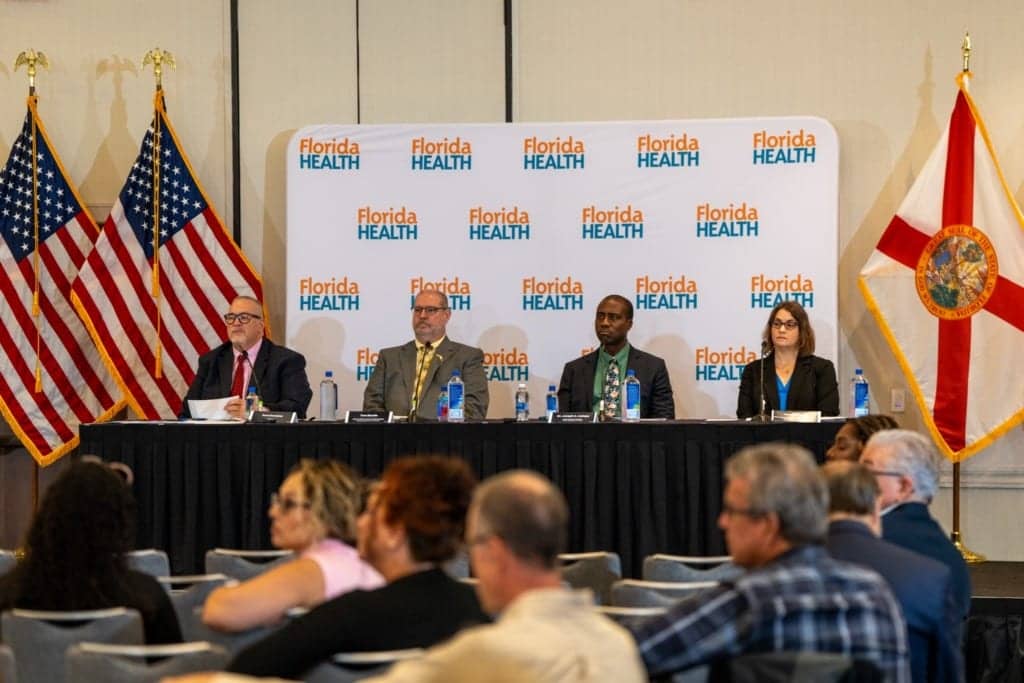
Florida Surgeon General Joseph Ladapo addressed the outbreak during an appearance in Orlando on July 24, speaking about cases in Collier County. Asked about the measles vaccine, Ladapo said it happens to be an effective vaccine against measles.
Ladapo has drawn national attention for positions on vaccination that have differed from mainstream public health consensus in other areas, and Florida has moved to reduce vaccine mandate requirements more broadly. The state's approach has emphasized individual and parental choice over mandate-based coverage targets.
County health departments retain responsibility for outbreak response, including contact tracing, exposure notification, and recommendations regarding exclusion of susceptible individuals from settings where exposure has occurred. Those functions operate at the county level through the Florida Department of Health's local offices.
Why the school calendar matters
The timing is the central concern for public health officials. Schools concentrate large numbers of children in shared indoor spaces for extended periods, which is close to ideal conditions for a virus that spreads through the air and persists in a room after an infected person departs.
Summer offers some natural dampening of transmission because children are dispersed. The return to school removes that dampening effect. Outbreaks that have simmered at low levels through July can expand once the school year restores dense daily contact.
Florida's school immunization requirements provide for exemptions, and the rate at which exemptions are claimed varies by district and by school. Schools with high exemption rates carry correspondingly higher outbreak risk.
What it means for Florida families
The most direct action available to families is confirming immunization status before school starts. The measles, mumps, and rubella vaccine is typically administered in two doses, the first around 12 to 15 months of age and the second between ages 4 and 6. Two documented doses provide strong protection.
Adults uncertain about their own status can check records or, where records are unavailable, receive a dose without harm. Adults born before 1957 are generally presumed immune through childhood infection during the pre-vaccine era.
Families planning international travel should pay particular attention, as many current outbreaks in the United States have originated with travel-associated importation. Infants between 6 and 11 months old can receive an early dose before international travel, which does not replace the standard two-dose schedule but provides interim protection.
Parents should also know the symptoms. Measles typically begins with fever, cough, runny nose, and red eyes, followed several days later by the characteristic rash that starts at the hairline and spreads downward. Anyone suspecting measles should call ahead before going to a clinic or emergency department, so that staff can prevent exposure in the waiting room. Walking into a crowded waiting area with measles is a common way outbreaks expand.
Local impact across the state
Collier County has been a focus of recent attention following the cases the surgeon general discussed. Southwest Florida's exposure reflects a combination of local vaccination coverage and travel patterns.
Central Florida's tourism economy creates a distinct dynamic. The Orlando area receives tens of millions of visitors annually from across the United States and internationally, which raises the baseline probability of importation compared with regions that receive fewer travelers.
South Florida's international connectivity through Miami produces similar exposure. Both regions depend on local vaccination coverage to prevent imported cases from becoming sustained community transmission.
Why elimination status matters
The comparison to 1992 carries specific technical meaning that is easy to miss in headline coverage.
Measles was declared eliminated in the United States in 2000. Elimination does not mean the disease never appears. It means that continuous transmission within the country has been interrupted for at least 12 months, and that cases arise from importation followed by limited local spread rather than from an endemic domestic reservoir.
Maintaining that status depends entirely on vaccination coverage. When coverage is high, an imported case produces few or no secondary infections because the virus encounters immune individuals. When coverage falls in a community, an imported case can generate sustained chains of transmission.
Case counts approaching pre-elimination levels indicate that those chains are becoming longer and more frequent. If transmission of a single chain continues for more than 12 months, the United States would formally lose elimination status, an outcome that public health officials have identified as a genuine risk rather than a theoretical one.
The practical consequences of losing that status extend beyond symbolism. It would change travel health guidance, affect the calculus for infant vaccination timing, and signal that a disease controlled for a generation had returned to circulation.
How outbreaks actually spread
Measles transmission follows a pattern that explains why localized coverage matters more than state averages.
The virus spreads through respiratory droplets and remains suspended in air, staying infectious in a room for up to two hours after an infected person has left. A person with measles is contagious for roughly four days before the rash appears, meaning transmission occurs during a period when neither the infected individual nor anyone around them knows measles is involved.
The early symptoms, fever, cough, runny nose, and red eyes, resemble numerous ordinary illnesses. Patients typically seek care during this phase, which is why waiting rooms have repeatedly served as amplification points in American outbreaks.
The reproduction number for measles in a fully susceptible population is among the highest of any known infectious disease, which is the mathematical reason the coverage threshold for community protection sits near 95 percent rather than the 60 to 80 percent sufficient for many other pathogens.
This is why a state at 88.8 percent coverage faces meaningful risk, and why the risk concentrates in specific schools and neighborhoods where local coverage falls well below the state figure.
Florida's particular exposure
Several features of Florida raise its baseline risk relative to most states.
The state receives enormous international and domestic visitor volume. Orlando alone draws tens of millions of visitors annually, and Miami functions as a hemispheric travel hub. Every arriving traveler represents a potential importation pathway, and Florida's exposure to that pathway substantially exceeds that of states with less tourism.
Florida's population also includes large communities with strong international travel patterns to regions where measles circulates more actively, which adds another importation channel.
The state's population growth means a continuous influx of new residents whose immunization records transfer imperfectly across state lines, creating documentation gaps even among vaccinated individuals.
Set against those factors, the state's vaccination coverage provides less margin than the national average. That combination, high importation probability and below-threshold coverage, is what produces the current case ranking.
What's next
Case counts will be updated through CDC reporting and the Florida Department of Health as the school year progresses. The weeks following the August reopening will provide the clearest indication of whether the return to classrooms accelerates transmission.
County health departments will continue managing exposure notifications where cases are identified. Families who receive an exposure notice from a school or health department should follow the guidance provided, which typically involves monitoring for symptoms and, for unvaccinated individuals, a period of exclusion from group settings.
The broader trajectory depends on vaccination coverage, which changes slowly. For the current school year, the relevant coverage numbers are largely already set by the decisions families have made.
Spotted an issue with this article?
Have something to say about this story?
Write us a letterComments
No comments yet. Be the first to weigh in.
Related Coverage

DeSantis Says Florida Fentanyl Deaths Fell Nearly 60% Since 2023, Crediting State's Trafficking Crackdown
4h ago
Miami Archbishop Thomas Wenski Accuses AG James Uthmeier of 'Classic Bullying' Over Catholic School Vaccine Rules
1d ago

Florida AG Uthmeier subpoenas Performance Food Group as potassium bromate probe widens
4d ago

Manatee Mosquito Control Pilot Killed After Helicopter Strikes Unlit Radio Tower in Myakka City
5d ago